Updated: 1 November 2026, 10:33 AM IST Curated by Vishaljeet Singh, Lisbon, Portugal
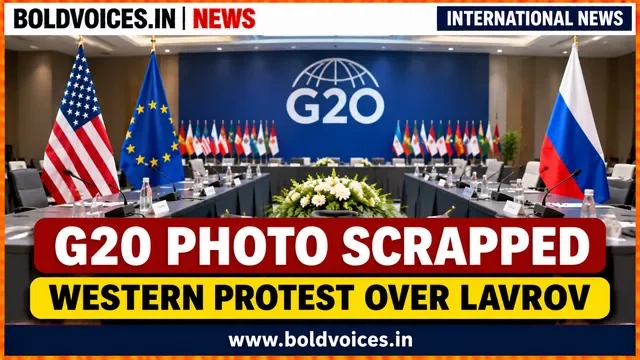
The Group of Twenty (G20) foreign ministers’ meeting in Atlanta has opened against a backdrop of diplomatic tension after the United States cancelled the traditional group photograph following objections from several Western representatives to appearing alongside Russian Foreign Minister Sergey Lavrov.
The decision, taken by US Secretary of State Marco Rubio, avoided a public confrontation at the opening of the gathering. But it also exposed the political divisions confronting the world’s leading economies as they attempt to discuss conflicts, trade tensions and threats to international security.
The meeting is particularly significant because it comes ahead of the G20 leaders’ summit scheduled to take place in Florida in December.
Why was the G20 group photograph cancelled?
The traditional G20 family photograph is a familiar feature of high-level diplomatic meetings. It brings together representatives of major economies in a symbolic display of cooperation.
This time, however, the presence of Russia’s Lavrov created a problem for several participating countries. Western officials indicated that they did not want to be photographed alongside the Russian foreign minister while Russia’s war against Ukraine continues.
A Western diplomat said that roughly one-third of participants, including representatives from Australia and Canada, opposed appearing in a joint photograph with Lavrov. European officials reportedly discussed the possibility of taking separate photographs, one including Lavrov and another without him. The United States ultimately removed the group photograph from the official agenda.
Germany’s Foreign Minister Johann Wadephul said there could be no appearance of normal relations with Russia. Poland’s Foreign Minister Radosław Sikorski also expressed opposition to being photographed alongside Lavrov. Australia supported the US decision, reiterating that it would not normalise Russia’s invasion of Ukraine.
Rubio calls for cooperation amid global crises
Despite the disagreement over the photograph, the meeting proceeded. Rubio opened the discussions by describing the international situation as a critical moment, warning that interconnected economic and geopolitical crises were threatening the foundations of the global economic order.
The US-hosted discussions covered several issues with direct consequences for international trade and security, including the Russia-Ukraine war, tensions involving Iran, US tariffs, China’s activities in the South China Sea and freedom of navigation through major maritime routes.
The United States has placed particular emphasis on protecting shipping routes, including the Strait of Hormuz, the Red Sea, the Black Sea and the South China Sea. These waterways are essential to the movement of energy, food, manufactured goods and other commodities. Disruptions can quickly affect shipping costs, insurance premiums and global supply chains.
Russia’s presence remains controversial
Lavrov’s attendance was itself a source of diplomatic tension. Russia has faced extensive criticism and sanctions from Western governments since its full-scale invasion of Ukraine in 2022. European representatives have maintained that normal diplomatic appearances alongside Moscow’s officials could send the wrong political message.
Moscow, however, has used international gatherings to defend its positions and promote a vision of a multipolar international system. The Russian delegation also raised objections to Poland’s participation in the Atlanta meeting. Lavrov criticised the invitation extended to Poland, arguing that G20 participation and membership arrangements should follow established diplomatic practices.
Poland has been seeking a larger role in the group, with its foreign minister indicating that Washington had proposed making the country a permanent member.
South Africa’s absence creates another disagreement
The dispute over Russia was not the only source of friction. South Africa, a founding member of the G20 and the only African country in the group, was not invited to the Atlanta meeting by the United States.
Pretoria rejected suggestions that its absence was voluntary. A spokesperson for South Africa’s foreign minister said the country remained ready to participate on an equal footing with other members.
The exclusion has drawn criticism because the G20 is intended to bring together major advanced and emerging economies. South Africa’s absence raises questions about representation, participation and the role of the host country in shaping the agenda.
Ukraine was also not invited to the Atlanta gathering, with US officials citing its status as a non-member of the G20.
Meeting ends without a joint communiqué
The G20 foreign ministers concluded two days of talks in Atlanta on 31 October without reaching consensus on several major security issues. No joint communiqué was issued. Differences over Russia’s war in Ukraine, the US-Israeli conflict involving Iran, American tariffs and China’s activity in the South China Sea remained unresolved.
After the talks, US Secretary of State Marco Rubio released a chair’s statement summarising priorities such as energy and food security, freedom of navigation and secure supply chains. The statement did not announce collectively agreed measures. Rubio said universally accepted solutions remained distant, while noting that some participating countries were cooperating on supply chains and critical minerals.
What it means for the December G20 summit
The Atlanta meeting is an important preparation for the G20 leaders’ summit scheduled for December in Florida. The challenge for Washington will be to bring leaders together despite disagreements over major international conflicts and economic policies.
The cancelled photograph may appear to be a small diplomatic episode, but it reflects a much larger problem: countries can remain members of the same international forum while holding sharply different positions on war, sanctions, trade and global security.
The G20’s ability to coordinate on these issues will matter well beyond the meeting room. Energy prices, food supplies, shipping routes and international investment are all affected by the decisions and tensions discussed by its members.
For now, the Atlanta meeting has demonstrated that diplomatic engagement continues, but political divisions remain substantial. Whether those divisions can be managed before the December summit will be a major test of the G20’s influence.
Like what you read? Help BoldVoices.in keep independent journalism going.
Manage Consent
To provide the best experiences, we use technologies like cookies to store and/or access device information. Consenting to these technologies will allow us to process data such as browsing behavior or unique IDs on this site. Not consenting or withdrawing consent, may adversely affect certain features and functions.
Functional
Always active
The technical storage or access is strictly necessary for the legitimate purpose of enabling the use of a specific service explicitly requested by the subscriber or user, or for the sole purpose of carrying out the transmission of a communication over an electronic communications network.
Preferences
The technical storage or access is necessary for the legitimate purpose of storing preferences that are not requested by the subscriber or user.
Statistics
The technical storage or access that is used exclusively for statistical purposes.The technical storage or access that is used exclusively for anonymous statistical purposes. Without a subpoena, voluntary compliance on the part of your Internet Service Provider, or additional records from a third party, information stored or retrieved for this purpose alone cannot usually be used to identify you.
Marketing
The technical storage or access is required to create user profiles to send advertising, or to track the user on a website or across several websites for similar marketing purposes.