
Curated by Vishaljeet Singh, Lisbon, Portugal
Updated: Monday, 2 November 2026, 12:25 AM IST
Latest verified update — 1 November 2026, 11:25 PM IST: Reuters reported that Iranian negotiators and Qatari mediators were in Doha for a third consecutive day of consultations. Foreign Minister Abbas Araghchi described the talks as ongoing and progressing, while confirming that discussion of the proposed two-day timetable for reopening the Strait of Hormuz had not reached a final conclusion. The two-day timetable remains a conditional Iranian proposal tied to a potential agreement with Washington; it is not a confirmed reopening date, and no settlement has been announced. Reuters reported that the Qatari-mediated contacts were being coordinated through regular communications with Washington.
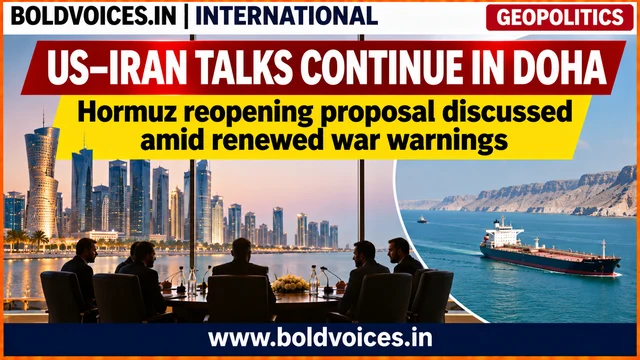
Diplomatic efforts to prevent a renewed escalation between the United States and Iran continued through Qatar-mediated consultations in Doha on Sunday. Iranian Foreign Minister Abbas Araghchi said discussions were under way on a proposal that could restore navigation through the Strait of Hormuz within two days, provided Washington accepts conditions set out by Tehran. No agreement has been announced, and Iran has said that the outcome depends on the US response.
The negotiations matter well beyond the two countries. The Strait of Hormuz is a critical route for international oil and liquefied natural gas shipments, while the wider conflict has increased concerns about energy security, maritime trade and regional stability. The latest diplomatic activity is taking place alongside military warnings from both sides, leaving the situation fragile.
Regional reaction — Monday, 2 November 2026, 12:25 AM IST: The Associated Press reported that UAE presidential adviser Anwar Gargash, speaking at the Manama Dialogue in Bahrain on Sunday, said the region hoped Qatar-led mediation could produce a diplomatic breakthrough and warned that military solutions would complicate the crisis without providing a quick exit. He acknowledged that Washington and Tehran remain far apart and said Gulf states were preparing for possible escalation. Bahrain’s foreign minister Abdullatif bin Rashid Al Zayani also welcomed efforts to reduce tensions and create space for dialogue, while making separate allegations about Iranian threats to regional security. These are the officials’ stated positions, not evidence that a ceasefire or agreement has been reached.
Qatar-Mediated Contacts Continue in Doha
Iranian representatives have been holding consultations with Qatari mediators in Doha as part of an effort to find a diplomatic route out of the conflict. Qatar has also held discussions with Iranian officials in Tehran and is relaying messages between the parties. Pakistan has been involved in the wider mediation effort as well.
It is important to distinguish these indirect contacts from direct negotiations: Iranian Foreign Minister Abbas Araghchi said no meeting with an American delegation was planned during the Iranian delegation’s Doha visit. US Secretary of State Marco Rubio has confirmed that multiple channels of communication remain active and said Washington would be open to a diplomatic solution.
Araghchi described the consultations as continuing but said no final decision had been reached. The central question is whether Washington will respond positively to Tehran’s proposed conditions.
Iran’s Two-Day Proposal to Reopen the Strait of Hormuz
Araghchi has said that Iran is discussing a plan under which the Strait of Hormuz could reopen within two days after the United States takes specified steps. According to his account, the proposal developed from an earlier Iranian confidence-building plan with a longer implementation period, which was shortened following discussions with Qatari mediators.
Under the sequence described by the Iranian foreign minister, the United States would implement agreed measures on the first day and maritime navigation would be restored on the second. This is Iran’s description of a proposal under discussion, not an agreed timetable or a confirmed reopening commitment.
Tehran’s stated conditions include lifting certain recently imposed US sanctions, restoring oil-related waivers, reducing the US military presence in the region, addressing frozen Iranian funds and recognising shipping arrangements discussed by Iran and Oman. Iran has also connected the wider settlement to ending hostilities across the region, including the conflict involving Israel and Lebanon.
Washington has not publicly accepted these conditions. The distance between the positions remains a major obstacle to a comprehensive agreement.
Why the Strait of Hormuz Is So Important
The Strait of Hormuz connects the Persian Gulf with the Gulf of Oman and the Arabian Sea. It is one of the world’s most strategically important maritime energy corridors. Oil and gas exports from several Gulf producers pass through the waterway, making its security a matter of international economic concern.
Any restriction on shipping can affect tanker movements, freight costs, insurance premiums, delivery schedules and energy prices. Even uncertainty can influence commercial decisions, as ship operators and energy buyers assess the risks of moving cargo through the region.
For large energy-importing economies in Asia, including India, China, Japan and South Korea, prolonged disruption could have consequences for fuel procurement, inflation and industrial costs. The importance of the route means that a durable arrangement would require more than a political announcement: shipping operators would need confidence that navigation is safe, predictable and supported by workable procedures.
Washington Says Diplomacy Remains an Option
US Secretary of State Marco Rubio has said that contacts with Iran are continuing through multiple channels. He has indicated that President Donald Trump has not made a decision on further military action and that the administration remains open to a diplomatic resolution.
President Trump has publicly described the latest negotiations as progressing, while also warning that unresolved Iranian targets remain a concern for Washington. His statements have left open the possibility of renewed military action, even as intermediaries continue their work.
The timing is politically sensitive, with the United States approaching its November 3 midterm elections. However, no final diplomatic timetable or decision on military action has been formally announced. Statements by political leaders should therefore be distinguished from concrete agreements or operational decisions.
Tehran Maintains Its Military Readiness
Iranian officials have paired their willingness to continue diplomatic consultations with warnings that the country is prepared to respond to another attack. Supreme Leader Mojtaba Khamenei has directed military commanders to maintain readiness and respond to threats. Other Iranian officials have also warned of retaliation against US and Israeli interests in the region.
These statements underline the risks facing the diplomatic process. Negotiations are continuing, but neither side has publicly set aside its security position. A new military incident, attack or miscalculation could undermine the mediation effort before the parties reach a framework for de-escalation.
Iranian statements about its military capabilities and intended response are official positions; they should not be treated as independent confirmation of operational outcomes.
What the Negotiations Could Mean for Global Energy Markets
The Strait of Hormuz is not merely a regional shipping passage. Its operation affects the movement of energy supplies to markets across the world. A prolonged disruption could have several economic consequences:
- Energy prices: Reduced supply or uncertainty over shipping can place upward pressure on crude oil and gas prices.
- Shipping and insurance: Tanker operators may face higher insurance premiums, additional security costs and delays.
- Inflation: Higher fuel and transport costs can feed into prices for goods, manufacturing and logistics.
- Energy security: Import-dependent countries may need to use reserves, diversify suppliers or adjust procurement schedules.
- Diplomatic pressure: Major energy importers have an interest in safe international sea lanes and in preventing regional conflict from disrupting trade.
For India, the issue is particularly relevant because imported energy is closely connected to domestic fuel costs, transport, industrial activity, inflation and the wider economic outlook. The actual impact would depend on the duration and scale of any disruption, market conditions and the availability of alternative supplies.
Qatar and Pakistan as Intermediaries
Qatar’s role reflects its established position as a diplomatic intermediary in regional disputes. Its relationships across the region and its experience in facilitating sensitive communication have made Doha an important venue for indirect contacts.
Pakistan has also been involved in the wider mediation effort, maintaining contacts with Tehran and Washington. Multiple intermediaries can help exchange proposals, clarify positions and keep communication open when direct talks are politically difficult.
However, mediation cannot itself resolve the underlying differences. Any settlement would require decisions on sanctions, security arrangements, maritime access and the future of military operations. Previous diplomatic efforts have also shown how quickly progress can be reversed when these issues remain unresolved.
What to Watch in the Coming Days
1. A verifiable maritime arrangement
Any announcement concerning the Strait of Hormuz will need to be assessed against practical details: which routes are covered, what rules apply to commercial vessels, how safety will be monitored and whether shipping operators can resume normal movements.
2. A response from Washington on sanctions
Iran has made sanctions relief and related economic measures central to its proposal. A clear US response would help establish whether the discussions are moving towards a negotiated framework or remain at the stage of exchanging positions.
3. Steps towards military de-escalation
Reduced threats, fewer incidents and clear communication channels would help create space for diplomacy. Without de-escalation, even a limited maritime understanding could remain vulnerable.
4. The role of regional partners
Qatar and Pakistan are likely to remain important channels for communication. Other Gulf states and major energy-importing countries will also have an interest in a stable and predictable outcome.
Conclusion
The Doha consultations represent a continuing attempt to find a diplomatic route out of the US-Iran conflict. Iran has described a two-day proposal for restoring navigation through the Strait of Hormuz, conditional on US measures, but no agreement has been reached and Washington has not publicly accepted Tehran’s demands.
The distinction between an Iranian proposal and an agreed settlement is essential. For now, diplomacy is active, military warnings remain, and the future of the strategic waterway is unresolved. India and other energy-importing economies will be watching for concrete progress because the outcome could affect energy costs, trade flows and economic stability well beyond the Middle East.
#USIranRelations #Iran #UnitedStates #Qatar #DohaTalks #StraitOfHormuz #MiddleEast #Geopolitics #InternationalPolitics #GlobalEnergy #OilMarkets #MaritimeSecurity #Diplomacy #WorldNews #BoldVoices


