
Date: 31 October 2026
Curated by the team of boldvoices
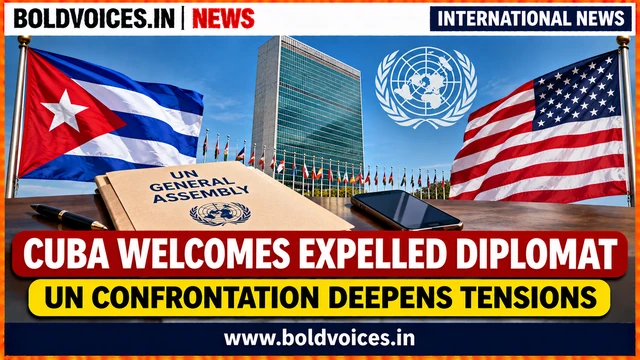
Cuba has publicly welcomed back diplomat Richard Tur de la Concepción after the United States expelled him following a heated confrontation between Cuban and American representatives at the United Nations in New York. The incident, which unfolded during a debate over the decades-old US embargo on Cuba, has added another flashpoint to already strained relations between Washington and Havana.
Cuban Deputy Foreign Minister Gerardo Peñalver announced Tur’s return on Friday, sharing a photograph of the diplomat alongside officials from the Cuban Foreign Ministry at Havana’s airport. Peñalver described Tur’s conduct as a firm response to what he called disrespectful and provocative behaviour by the US delegation.
The welcome was Cuba’s first prominent public response since Washington announced action against the diplomat. Tur had served as first secretary at Cuba’s UN mission.
What happened at the United Nations?
The confrontation took place on Tuesday, 27 October, during a session of the UN General Assembly focused on the US economic, commercial and financial embargo against Cuba.
The dispute involved US Ambassador to the United Nations Mike Waltz, Cuban Foreign Minister Bruno Rodríguez and members of the two countries’ delegations. The exchange became increasingly heated, with Rodríguez and Waltz engaging in a public verbal confrontation.
A separate incident involving Tur and a US diplomat also drew attention. American officials alleged that Tur shoved a member of the US delegation and attempted to knock a mobile phone out of the person’s hand while the confrontation was being recorded. Washington said the conduct warranted his removal from the United States.
Cuban authorities offered a sharply different account. They said Tur was defending himself after his personal space had been invaded and accused the American delegation of provoking the confrontation.
The competing accounts remain central to the diplomatic dispute. The allegations made by either government should not be treated as an independently established finding of wrongdoing.
Washington orders the diplomat’s expulsion
The decision to expel Tur was announced by Waltz and subsequently confirmed by the US State Department. The action turned an already tense exchange inside the General Assembly into a formal diplomatic dispute.
For Washington, the incident involved unacceptable conduct toward a member of its delegation. Cuban officials, however, presented the expulsion as an attempt to intimidate their representative and weaken Cuba’s position at the United Nations.
Peñalver also alleged that the US action was intended to undermine Tur’s candidacy for a position on a UN body. Cuba’s permanent representative to the United Nations separately lodged a protest, according to reports from the region.
Tur, after arriving in Havana, thanked Cuban officials and colleagues for their support. His public response was defiant, reflecting the political significance Havana has attached to the episode.
The vote that formed the backdrop
The confrontation occurred during the annual diplomatic campaign over the US embargo on Cuba. On Wednesday, 28 October, the UN General Assembly adopted a nonbinding resolution calling for an end to the American embargo.
The measure received 130 votes in favour, 17 against and 25 abstentions. Although the resolution carries considerable diplomatic and political weight, it is not legally binding and does not itself compel the United States to lift its restrictions.
The result also reflected a shift in international voting patterns. Support was lower than in the previous year, when the resolution received 165 votes in favour and seven against. US diplomatic lobbying had persuaded several countries to abstain, including some that had previously supported the resolution.
The annual vote has long served as a measure of international opinion on the embargo. Cuba argues that the restrictions damage its economy and affect ordinary citizens. Washington maintains that its policy is intended to pressure the Cuban government over its political system and human-rights record.
A wider deterioration in US-Cuba relations
The latest confrontation comes amid a broader deterioration in relations. The Trump administration has intensified pressure on Havana, including through measures affecting energy supplies. The resulting strain has compounded Cuba’s existing economic difficulties, including shortages and prolonged power disruptions.
Washington has framed its approach as an effort to force political change. Havana describes the pressure as economic coercion and has repeatedly called for the removal of the embargo.
The dispute over Tur has therefore become more than a disagreement about conduct inside a UN meeting. Each government is using the episode to reinforce its wider position: the United States is emphasising the conduct of Cuban officials, while Cuba is portraying the expulsion as part of a broader campaign against its diplomatic and political interests.
What happens next?
The immediate expulsion has been carried out, but the diplomatic consequences may continue. Cuba’s protest and its allegations about the circumstances of the confrontation could keep the issue alive in discussions at the United Nations.
The episode also highlights the limits of the General Assembly’s annual embargo resolution. A large majority of countries again called for an end to the restrictions, but the vote cannot change US policy on its own. Any substantive shift would require action by the American government and, where applicable, the US Congress.
For now, Tur’s return has given Havana an opportunity to demonstrate public support for its diplomat. For Washington, the expulsion signals that it intends to respond firmly to conduct it considers unacceptable.
The deeper disagreement over the embargo, political freedoms, economic pressure and the future of US-Cuba relations remains unresolved. The confrontation at the United Nations has added another chapter to that long-running dispute, with both sides presenting sharply different versions of what happened.
#Cuba #UnitedStates #UnitedNations #RichardTur #MikeWaltz #CubaUSRelations #WorldNews #InternationalNews


