
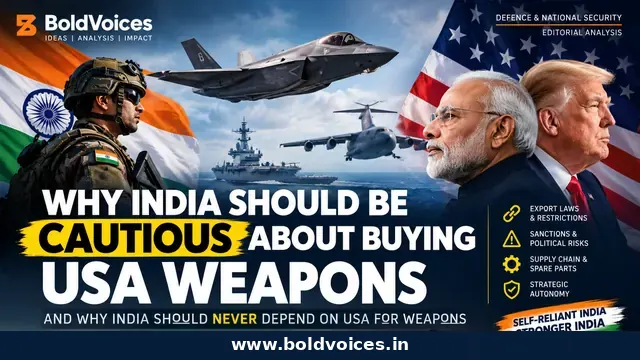
American military technology offers important capabilities, but India must assess the long-term implications of export controls, sanctions, software restrictions and supply chains.
Introduction: A Powerful Weapon Is Not Always an Independent Weapon
Imagine India facing a serious military confrontation. Its armed forces are mobilised, yet a critical imported component needs replacement, a software upgrade requires foreign authorisation, or additional ammunition is delayed by an export review. This is not a prediction of American conduct. It is a structural vulnerability that every military dependent on foreign technology must assess. India’s central question is not whether American weapons are advanced. Many are. It is whether India can maintain, repair, modify and sustain those systems independently when supplier interests differ from its own.
1. American Weapons and American Export Laws
US defence exports operate under laws and contractual obligations, including International Traffic in Arms Regulations (ITAR) and end-use monitoring. These mechanisms govern certain transfers, modifications and verification of supplied equipment. They are not unique to India, and their precise effect varies by contract. Indian negotiators must therefore establish in advance what modifications are permitted, whether Indian weapons can be integrated, what technical data is supplied, and whether domestic companies may manufacture critical replacement parts. Payment and delivery alone do not automatically confer complete control over underlying technology.
2. Sanctions and Shifting Political Priorities
Governments and strategic priorities change over the decades that a military platform remains in service. The US Countering America’s Adversaries Through Sanctions Act (CAATSA) illustrates how American domestic legislation can affect defence relationships. Turkey faced sanctions and exclusion from the F-35 programme following its Russian S-400 purchase. India has also purchased the S-400, making potential interactions between supplier laws and independent procurement choices relevant. This does not establish that Washington will sanction India; it establishes why contracts and contingency plans should be evaluated against political uncertainty.
3. When Trade Disputes Reach Defence Discussions
In August 2025, Reuters reported that India had paused some planned US arms purchases during a tariff dispute. India’s Ministry of Defence disputed that account and said procurement continued. The alleged pause must not be represented as a confirmed policy decision. Nevertheless, the episode showed how closely defence discussions can be associated with wider trade and diplomatic disagreements. Procurement planning should address whether spare parts, ammunition, maintenance and upgrades can continue through future political friction.
4. Tejas Engines and the Meaning of Self-Reliance
India’s Tejas light combat aircraft is an important indigenous achievement, but it uses American GE engines. Deliveries of GE F404 engines for the Mk-1A suffered serious supply-chain delays; Reuters reported in November 2025 that only four of an earlier order of 99 engines had arrived. These delays are not evidence of deliberate American political interference. They do demonstrate that an aircraft assembled domestically may still depend on overseas production. ‘Made in India’ and ‘controlled by India’ are different standards. Sustainable autonomy also requires domestic expertise in engines, materials, avionics, testing and maintenance.
5. Software, Repairs and Operational Control
Modern aircraft and weapons rely on software, encryption, sensors and tightly integrated electronics. India’s procurement questions must include source-code access, independent repair rights, integration with Indian missiles and the ability to upgrade systems without unexpected restrictions. Claims of a universal American remote ‘kill switch’ for weapons supplied to India are not supported by established public evidence. The documented issues are more specific: technical-data access, maintenance arrangements, software permissions, logistics and export licences.
6. The F-35 Question
The F-35 offers sophisticated stealth, sensor fusion and networking capabilities. American officials have discussed potential supply to India, but such discussions should not be confused with a completed acquisition. India would need to examine operational data protection, mission-system access, integration with existing Russian, French and Indian platforms, repair arrangements, software upgrades and total life-cycle cost. Fighter aircraft serve for decades; the true cost is much larger than the initial purchase price. Advanced capability and operational independence are distinct procurement criteria.
7. Lessons From India’s Defence History
After India’s 1998 nuclear tests, US sanctions affected aspects of technology cooperation. Such history explains why long-term supply resilience matters. Yet Russia and European suppliers also create their own maintenance, component and export risks. Replacing dependence on one foreign country with dependence on another is not the same as independence. Diversification can reduce concentration risk, while domestic design and production provide deeper control.
8. What the Arms-Import Data Shows
According to SIPRI’s March 2026 release, India accounted for 8.2% of global major arms imports during 2021–2025 and remained the world’s second-largest importer. Russia supplied approximately 40% of India’s major arms imports in that period, down from 70% during 2011–2015. These are shares of major arms-transfer volume, not percentages of defence spending. The data shows changing procurement relationships, but supplier diversification alone does not eliminate external dependence.
9. What India Gains From US Cooperation
An informed analysis must also recognise the benefits of American cooperation. P-8I maritime patrol aircraft, C-17 and C-130J transports and Apache helicopters contribute significant operational capabilities. Bilateral exercises, maritime awareness and defence-industrial collaboration also offer value. The ten-year India-US defence cooperation framework signed in October 2025 envisaged further technology and industrial cooperation. A blanket rejection of American equipment could impose its own capability costs. The relevant question is how much independent control India retains in each transaction.
10. Building Genuine Defence Autonomy
India can strengthen indigenous research through DRDO, HAL, BEL, private manufacturers and universities; negotiate substantive technology transfer rather than assembly alone; secure domestic repair rights and critical spare-parts capacity; diversify suppliers of essential components; and assess each system over its entire service life. Predictable procurement and investment in advanced engineering can help Indian companies build engines, electronics, materials and sensors. These capabilities take time and money, but they make national defence less vulnerable to foreign industrial or political disruption.
Conclusion: Strategic Autonomy Must Be Built
India can cooperate with the United States and other partners without treating any one of them as indispensable. The enduring test of procurement policy is not only how powerful a weapon is, but whether India can sustain and control it through a crisis. A weapon provides military capability; domestic capacity to repair, upgrade and supply it adds resilience. India’s long-term goal should be the ability to make its own strategic decisions while drawing on international partnerships where they genuinely strengthen national security.
Curated by the team of BoldVoices
#IndiaDefence #StrategicAutonomy #IndianArmedForces #DefenceTechnology #MakeInIndia #NationalSecurity #IndiaUSRelations #BoldVoices


