
Curated by Vishaljeet Singh, Lisbon, Portugal
Updated: 2 November 2026, 10:10 AM IST
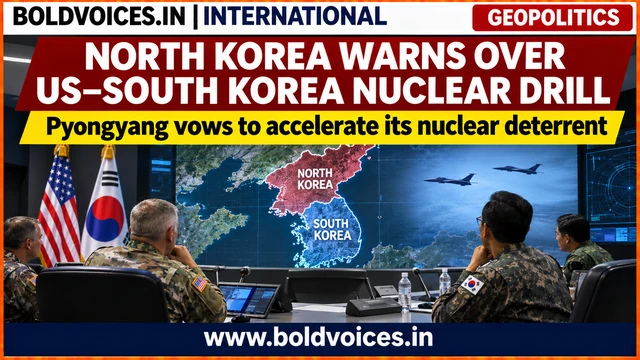
North Korea has condemned a recent United States–South Korea military exercise that linked American nuclear capabilities with South Korean conventional forces, describing it as a rehearsal for nuclear war and vowing to strengthen its own nuclear deterrent at a faster pace. The statement, carried by North Korea’s state media on Monday, brings the competing security doctrines of the two Koreas and their allies back into focus.
The exercise, known as Iron Mace, was held from 29 September to 2 October at the South Korean Joint Chiefs of Staff headquarters in Seoul. It was a tabletop exercise rather than a live-fire operation. Its purpose was to examine how the allies would coordinate their capabilities in response to a possible North Korean nuclear threat.
The latest exchange does not confirm that a military confrontation is imminent. It does, however, demonstrate how deterrence measures intended by one side to prevent conflict can be interpreted by the other as evidence of hostile intent, creating pressure for further military preparations.
What North Korea Said on 2 November
In a statement carried by the Korean Central News Agency (KCNA), Kim Jong-sik, a senior official of North Korea’s ruling Workers’ Party involved in the country’s munitions and weapons development system, criticised Iron Mace and other allied military activities. He described the exercise as a nuclear-war rehearsal directed against the Democratic People’s Republic of Korea (DPRK), North Korea’s official name.
Kim argued that the exercise demonstrated that Washington’s nuclear posture towards Pyongyang had not changed. He said North Korea would continue strengthening its nuclear forces to counter what it regards as existing and potential threats, presenting the policy as an enduring element of national defence.
He also criticised South Korea’s Hoguk and Freedom Flag activities and the United States–Japan Keen Sword exercise. The comments were North Korea’s official characterisation of the exercises; they are not independent evidence that the participating countries were preparing to launch a nuclear attack.
What Is the Iron Mace Exercise?
Iron Mace is a tabletop exercise designed to improve coordination between South Korea’s conventional military capabilities and the United States’ nuclear capabilities. The September 29–October 2 exercise took place at the South Korean Joint Chiefs of Staff headquarters in Seoul.
A tabletop exercise generally involves military and government officials working through hypothetical scenarios, assessing decision-making procedures, command relationships, communication and possible responses. It is different from a live-fire drill, a missile launch or the movement of combat forces for an actual operation.
The exercise reflects the allies’ effort to make extended deterrence more credible. South Korea does not possess its own nuclear arsenal. Instead, it relies on its alliance with the United States, including the American commitment to use its full range of capabilities to help defend South Korea if necessary.
For Washington and Seoul, planning for a nuclear contingency is intended to reduce the risk that North Korea might believe it could use nuclear threats or weapons without facing a coordinated response.
Why Washington and Seoul Consider Nuclear Coordination Necessary
North Korea has continued developing nuclear weapons and delivery systems despite international sanctions and repeated diplomatic efforts. Its leadership presents the arsenal as a guarantee of national survival and as protection against what it describes as the threat posed by the United States and its regional allies.
South Korea faces a direct security challenge because of its proximity to North Korea and the concentration of population, industry and military infrastructure on the peninsula. Seoul therefore places considerable importance on the credibility of the American security guarantee.
The United States, meanwhile, must demonstrate that its commitments to South Korea and Japan remain reliable. Extended deterrence is intended to reassure allies that they do not need to develop independent nuclear arsenals to address threats from North Korea.
Joint planning, consultation and communication are central to that assurance. The challenge is to strengthen deterrence without creating an impression that an attack is being prepared.
Why Pyongyang Sees the Same Exercise Differently
North Korea argues that the presence of American forces in South Korea, allied military exercises and the US nuclear umbrella threaten its security. It presents its nuclear programme as a response to these pressures and says that a stronger deterrent makes an attack against the country less likely.
Washington and Seoul reject this reasoning. They maintain that their military cooperation is defensive and is required because of North Korea’s nuclear and missile programmes. They also argue that Pyongyang’s weapons development is a principal source of instability in the region.
This is a classic security dilemma: actions taken by one side to increase its own security can make the other side feel less secure. The second side then responds with additional military measures, which can reinforce the first side’s threat perceptions.
In this environment, even exercises that are planned well in advance can become politically sensitive. The risk is not limited to deliberate aggression; misinterpretation, poor communication or an incident at sea or along the border can also produce escalation.
The Wider Network of US, South Korean and Japanese Exercises
North Korea’s statement also referred to other military activities involving the United States, South Korea and Japan.
Hoguk
Hoguk is a South Korean military exercise associated with the country’s defence preparedness. North Korea has repeatedly criticised South Korean exercises, arguing that they contribute to an increasingly hostile military environment.
Freedom Flag
Freedom Flag is a joint air exercise involving the United States and South Korea. Such activities are intended to improve interoperability, operational coordination and readiness between the two air forces.
Keen Sword
Keen Sword is a United States–Japan exercise designed to strengthen coordination between the two allies. Japan has a direct interest in the security of the Korean Peninsula because North Korean missiles and regional military developments can affect Japanese territory and surrounding waters.
These exercises have different formats and objectives. Grouping them together in political statements may serve Pyongyang’s argument that it faces a coordinated military environment, but each activity should be assessed on its own stated purpose and operational details.
Why Kim Jong-sik’s Public Role Is Being Noticed
Kim Jong-sik is a senior Workers’ Party official associated with North Korea’s munitions industry and weapons development. His public statement on nuclear policy has drawn attention because such messaging is often delivered by senior defence or foreign-affairs officials.
Analysts cited in reporting have suggested that his public role may be extending beyond the technical development and production of weapons to include a broader explanation of nuclear policy. That is an assessment, not confirmation of a formal change in his responsibilities or in North Korea’s command arrangements.
The choice of messenger is nevertheless politically relevant. By using an official connected to weapons development, Pyongyang can link its public nuclear-policy message directly to the institutions responsible for expanding its military capabilities.
The Korean Peninsula’s Unresolved Security Problem
The division of Korea followed the end of Japanese colonial rule in 1945. The Korean War began in 1950 and ended in 1953 with an armistice, not a comprehensive peace treaty. The two sides remain technically in a state of war, and the Demilitarized Zone continues to separate their forces.
Decades of failed negotiations, military incidents and competing political systems have made the relationship difficult to stabilise. North Korea’s nuclear programme has added a further layer of complexity because it changes the potential consequences of any major military crisis.
For South Korea, the challenge is to maintain credible defence while avoiding a conflict that could devastate the peninsula. For the United States, it is to deter aggression and reassure allies without allowing a crisis to spiral beyond control. For North Korea, the leadership continues to describe nuclear weapons as central to its security and sovereignty.
Recent Tensions and the Risk of Miscalculation
The latest statement comes amid wider friction between the two Koreas. Reporting on Monday also noted tensions following a border mine explosion in September and a North Korean threat to resume propaganda loudspeaker broadcasts towards the South by the end of October.
South Korea’s military said it had no confirmed indication on Monday that Pyongyang had carried out that particular threat. This distinction is important: a threat or announcement should not be reported as an action unless there is confirmation that it occurred.
When relations are strained, relatively limited incidents can acquire wider significance. A border event, an unexpected military movement or a misread signal may create domestic pressure on leaders to respond. Reliable communication channels and restraint are therefore important even when political relations remain poor.
What the Latest Warning Could Mean for Regional Security
1. Continued nuclear and missile development
North Korea’s statement reinforces its declared intention to strengthen its nuclear deterrent. It does not, by itself, establish a date for a new nuclear test or missile launch. Any such development would need to be verified separately.
2. Stronger allied consultation
Washington and Seoul may continue improving their planning and consultation mechanisms. The central objective will be to ensure that the American security commitment is credible and that both sides understand how decisions would be coordinated during a crisis.
3. Greater attention from Japan
Japan has a direct stake in regional stability and is likely to continue monitoring North Korean weapons development and allied military activity. Trilateral coordination among Washington, Seoul and Tokyo remains an important part of the regional security architecture.
4. More pressure on crisis-management channels
As military activity and political rhetoric increase, the need for reliable communication becomes more urgent. Hotlines, clear notifications and procedures for managing unexpected incidents can help prevent a local event from becoming a wider confrontation.
5. A difficult path back to diplomacy
North Korea’s insistence that nuclear expansion is a permanent defence policy makes negotiations over denuclearisation particularly difficult. Any future diplomatic initiative would need to address security concerns, sanctions, verification and the broader question of a lasting peace arrangement.
Can Diplomacy Break the Cycle?
Military deterrence can reduce the incentive for an attack, but it cannot resolve the political and historical disputes that divide the two Koreas. A more stable arrangement would require sustained communication and practical measures to reduce the risk of accidental escalation.
Possible confidence-building steps could include restoring military communication channels, establishing procedures for notifying certain activities, agreeing on ways to investigate border incidents and creating space for diplomatic contacts. These measures would not settle the nuclear dispute, but they could reduce the danger of miscalculation.
The difficulty is that trust is extremely limited. North Korea wants its nuclear status and security concerns addressed, while the United States and South Korea regard denuclearisation and deterrence as essential to regional security. Bridging these positions would require political decisions that have so far remained elusive.
What to Watch in the Coming Days
- North Korean military announcements: Watch for verified announcements of missile tests, nuclear activity or new weapons deployments rather than treating general warnings as operational events.
- Statements from Seoul and Washington: Their response will indicate whether they intend to maintain the current exercise and deterrence approach or adjust public messaging.
- Japan’s security posture: Any additional trilateral consultation or joint activity could show how the regional response is evolving.
- Border developments: Independent confirmation of any resumption of propaganda broadcasts or other military activity will be important.
- Diplomatic signals: Any proposal to restore communication or resume talks could offer a limited opening to reduce tensions.
Conclusion
North Korea’s condemnation of the Iron Mace exercise highlights the widening gap between the security approaches of Pyongyang and the US–South Korean alliance. Washington and Seoul see nuclear coordination as a way to deter aggression; North Korea portrays it as proof that its own nuclear forces must grow stronger.
The latest statement is a serious signal of policy continuity, but it is not proof that an attack is imminent. The central challenge for regional powers is to maintain credible deterrence while preserving communication and preventing a military incident from escalating into a crisis.
Without practical crisis-management measures and a diplomatic channel, the Korean Peninsula risks remaining trapped in a cycle in which every attempt by one side to feel safer makes the other side more insecure.
#NorthKorea #SouthKorea #UnitedStates #IronMace #NuclearDeterrence #KoreanPeninsula #IndoPacific #Geopolitics #InternationalPolitics #MilitaryStrategy #RegionalSecurity #WorldNews #BoldVoices


