10 November 2026 Curated by the team of Boldvoices
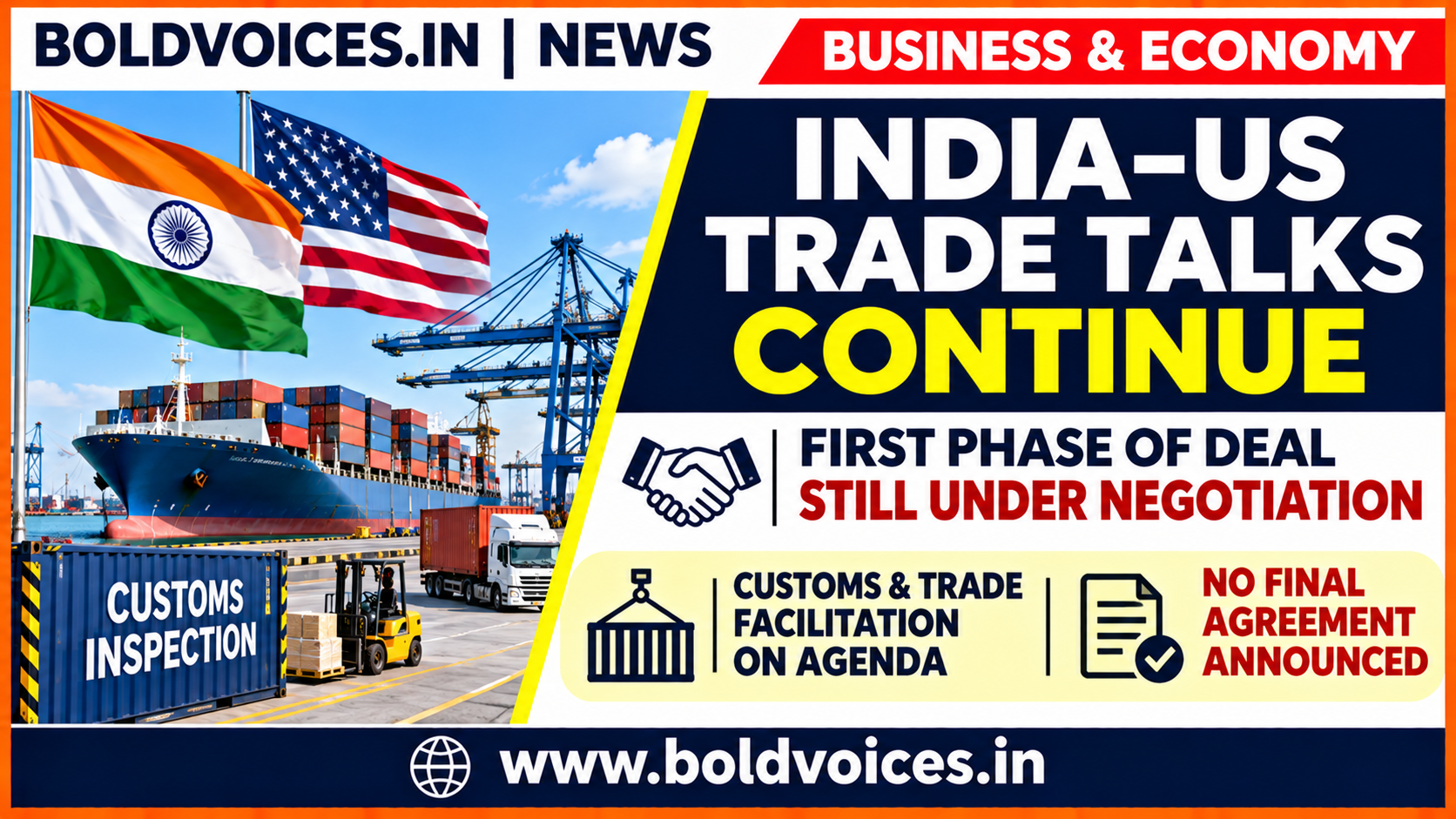
India and the United States are continuing discussions to finalise the first tranche of a bilateral trade agreement, an Indian official said on 10 November. US officials visited India earlier this month, with the latest round of discussions focusing on customs procedures and trade facilitation.
The update indicates that negotiations remain active, but it does not mean the first phase has been concluded. No final text, signing date or implementation schedule was announced in the official comments reported so far. For businesses on both sides, the immediate question is whether the negotiations can translate into clearer, faster and more predictable cross-border trade rules.
What is being discussed in the latest round?
The most specific subject identified in the latest update is customs and trade facilitation. These issues may sound technical, but they have a direct effect on the time and cost involved in moving goods across borders.
Customs processes cover the documentation, classification, valuation, inspection and clearance of imported and exported goods. Trade facilitation focuses on making those procedures more transparent, efficient and predictable while preserving the ability of authorities to enforce safety, security and revenue rules.
For exporters, delays at ports or uncertainty over documentation can increase inventory costs and disrupt delivery schedules. For importers and manufacturers, predictable clearance can help with the arrival of raw materials, components and machinery. Any agreed improvements would need to be reflected in practical procedures and implemented by the relevant agencies.
Why the first tranche matters
A phased trade agreement can allow two countries to make progress on selected areas before completing a wider set of negotiations. The first tranche could therefore establish an initial framework for addressing issues where both sides are able to reach workable commitments.
However, the latest public update does not specify which tariff lines, product categories or market-access commitments will be included in this first phase. It would be premature to assume that a particular Indian industry has secured tariff relief or that any new duty arrangement is already in force.
What Indian businesses could gain from smoother customs procedures
If the two countries agree on practical customs improvements, Indian exporters could benefit from more predictable documentation requirements, fewer avoidable clearance delays and better visibility over shipment procedures. Such changes can be particularly relevant for businesses operating on tight delivery schedules or supplying components to international production networks.
Potentially affected business segments include engineering goods, auto components, pharmaceuticals, textiles, chemicals, electronics and food products. These are examples of sectors for which border procedures can matter; the current negotiating update does not confirm that any of them has received a specific concession.
Smaller exporters may have a particular interest in simpler and more transparent processes. Large companies can often maintain specialist compliance teams and absorb administrative costs more easily. Smaller firms may find paperwork, classification disputes and unpredictable clearance times more burdensome.
Why the United States is an important trade partner
The US is a major destination for Indian goods and services and an important source of technology, investment and industrial inputs. A stable trade framework can help businesses plan sourcing, production and market expansion over longer periods.
For US companies, clearer procedures can also improve access to Indian suppliers and customers. A more predictable commercial environment can support investment decisions, although trade rules are only one part of the calculation. Market demand, logistics, standards, taxation, regulatory approvals and currency movements also influence business choices.
Negotiations continue amid political and economic uncertainty
The latest update comes against a changing political backdrop in Washington. Reuters reported that US President Donald Trump’s Republican Party suffered heavy losses in the 3 November midterm elections, with Democrats making major gains in the House and flipping Senate seats in several traditionally conservative states.
The election result adds a new political context to the negotiations, but it does not by itself establish that the trade talks will change direction. Trade policy decisions involve the administration, relevant departments, Congress and the wider economic relationship. The next steps will depend on the negotiating positions and the ability of both governments to reach terms they can implement.
What companies should watch next
Official confirmation: Any joint statement from India and the US describing the scope of the first tranche.
Customs commitments: Whether the countries agree on documentation, transparency, digital processes or clearance timelines.
Tariff details: Any published list of products receiving changes in duties or market access.
Rules of origin: How the agreement would determine whether goods qualify for any preferential treatment.
Implementation schedule: The date on which agreed provisions would take effect and the agencies responsible for delivery.
Business guidance: Clarifications from customs authorities and trade departments that exporters and importers can use in day-to-day operations.
What has not been announced yet?
As of 10 November, the reported update confirms continuing negotiations and discussions on customs and trade facilitation. It does not announce a completed agreement, a tariff-reduction schedule, product-specific concessions, a signing ceremony or an implementation date. Businesses should continue to follow the existing rules until governments formally publish any changes.
Bottom line
India and the US are still working towards the first tranche of their bilateral trade deal, with customs and trade facilitation among the latest subjects under discussion. Progress in these areas could reduce friction for exporters and importers, but the commercial impact will depend on the final text and its implementation. For now, companies should treat the negotiations as an active process—not as a concluded trade agreement or a confirmed source of tariff benefits.
This article is for general news and information purposes. It reflects the status of negotiations reported on 10 November 2026; it does not constitute confirmation of a concluded agreement or a change in existing customs duties.
Like what you read? Help BoldVoices.in keep independent journalism going.
Manage Consent
To provide the best experiences, we use technologies like cookies to store and/or access device information. Consenting to these technologies will allow us to process data such as browsing behavior or unique IDs on this site. Not consenting or withdrawing consent, may adversely affect certain features and functions.
Functional
Always active
The technical storage or access is strictly necessary for the legitimate purpose of enabling the use of a specific service explicitly requested by the subscriber or user, or for the sole purpose of carrying out the transmission of a communication over an electronic communications network.
Preferences
The technical storage or access is necessary for the legitimate purpose of storing preferences that are not requested by the subscriber or user.
Statistics
The technical storage or access that is used exclusively for statistical purposes.The technical storage or access that is used exclusively for anonymous statistical purposes. Without a subpoena, voluntary compliance on the part of your Internet Service Provider, or additional records from a third party, information stored or retrieved for this purpose alone cannot usually be used to identify you.
Marketing
The technical storage or access is required to create user profiles to send advertising, or to track the user on a website or across several websites for similar marketing purposes.