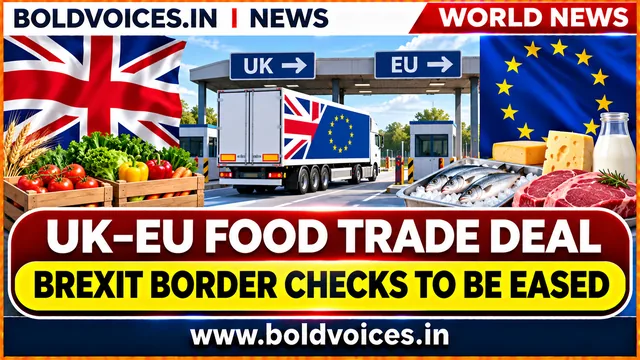
The United Kingdom and the European Union have finalised the text of a major draft agreement designed to remove many of the additional checks and certificates that have complicated food and agricultural trade since Brexit. The sanitary and phytosanitary (SPS) agreement covers a wide range of food, animal and plant products and is expected to be formally presented as part of a wider UK-EU reset at the leaders’ summit in Brussels on 20 November 2026.
The development could be particularly important for British farmers, food manufacturers, fish exporters, supermarkets and smaller specialist retailers. It is intended to reduce the paperwork, inspection costs and delays that have affected shipments moving between Britain and the EU. However, the agreement is not expected to become operational immediately. Current reporting points to implementation in the first quarter of 2028, subject to the necessary legal and regulatory steps.
What has been agreed?
The two sides have settled the text of a roughly 200-page SPS agreement. SPS rules are the standards and official controls used to protect people, animals and plants from food-safety risks, pests and diseases. They cover matters such as food hygiene, animal health, plant health, pesticides, contaminants and certain marketing standards.
Under the proposed framework, Great Britain would align relevant rules with the EU’s in-scope legislation. In return, most routine SPS certificates and border checks for covered goods moving between the EU and Great Britain would be removed or simplified. The agreement is also intended to ease qualifying movements from Great Britain to Northern Ireland through the arrangements that apply under the Windsor Framework.
The text has been circulated to EU member states for consideration ahead of the November summit. The completion of negotiations on the text is an important step, but it should not be confused with the agreement already being in force. Formal political endorsement, legal procedures and implementation work still matter.
Which products could benefit?
The proposed agreement covers a broad range of food and agricultural trade. Products expected to benefit include meat and dairy goods, fish and shellfish, eggs, plants, plant products, animal products and certain processed foods. It is also expected to enable the resumption of some trade that has been restricted under post-Brexit rules, including fresh sausages and burgers, certain shellfish from UK waters and seed potatoes.
For exporters, fewer certificates and inspections could make it easier to send perishable products across the Channel. Fish, meat, dairy and fresh produce are particularly sensitive to delays because additional time at a border can affect shelf life, delivery schedules and commercial value.
The proposed changes are also relevant to smaller businesses. Before Brexit, some specialist retailers and delicatessens could buy relatively small batches of European cheese and other products. The cost of new paperwork and border procedures made some of these shipments uneconomical. Lower administrative costs could help restore more flexible trading arrangements.
How much paperwork and cost could be removed?
Reports on the draft say it would remove a number of export health and phytosanitary certificates, inspection fees and related charges for goods covered by the agreement. Some export health certificates have cost businesses around £200, while certain phytosanitary certificates have cost around £25, before other inspection and handling charges are considered.
These costs can be especially burdensome for smaller consignments. A large exporter may spread compliance expenses across substantial volumes, while a small farm or food producer faces many of the same administrative steps for a much smaller shipment. Reducing fixed costs could therefore widen access to EU customers.
Why the agreement matters to British farmers and exporters
European markets remain important to the UK food and farming sector. Since the end of the Brexit transition period, exporters have had to navigate new certification and border-control requirements for many products. Industry representatives have reported significant disruption, and the National Farmers’ Union has highlighted a sharp decline in some food exports to the EU since 2019.
The agreement could help British producers compete by reducing the time and expense involved in reaching nearby customers. It may be particularly relevant to sectors such as eggs, poultry, potatoes, meat and seafood, where certification requirements and border delays can influence whether an export order is commercially viable.
However, simpler procedures alone cannot guarantee that exports will return to previous levels. Producers will still need competitive prices, reliable logistics, sufficient demand, marketing support and the capacity to meet the agreed standards. Exchange rates, labour costs and changing consumer preferences will also influence trade.
Northern Ireland: a major part of the Brexit settlement
Northern Ireland has a distinct position because the Windsor Framework protects its access to both the UK internal market and the EU single market for goods. This arrangement was designed to avoid a hard border on the island of Ireland while managing the movement of goods between Great Britain and Northern Ireland.
The SPS agreement is intended to reduce many checks and paperwork requirements for qualifying food and agricultural goods moving from Great Britain to Northern Ireland. Reports also indicate that the proposed changes would remove the need for the “Not for EU” labels on relevant products. The final legal text and implementation guidance will determine precisely how each category of goods is treated.
For retailers and suppliers, fewer procedures could make it easier to maintain consistent product ranges across the UK. It may also reduce the administrative burden on businesses that serve customers on both sides of the Irish Sea.
Dynamic alignment: the political trade-off
The central condition behind the agreement is dynamic alignment. In practical terms, the UK would keep relevant domestic rules aligned with applicable EU food, animal and plant-health legislation, including future changes within the agreement’s scope. This is intended to prevent regulatory differences from recreating the need for checks.
Supporters argue that accepting common standards is a pragmatic way to reduce trade barriers with the UK’s major nearby market. They say businesses would benefit from predictable rules and lower compliance costs.
Critics see a sovereignty concern. If the EU updates rules in areas covered by the agreement, Britain may need to follow those changes to retain the benefits of simplified trade. This has revived the Brexit-era debate about whether the UK risks becoming a “rule taker” in areas where it no longer participates in EU decision-making in the same way as a member state.
The framework is not necessarily without exceptions. The UK government has said it wants to preserve high standards in areas including animal welfare, public health and the use of new technologies. The precise scope, safeguards and exceptions in the final arrangements will therefore be important.
Could the deal affect imports and supermarket prices?
The agreement is not only about British exports. Easier movement of eligible EU food products into Great Britain could also reduce paperwork and routine SPS checks for importers. This may help retailers and wholesalers source a wider range of products and manage deliveries more efficiently.
Some businesses have nevertheless raised concerns about possible effects on supply chains involving countries outside the EU. If UK rules become more closely aligned with EU requirements, importers may need to consider how products from non-EU suppliers meet the relevant standards. The impact will depend on the final scope, exceptions and how the new system is administered.
Consumers could benefit if lower administrative costs and smoother logistics are passed through the supply chain. But cheaper food is not guaranteed. Retail prices also depend on production costs, wages, energy, transport, weather, exchange rates and global commodity prices. The first visible effect may be more reliable availability and fewer delays rather than an immediate fall in supermarket prices.
Why will implementation take until 2028?
Although the text has been settled, the new system requires Britain to align relevant legislation, prepare regulators and border systems, and give businesses time to adapt. The UK government had previously indicated an earlier intended timetable, but the latest reporting says the agreement may not take effect until the first quarter of 2028.
Some products may also need additional transition arrangements. Reports have highlighted a possible six-month transition for certain goods, including some grain crops treated with fungicides that are not approved under EU rules. This illustrates why a political agreement does not automatically remove every practical obstacle on the day it is announced.
Businesses should therefore continue following the current export and import rules until official implementation instructions confirm that the new arrangements have started. The UK Department for Environment, Food and Rural Affairs has published preparation guidance for businesses across the agrifood sector.
Part of a wider UK-EU reset
The food agreement is one of several areas being discussed as part of a broader effort to improve relations between London and Brussels. The November summit is also expected to address linking the UK and EU emissions trading systems and a possible youth mobility arrangement. These are separate files, with their own negotiations and approval requirements.
A youth mobility scheme could create a route for eligible young people to live, work, study or travel temporarily in the other jurisdiction. However, key details remain under discussion, including conditions and the treatment of university tuition fees. The food agreement should not be taken as confirmation that these separate proposals have already been finalised.
What happens next?
EU member states are considering the settled text ahead of the UK-EU summit scheduled for 20 November 2026 in Brussels. Leaders are expected to set out the political direction, after which the required legal approvals, domestic legislation and practical preparations will determine when the agreement can be applied.
For British exporters, the key questions are which products qualify, which checks will disappear, what exceptions remain and how future regulatory changes will be handled. For Northern Ireland, the details will determine how far routine procedures can be reduced while maintaining the safeguards of the Windsor Framework.
The bigger picture
The draft SPS agreement is a significant attempt to reduce one of the most visible practical costs of Brexit for the food and farming sector. It could improve trade flows, help smaller exporters and make supply chains more predictable. But its success will depend on implementation, business readiness and whether the benefits of regulatory alignment outweigh the concerns about reduced freedom to diverge.
For now, the text represents an important negotiated step rather than an immediate change at the border. The November summit will be a political milestone; the real test will come when businesses begin using the new system and can measure whether it delivers faster, simpler and more affordable trade.
Like what you read? Help BoldVoices.in keep independent journalism going.
Manage Consent
To provide the best experiences, we use technologies like cookies to store and/or access device information. Consenting to these technologies will allow us to process data such as browsing behavior or unique IDs on this site. Not consenting or withdrawing consent, may adversely affect certain features and functions.
Functional
Always active
The technical storage or access is strictly necessary for the legitimate purpose of enabling the use of a specific service explicitly requested by the subscriber or user, or for the sole purpose of carrying out the transmission of a communication over an electronic communications network.
Preferences
The technical storage or access is necessary for the legitimate purpose of storing preferences that are not requested by the subscriber or user.
Statistics
The technical storage or access that is used exclusively for statistical purposes.The technical storage or access that is used exclusively for anonymous statistical purposes. Without a subpoena, voluntary compliance on the part of your Internet Service Provider, or additional records from a third party, information stored or retrieved for this purpose alone cannot usually be used to identify you.
Marketing
The technical storage or access is required to create user profiles to send advertising, or to track the user on a website or across several websites for similar marketing purposes.