
Curated by the Team of Boldvoices · 22 November 2026
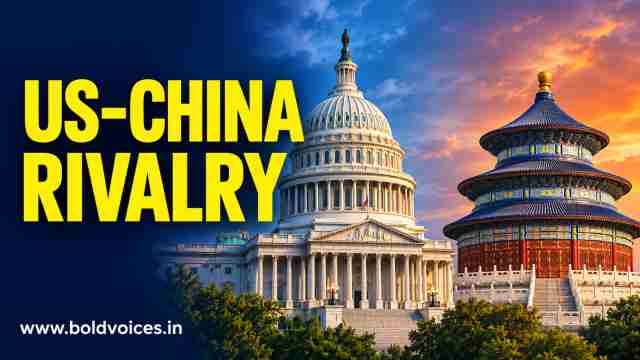
The United States and China became rivals as China grew from a manufacturing partner into a power capable of competing with the US in advanced technology, military influence and international diplomacy. The trade that connected them also exposed each country to decisions made by the other. Washington worries that US technology and investment could strengthen Chinese capabilities it considers a security threat. Beijing argues that American restrictions are intended to hold back China’s development.
Yet American and Chinese businesses still buy from and sell to one another on a large scale. In 2025, the US exported about $106 billion in goods to China and imported about $309 billion, according to the US Census Bureau. The combined total of roughly $415 billion covers goods only. It captures the scale of trade that continued even as the two governments tightened some economic restrictions.
The rivalry is easiest to understand through three questions. How did the two countries become so economically connected? Why do they treat certain technologies and territories as security issues? And how do other countries respond when their biggest markets and security partners want different things?
How did Washington and Beijing go from confrontation to cooperation?
After the Chinese Communist Party established the People’s Republic of China in 1949, the United States continued to recognise the Republic of China government, which had relocated to Taiwan. American and Chinese forces fought on opposite sides during the Korean War. For years, the two governments had little direct diplomatic contact.
The opening came in the 1970s, when the Cold War gave both governments a reason to reconsider. China’s relationship with the Soviet Union had deteriorated. Washington saw an opportunity to improve relations with Beijing and gain diplomatic room in its own competition with Moscow. President Richard Nixon visited China in 1972, and the two countries established formal diplomatic relations in 1979.
Their agreement left Taiwan as a continuing source of disagreement. The United States recognised the government in Beijing as the sole legal government of China and acknowledged Beijing’s position that Taiwan is part of China. Washington also maintained unofficial ties with Taiwan. The Taiwan Relations Act provides a US legal framework for those ties and for supporting Taiwan’s self-defence. Beijing’s claim to sovereignty over Taiwan is a separate position from the wording Washington uses in its own policy.
This period established a pattern that lasted for decades. The two governments could find grounds for cooperation while leaving a serious dispute unresolved. The reasons for cooperating changed over time. As Cold War considerations receded, the economic relationship became more important.
Why did the two economies become so closely connected?
Beginning in the late 1970s, China opened more of its economy to private enterprise, foreign investment and international trade. Manufacturers gained access to a large workforce and, over time, dense networks of suppliers, factories, transport links and ports. China gained export markets and investment. US businesses gained access to production capacity and a growing market for their goods and services.
China joined the World Trade Organization in December 2001. Its accession brought China further into a system of international trade rules and gave firms more confidence that they could invest in cross-border production. A product sold by a US company might use components from several economies, be assembled in China and reach US consumers through a global shipping network. Businesses could expand production across this network much faster than they could build one from scratch.
The gains and costs were uneven. US consumers and importers benefited from access to many lower-cost goods. US exporters gained customers. Some manufacturing communities faced intense competition from imports, and workers who lost jobs could struggle to find similarly paid work nearby. In China, export growth supported industrial employment and helped firms build manufacturing expertise. Those effects explain why the same trade relationship could look beneficial from one city and deeply disruptive from another.
As China’s industrial capabilities advanced, US concerns broadened. Washington increasingly objected to Chinese policies involving market access, industrial subsidies and technology transfer. Beijing viewed industrial upgrading as part of its development and argued that US objections increasingly focused on slowing its progress. The disagreement grew more consequential as Chinese firms began competing in sectors where US companies had long been leaders.
Why did tariffs become a central part of the rivalry?
In 2018, the United States began imposing tariffs on Chinese imports under Section 301 of the Trade Act. The US Trade Representative cited Chinese practices concerning technology transfer, intellectual property and innovation. China responded with tariffs on US goods. What began as a dispute over particular practices became a wider argument about manufacturing, market access and each country’s reliance on the other.
A tariff raises the cost of importing a covered product. The importer pays the duty to its own government, then faces a business decision. It can raise prices, accept a lower margin, negotiate a lower price with its supplier, or find a different source. The cost can therefore be shared among businesses and consumers in different ways. Retaliatory tariffs can also hit exporters that had little to do with the original dispute.
A fall in direct imports from China can signal that firms changed suppliers. It can also reflect a shift in where a product is assembled, with some of its components still coming from China. For example, moving final assembly to another country may change where the finished product is recorded as coming from, while leaving upstream suppliers in place. Headline trade totals tell you how goods crossed a border. They give only part of the picture of how those goods were made.
Why are advanced chips such a big issue?
A leading-edge chip can run AI workloads, power a commercial data centre or support defence applications. Its value depends on an international supply chain that includes design software, specialised manufacturing equipment, fabrication, packaging and testing. That makes technology policy a matter of foreign relations. A rule issued by one government can affect companies in several other countries.
In October 2022, the US introduced controls targeting certain advanced computing chips, semiconductor manufacturing equipment and related activities involving China. Washington cited national-security concerns. Beijing has described such restrictions as an attempt to contain China’s technological development. Both governments have also tried to strengthen production of strategic technologies at home.
The rivalry has different consequences depending on the product. A company buying widely available chips for a common appliance has more options than a company relying on an advanced processor with few qualified suppliers. Replacing a specialised process can involve redesigning a product, qualifying new factories and testing reliability. Governments can announce an incentive or restriction in a day. Manufacturers may need years to build the capacity that changes their options.
| Policy tool | What it affects | What to check in a news report |
|---|---|---|
| Tariff | The cost of importing covered goods. | Which products are covered, when the duty takes effect and who imports them. |
| Export control | Whether covered goods, software or technology can be supplied, and under what licensing conditions. | The technical thresholds, destinations, end users and licences involved. |
| Investment restriction | Whether certain investments can proceed or need to be reported. | The technologies and transactions covered. |
| Industrial subsidy | The cost or attractiveness of building capacity in a particular place. | Whether the money has been awarded and when production could begin. |
Why do Taiwan and the western Pacific matter so much?
Taiwan is a self-governing democracy that Beijing claims as part of China. Washington maintains unofficial relations with Taipei and provides support for Taiwan’s ability to defend itself. Beijing treats the issue as a matter of sovereignty and opposes what it considers outside interference. Those positions make events around Taiwan especially sensitive. A change that one government sees as a routine expression of its existing policy may be read by another as an attempt to change the situation.
Geography gives the dispute a wider reach. Taiwan is near Japan and the Philippines, and the waters around it are important to shipping and commerce. Taiwan is also a major centre for advanced chip manufacturing. A prolonged crisis could make shipping more expensive or interrupt supplies of components used far beyond East Asia. The extent would depend on the area affected, the duration of disruption and the availability of alternative routes and suppliers.
The South China Sea adds a different set of disputes. China and several Southeast Asian governments have overlapping claims to maritime areas or features. The United States emphasises freedom of navigation and has treaty commitments to allies in the region, including the Philippines. Southeast Asian governments have interests of their own, including fishing access, offshore resources, shipping and enforcement of their maritime rights. Their choices often reflect local disputes and domestic pressures as much as competition between Washington and Beijing.
How does the rivalry affect countries outside East Asia?
Many governments have strong reasons to keep working with both powers. China can be an important export market, infrastructure financier or source of manufactured goods. The United States can be a major customer, investor, technology partner or security ally. The relationship often varies by sector even within the same country.
A government might buy inexpensive solar components from China, seek US investment in advanced manufacturing and apply tighter scrutiny to suppliers for critical telecommunications networks. Those choices involve different risks and different ministries. They may change as prices, domestic regulations and political relationships change.
There is also competition over which technical standards, infrastructure providers and financing arrangements countries adopt. A decision about a port, cloud provider or power network may shape procurement and maintenance for years. Local governments still have agency. They can renegotiate terms, diversify suppliers or set their own requirements, and their decisions often turn on costs and service as much as geopolitics.
Is this a new Cold War?
The analogy captures parts of the relationship. Both governments compete for influence, treat some technologies as security assets and assess military developments with the other in mind. The economic resemblance is weaker. The US and the Soviet Union never built commercial and manufacturing ties comparable to those between the US and China. Businesses, investors and consumers in both economies would bear costs if those links were cut broadly.
That is why policymakers often distinguish de-risking from decoupling. De-risking usually means reducing dependence in particular sectors or adding backup suppliers. Decoupling implies a much wider unwinding of economic links. The practical question is which activities a government will restrict. Tightening controls on certain advanced chips has a different reach from trying to replace suppliers across an entire consumer-goods market.
Competition also leaves reasons to talk. Misunderstandings at sea or in the air can escalate. Businesses need to know how new rules will operate. Transnational issues such as financial stability and climate change can create overlapping interests. Diplomatic communication can help narrow a disagreement or limit escalation even when the policies behind it remain contested.
Frequently asked questions
When did the US–China rivalry begin?
There is no single starting date. The countries confronted one another after 1949, moved toward cooperation in the 1970s, and developed extensive trade ties after China’s economic opening. The tariff rounds that began in 2018 and advanced-chip controls introduced in 2022 are milestones in the modern economic and technology rivalry.
Are the US and China still major trading partners?
Yes. US Census Bureau figures show about $415 billion in two-way goods trade in 2025. Trade volumes can fall while substantial reliance continues in particular products or production stages.
Why doesn’t a trade deal settle the rivalry?
A deal can settle specific tariffs or purchasing commitments. It leaves questions about Taiwan, regional security, advanced technology and international influence to other negotiations or policies.
Will other countries have to choose between the US and China?
Some decisions, especially in security or sensitive technology, can put governments under pressure to choose a supplier or partner. Many governments maintain ties with both and make different choices across industries.
#USChina #Geopolitics #InternationalRelations #GlobalTrade #Semiconductors #IndoPacific


