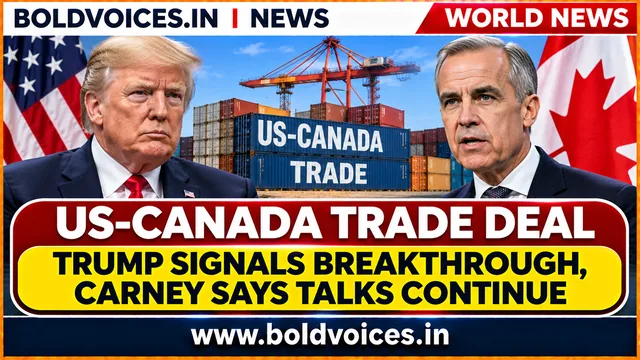
US President Donald Trump says Washington is close to reaching a trade agreement with Canada, raising hopes of easing months of tariff tensions between the two neighbours. Canadian Prime Minister Mark Carney has also reported progress, but stressed that negotiations are not finished and important work remains.
Trump made the comments in a November 3 interview with Fox News, saying the United States expected to make a deal with Canada soon. The remarks followed a recent conversation between the two leaders about the future of cross-border trade.
Carney says Washington has softened some demands
Carney described the latest discussions as more constructive, saying the US side had withdrawn some earlier demands. One proposal that has reportedly been dropped would have given Washington final approval over trade agreements Canada might negotiate with other countries.
At a news conference after a summit in Antigua, Carney said the two sides had made progress but had not completed the negotiations. He characterised the current position as the United States asking for less and offering more, while making clear that the remaining differences still needed to be resolved.
Why the dispute matters to both economies
The United States and Canada have deeply integrated economies. Their businesses rely on cross-border trade in energy, agricultural products, metals, automobiles, machinery and industrial components. Tariffs can raise costs for manufacturers, disrupt supply chains and create uncertainty for workers and investors on both sides of the border.
The dispute has involved billions of dollars in tariffs and countermeasures. Steel, aluminium and automotive production have been among the sectors exposed to the trade tensions. The issue has also become politically sensitive in US border states, where companies and workers depend heavily on commerce with Canada.
What a deal could mean
A negotiated settlement could improve predictability for exporters and manufacturers, reduce some tariff-related costs and support investment in North American supply chains. It could also give businesses more confidence when planning production, hiring and cross-border shipments.
But the outcome will depend on the final terms. Until the two governments publish and confirm an agreement, businesses cannot assume that existing tariffs have been removed or that market access has changed.
Canada also wants to protect its economic independence
For Carney’s government, any agreement must address trade concerns without compromising Canada’s ability to pursue partnerships with other countries. Ottawa has been seeking to diversify export markets and strengthen economic relationships beyond the United States, while recognising the importance of its largest trading partner.
What happens next?
The two governments are expected to continue working through the outstanding issues in the coming weeks. The immediate test will be whether the positive public statements from Trump and Carney can be translated into agreed terms on tariffs, market access and the rules governing future trade.
For now, the tone of the negotiations has improved, but a trade deal has not been finalised. Canadian exporters, US manufacturers and investors will be watching for concrete details before deciding what the latest diplomatic progress means for their businesses.
Like what you read? Help BoldVoices.in keep independent journalism going.
Manage Consent
To provide the best experiences, we use technologies like cookies to store and/or access device information. Consenting to these technologies will allow us to process data such as browsing behavior or unique IDs on this site. Not consenting or withdrawing consent, may adversely affect certain features and functions.
Functional
Always active
The technical storage or access is strictly necessary for the legitimate purpose of enabling the use of a specific service explicitly requested by the subscriber or user, or for the sole purpose of carrying out the transmission of a communication over an electronic communications network.
Preferences
The technical storage or access is necessary for the legitimate purpose of storing preferences that are not requested by the subscriber or user.
Statistics
The technical storage or access that is used exclusively for statistical purposes.The technical storage or access that is used exclusively for anonymous statistical purposes. Without a subpoena, voluntary compliance on the part of your Internet Service Provider, or additional records from a third party, information stored or retrieved for this purpose alone cannot usually be used to identify you.
Marketing
The technical storage or access is required to create user profiles to send advertising, or to track the user on a website or across several websites for similar marketing purposes.