
24 November 2026 · Team of Boldvoices
NATO has authorised the deployment of an airborne early-warning aircraft to Poland after Polish prosecutors identified debris from three Russian cruise missiles at separate crash sites in the country’s southeast. The alliance announced the decision on 23 November after its ambassadors met in Brussels. Later that night, Poland’s military reported a separate incursion by a Russian drone, underscoring how quickly another airspace incident can follow.
How the incident unfolded
| Date | What happened |
|---|---|
| 20 November | Three objects came down in southeastern Poland near the Ukrainian border during a wave of Russian attacks on Ukraine. Early assessments suggested that one object might have been a drone. |
| 22 November | Polish prosecutors said investigators had found fragments of Russian Kh-101 cruise missiles at all three sites, revising the initial assessment. |
| 23 November | NATO ambassadors met in Brussels. Poland’s deputy defence minister announced that one early-warning aircraft would be made available to Poland, and NATO confirmed that its senior military commander in Europe had authorised the deployment. |
| Night of 23 November | Poland’s military reported that a Russian drone briefly entered its airspace from Ukraine. The command said it decided against shooting it down after the drone turned back toward the border, citing potential risks to civilians. |
What investigators established about the missiles
The debris findings changed the picture of Friday’s incident. Polish authorities were dealing with evidence of cruise missiles at all three sites. NATO said Russia bore responsibility for the airspace violations. The missiles’ intended targets remain a separate question, and the publicly reported findings reviewed as of 24 November did not establish that Poland was deliberately targeted.
The later drone incursion also showed why identifying an object and deciding how to respond are separate decisions. Poland’s operational command said it tracked the drone and authorised an interception. When the drone changed course, the command weighed the danger posed by the object against the possible consequences of bringing it down near civilians.
What the radar plane adds to Poland’s air defences
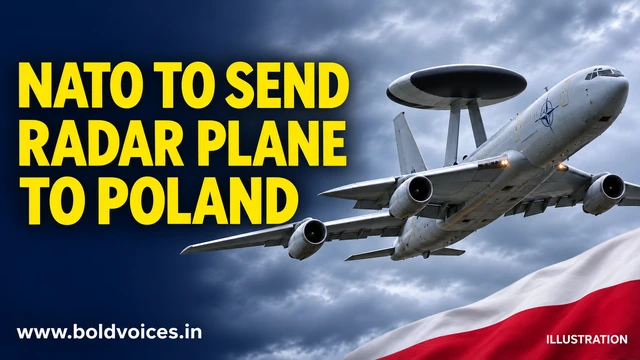
The aircraft is an Airborne Warning and Control System, or AWACS. Its crews use airborne radar to monitor airspace and share a common picture with allied aircraft and ground command centres. That gives commanders more information to work with when identifying an object, coordinating across forces and deciding whether a response is warranted. NATO has used these aircraft for surveillance along its eastern flank since Russia’s full-scale invasion of Ukraine in 2022.
Polish Deputy Defence Minister Paweł Zalewski described the aircraft as an immediate defensive response that would improve Poland’s ability to assess what is happening in its airspace. NATO said its commander in Europe was also evaluating whether additional resources were needed in Poland and elsewhere. The reporting reviewed for this article confirmed authorisation for one aircraft. Its arrival date and mission duration remain unconfirmed.
Why this matters for NATO’s eastern flank
Poland shares a border with Ukraine, so Russian attacks on western Ukraine can pose immediate decisions for a NATO member next door. The alliance faces a practical challenge each time an object crosses the border. It has to establish what crossed, assess the risk to people on the ground and choose a response while the situation is still developing. Putting an allied surveillance aircraft at Poland’s disposal gives Warsaw additional support with the first of those decisions.
The alliance has dealt with similar concerns before. In September 2025, Poland invoked Article 4 after Russian drones entered its airspace. Article 4 lets allies consult when a member believes its security is threatened. Article 5 addresses collective defence after an armed attack and calls for each ally to take the action it deems necessary. The decision announced on 23 November concerned surveillance support and a review of possible reinforcements.
What to watch next
The first milestone is confirmation that the aircraft has arrived and begun its mission. The second is whether NATO adds further resources after reviewing its defences in Poland and elsewhere. The third is whether Polish investigators can establish more about the missiles’ intended targets. Together, those developments will show how far NATO’s response extends beyond the immediate surveillance deployment.
#NATO #Poland #UkraineWar #EuropeanSecurity #Geopolitics


