
Curated by Vishaljeet Singh, Lisbon, Portugal
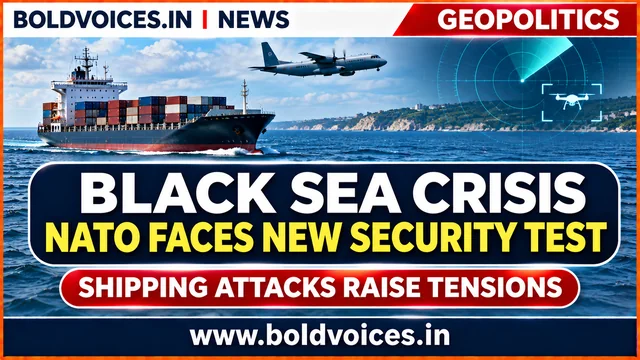
The Black Sea is emerging as a growing security challenge for NATO as repeated attacks on commercial vessels near Romania and Bulgaria bring the consequences of the Russia–Ukraine war closer to alliance territory. A series of incidents in October, including the sinking of a container ship in Bulgaria’s exclusive economic zone, has raised concerns about maritime safety, regional energy infrastructure and international trade.
On November 3, Reuters reported that NATO plans to strengthen surveillance on its eastern flank with maritime patrol aircraft, radar systems and drones. The alliance’s response reflects the growing pressure on its Black Sea members, particularly Romania and Bulgaria, to protect shipping and critical infrastructure while avoiding a wider military confrontation.
What has happened in the Black Sea?
At least nine commercial vessels were struck, sunk or capsized in incidents reported between October 5 and October 28 in the western Black Sea. The ships included cargo carriers, grain vessels, tankers and a container ship. Several incidents involved drones, and some resulted in deaths or missing crew members. Other crews were rescued.
Among the incidents, the cargo vessel Khoryv capsized and sank on October 23 near Romania’s major Black Sea port of Constanta, with its crew rescued. On October 28, the Liberian-flagged container ship Contship Jet was struck by three naval drones and later sank in Bulgaria’s exclusive economic zone. Its crew was rescued.
The incidents occurred along important commercial routes used by ships travelling to and from Ukrainian ports and the Danube export corridor. They have intensified concern among shipping companies, insurers and governments operating around the Black Sea.
Why Romania and Bulgaria are concerned
Romania and Bulgaria are NATO members with coastlines along the western Black Sea. The attacks have raised questions about the safety of commercial vessels and the protection of infrastructure in their surrounding maritime zones.
Romania is particularly focused on the security of its offshore energy infrastructure, including the Neptun Deep natural gas project. A naval drone was spotted near the project in August, prompting Romanian F-16 fighter jets to respond. Romania has also reported other drone-related incidents and has called for stronger surveillance and air-defence capabilities.
Bulgaria is concerned about threats to shipping and the security of its maritime approaches. An important legal distinction is that an exclusive economic zone (EEZ) is not the same as a country’s territorial sea. Coastal states have specific sovereign rights over resources and certain jurisdictional powers in an EEZ, but it is not sovereign territory in the same way as territorial waters.
NATO’s response and the surveillance challenge
NATO has said it will deploy additional maritime patrol aircraft, radar systems and drones to strengthen its eastern flank in the Black Sea. The alliance has also highlighted the need for cost-effective counter-drone systems and better monitoring of maritime activity.
France has separately moved an Atlantique 2 maritime patrol aircraft to Romania for surveillance missions over the western Black Sea. The aircraft is intended to help identify navigation risks and improve protection of critical infrastructure.
For NATO, the operational challenge is complex. It must improve detection, intelligence sharing and coordination among member states, while distinguishing between incidents in territorial waters, incidents in an EEZ and threats to allied airspace or infrastructure. These differences matter when governments decide what legal and security response is appropriate.
Who is responsible for the attacks?
Responsibility for individual incidents remains contested. Military analysts cited in recent reporting have assessed that Russia may be behind several attacks. A maritime security firm said a naval drone visible in footage of the Contship Jet incident resembled a Russian variant.
Romania has accused Russia of systematic attacks on civilian shipping but has said forensic evidence is needed before attributing particular incidents. Bulgaria has expressed concern but has not publicly established responsibility for every attack. Russia denies targeting Ukraine’s neighbouring countries and has blamed European governments for escalating the war by supporting Kyiv.
It is therefore important to distinguish between confirmed events, technical assessments and official allegations. The fact that a vessel was struck does not, by itself, establish who carried out the attack.
Why the Black Sea matters to global trade
The Black Sea is a major route for grain, energy and other commercial shipments. Russia and Ukraine are important participants in global agricultural markets, while ports and river routes in the region connect producers with customers across the world.
Shipping-security analysis cited by Reuters recorded 317 merchant and other vessels struck in the Black Sea and Sea of Azov between May and October. That was more than four times the 74 vessels recorded during the preceding six-month period. The figure covers vessels struck by both sides and should not be interpreted as an attribution to one country.
Disruption to ports and shipping routes can increase freight costs, insurance premiums and delivery times. If interruptions persist, import-dependent countries could face additional uncertainty over grain, energy and other essential supplies. The actual effect on prices will depend on the duration of disruption, alternative routes, global supply and demand, and market conditions.
Turkey’s strategic and diplomatic role
Turkey occupies a strategically important position because the Bosphorus and Dardanelles connect the Black Sea with the Mediterranean. Passage through these waterways is governed by the Montreux Convention, which sets rules for the movement of military vessels.
Turkey has maintained diplomatic contacts with both Russia and Ukraine and has been involved in discussions about Black Sea security and the protection of commercial shipping. Romania, Bulgaria and Turkey have also discussed closer coordination, including intelligence sharing and early warning arrangements.
A limited arrangement to protect civilian shipping has been discussed as one possible way to reduce risks. However, Russia has rejected the proposal reported in recent coverage, arguing that it would benefit Ukraine. A durable agreement would require the parties to address monitoring, enforcement and the treatment of ports and maritime infrastructure.
Does this mean NATO and Russia are heading for direct conflict?
The incidents increase the risk of miscalculation, especially if drones or other military equipment enter NATO airspace or territorial waters. However, an incident in an exclusive economic zone does not automatically constitute an armed attack on a NATO member’s territory.
Article 5 of the North Atlantic Treaty provides for collective defence when a member is the victim of an armed attack, subject to the treaty’s terms and the allies’ assessment of the circumstances. It is not automatically triggered by every maritime incident or security threat. Governments would examine the location, nature, evidence and consequences of an event before deciding on a response.
This distinction is central to the current situation. NATO must reassure its members and protect navigation, but it also has to manage escalation risks in a region where Russian and Ukrainian military operations are already active.
What to watch in the coming weeks
- Whether additional NATO patrol aircraft, radar and drones improve early warning and maritime awareness.
- Whether Romania and Bulgaria receive further surveillance, air-defence and counter-drone support.
- Whether commercial shipping companies change routes, insurance arrangements or operating procedures.
- Whether Turkey and other diplomatic channels make progress on safeguards for civilian vessels.
- Whether attacks and port disruptions affect grain, energy and other export flows.
The wider geopolitical picture
The Black Sea is no longer only a regional theatre in the Russia–Ukraine war. Its security has direct implications for NATO’s eastern flank, European energy infrastructure, global food supply chains and international maritime trade.
The immediate priority for countries in the region is to protect civilian crews and commercial navigation, improve the verification of incidents and maintain communication channels that can prevent miscalculation. Whether stronger surveillance and diplomacy can contain the risks will shape the next phase of security around the Black Sea.
#InternationalPolitics #BlackSea #NATO #RussiaUkraineWar #Geopolitics #WorldNews #MaritimeSecurity #BoldVoices


