
Curated by the Financial Desk of Boldvoices
India’s aviation industry faces an unusual challenge: passenger demand is expanding, airlines have placed enormous aircraft orders, yet the country still needs more planes to support its growth.
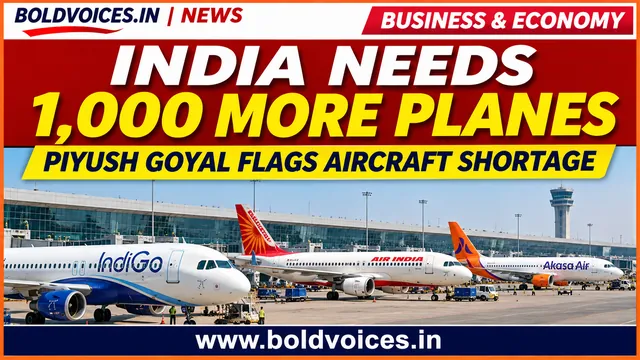
Union Commerce and Industry Minister Piyush Goyal has said India is ready to order another 1,000 civilian aircraft, even as Indian carriers have already ordered more than 1,200 planes. Speaking during his Cairo visit on 16 November, Goyal described the aircraft shortage as acute and urged established manufacturers to accelerate deliveries.
His statement highlights opportunities for airlines, airports, manufacturers and aviation financiers. It also raises a difficult question: can India’s aviation infrastructure and airline finances keep pace with its ambitions?
India’s aircraft demand: Understanding the numbers
Goyal cited more than 1,200 aircraft already ordered and the possibility of another 1,000 orders. These figures describe existing and potential procurement, not aircraft already delivered. Separately, the Ministry of Civil Aviation has projected a commercial fleet of approximately 1,100 aircraft by 2027 and more than 2,250 by 2035, while reporting 1,640 outstanding aircraft deliveries in an earlier official statement.
Orders, undelivered aircraft and projected operating fleets are different measures and must not be added together. Some ordered planes will replace older aircraft rather than increase the net fleet.
IndiGo: Domestic scale and international ambitions
IndiGo has built its business around high aircraft utilization, a large domestic network and a predominantly Airbus narrow-body fleet. Its aircraft pipeline is intended to support expansion, replace older aircraft and increase capacity. The airline’s Airbus A350 order also marks an ambition to operate more long-haul international services.
Government records documented IndiGo’s major Airbus orders, including 500 aircraft in 2023 and an A350 order announced in 2024. But even a substantial order book cannot immediately translate into flights when manufacturers face production constraints. Success will depend on aircraft availability, operating efficiency, international routes and sustainable ticket yields.
Air India: Modernizing the fleet
Air India is rebuilding its domestic and international network while modernizing aircraft, cabins and operating systems. Its Airbus and Boeing orders span narrow-body aircraft for shorter routes and wide-body aircraft for long-haul services.
New aircraft can improve fuel efficiency, customer experience and route flexibility, but fleet transformation requires financing, trained pilots, engineering capacity, maintenance infrastructure and reliable ground operations. The test is whether new deliveries produce better reliability, stronger international connections and improved financial results.
Akasa Air: Growth opportunities and risks
Akasa Air’s fleet strategy centres on Boeing 737 MAX aircraft. Earlier government records documented its initial order for 76 aircraft and a further order for 150 in 2024. Those historical orders should not be confused with a verified current undelivered balance.
For a newer carrier, timely aircraft deliveries, financing and route development are essential. Growing too quickly can strain finances; growing too slowly can make it difficult to achieve scale. Akasa has also established an aircraft-leasing entity at GIFT City, reflecting the importance of aviation financing.
Why Airbus and Boeing cannot deliver faster
Aircraft manufacturing is a complex global supply chain. Production depends on engines, avionics, structural parts, cabin equipment, skilled labour and regulatory certification. Engine availability, supplier delays and worldwide order backlogs can affect schedules.
Airlines may wait years between signing purchase agreements and receiving aircraft. That creates a mismatch between India’s passenger demand and the speed at which carriers can add seats. Announcing another 1,000 potential orders would not immediately resolve the shortage.
Aircraft leasing: A major financial consideration
The Ministry of Civil Aviation reported in 2026 that more than 85% of aircraft operated by Indian carriers are leased. Leasing reduces immediate capital requirements and offers flexibility, but rentals, maintenance reserves, financing costs and currency movements can weigh on profitability.
Many leases involve international financing centres, creating foreign-currency obligations. India is promoting GIFT City in Gujarat as an aircraft-financing and leasing hub. A stronger domestic ecosystem could create opportunities in finance, insurance, legal services, asset management and technical support.
Airports must grow alongside airlines
Aircraft orders alone cannot build an aviation network. Airlines also need airport slots, terminals, runways, parking stands, air-traffic-control capacity and ground-handling services. Some major airports face peak-hour constraints, and infrastructure delays could offset the benefits of more aircraft.
Regional connectivity matters too. Smaller cities need commercially sustainable routes, appropriate aircraft and dependable airport facilities. Expansion requires coordination among carriers, airport operators, regulators and governments.
Will more aircraft make air tickets cheaper?
Additional aircraft can increase available seats and competition, potentially putting downward pressure on fares where airlines can add services. But lower prices are not guaranteed.
Airfares also depend on aviation turbine fuel prices, exchange rates, airport charges, seasonal demand, aircraft availability and airline costs. When demand exceeds capacity, fares can remain high. Excessive expansion, meanwhile, can push prices below sustainable levels and weaken airline finances.
Employment opportunities across aviation
A larger operating fleet could support pilots, cabin crew, aircraft maintenance engineers, airport operations, ground handling, security, air-traffic management, training, leasing, finance and aerospace suppliers.
However, no reliable number of jobs can be attributed to the proposed 1,000 additional aircraft without an official workforce model. Employment depends on aircraft type, utilization, airline business models and actual delivery schedules. Training capacity will be important.
Can India become an aircraft-manufacturing hub?
India already participates in global aerospace supply chains. During his Egypt visit, Goyal highlighted component sourcing from India by Airbus and Boeing, along with growing manufacturing ambitions.
He also referred to existing assembly activities involving military transport aircraft and helicopters and opportunities in regional aircraft. Manufacturing components or assembling particular aircraft types, however, is not the same as building a complete domestic production line for large commercial passenger jets. Such an industry requires investment, certification expertise, technology and long-term supplier development.
Financial and operational risks
- Delivery delays: Late aircraft can disrupt expansion and fleet replacement.
- Fuel-price volatility: Aviation turbine fuel is a major operating expense.
- Currency exposure: Dollar-linked leases, purchases and maintenance can become more expensive when the rupee weakens.
- Financing pressure: Fleet growth requires substantial lease commitments, capital and working capital.
- Excess capacity: Overexpansion can weaken fares and airline profitability.
- Operational constraints: Pilot availability, maintenance, airport congestion and aircraft reliability can restrict growth.
An enormous order book is therefore not automatically a sign of financial strength.
What should investors monitor?
For aviation businesses, useful indicators include actual deliveries, operating fleet size, passenger load factors, revenue per available seat kilometre, unit costs, fuel expenses, lease liabilities and profitability. Investors should also examine international route performance and aircraft availability.
For airport and infrastructure companies, passenger throughput, non-aeronautical revenue, capital expenditure and capacity utilization matter. Aerospace suppliers, maintenance providers and financing firms may also benefit, although commercial outcomes will differ by business.
The bigger economic opportunity
Better air connectivity can support tourism, business travel, trade, investment and regional economic development. Improved international services could help Indian airlines capture a larger share of global passenger traffic. Goyal’s Cairo remarks also highlighted potential for more India–Egypt flights as aircraft become available.
India does not merely need another 1,000 aircraft orders. It needs timely deliveries, financially sustainable airlines, adequate airports and a stronger domestic aviation ecosystem. That is the real challenge behind the country’s aviation boom.
#IndianAviation #AircraftOrders #PiyushGoyal #IndiGo #AirIndia #AkasaAir #Airbus #Boeing #AviationIndustry #IndianEconomy #AirportInfrastructure #BusinessNews #BoldVoices


