Date: 30 October 2026 Curated by the team of boldvoices
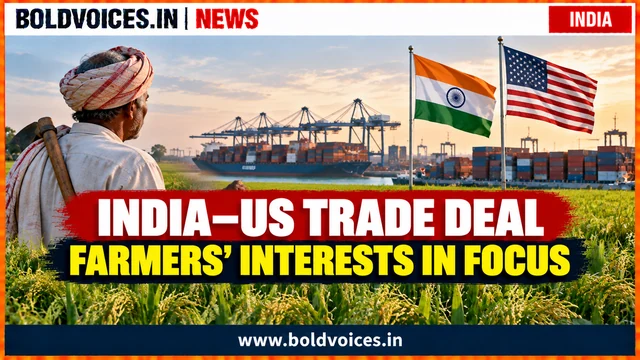
India has said it will not compromise the interests of its farmers in the proposed trade agreement with the United States, as negotiations enter a sensitive stage and agricultural market access remains a major point of concern.
Commerce and Industry Minister Piyush Goyal said on 29 October that Indian farmers and other domestic stakeholders would be protected. He expressed confidence that the public would welcome the agreement once its details were released.
His statement comes as New Delhi and Washington work to finalise the first phase of a bilateral trade agreement. Although both sides have made progress, the agreement has not yet been formally signed.
Government says farmers’ interests will remain protected
Goyal said India would not sacrifice the interests of farmers or other sensitive domestic sectors to secure a trade agreement.
The government’s position is significant because agriculture supports the livelihoods of a large section of India’s population. Changes in import duties and market access can influence domestic prices, farm incomes and the competitiveness of Indian producers.
However, the full text of the proposed agreement has not been released. The actual safeguards and concessions will become clearer only when the terms are formally disclosed.
Why farmer organisations are concerned
The proposed agreement has drawn criticism from farmer groups, including the Samyukt Kisan Morcha (SKM), a coalition representing more than 100 farm organisations.
The groups have expressed concern that lower tariffs on selected American agricultural products could expose Indian farmers to competition from subsidised imports.
Products mentioned in the debate include maize, almonds, walnuts, apples and soybean oil.
Farmer organisations fear that cheaper imports could put pressure on domestic prices and affect rural incomes. They have also demanded greater transparency about the negotiations.
These concerns represent the position of the protesting organisations; the final impact cannot be assessed without the agreement’s detailed terms.
What is at stake for India and the United States?
For India, the challenge is to improve access for its exporters in the American market while protecting sectors that are particularly sensitive to import competition.
A trade agreement could create opportunities for Indian manufacturers, exporters and service providers. It could also strengthen commercial ties between the two economies.
For the United States, improved access to the Indian market would create opportunities for American businesses and agricultural exporters.
The central negotiating question is how to balance these commercial opportunities with India’s domestic economic priorities.
What happens next?
The first phase of the agreement is nearing completion, but several details remain important.
Businesses, farmers and consumers will be watching for clarity on which agricultural products could receive lower import duties, whether sensitive crops and farm sectors receive exemptions or safeguards, how import competition and domestic prices will be monitored, what market-access benefits Indian exporters will receive, and whether the final agreement includes protections against sudden disruption to domestic producers.
Farmer organisations have indicated that they plan further demonstrations in November and are demanding that the government disclose the agreement’s terms.
A crucial test for India’s trade policy
The proposed India–US agreement could strengthen economic ties and expand opportunities for Indian businesses. But its success will also depend on whether domestic concerns are addressed transparently.
The government has given an assurance that farmers’ interests will not be compromised. The final agreement, its safeguards and its implementation will determine how that assurance translates into practice.
The real test will be whether India can expand international trade while protecting the livelihoods of its farmers.
Like what you read? Help BoldVoices.in keep independent journalism going.
Manage Consent
To provide the best experiences, we use technologies like cookies to store and/or access device information. Consenting to these technologies will allow us to process data such as browsing behavior or unique IDs on this site. Not consenting or withdrawing consent, may adversely affect certain features and functions.
Functional
Always active
The technical storage or access is strictly necessary for the legitimate purpose of enabling the use of a specific service explicitly requested by the subscriber or user, or for the sole purpose of carrying out the transmission of a communication over an electronic communications network.
Preferences
The technical storage or access is necessary for the legitimate purpose of storing preferences that are not requested by the subscriber or user.
Statistics
The technical storage or access that is used exclusively for statistical purposes.The technical storage or access that is used exclusively for anonymous statistical purposes. Without a subpoena, voluntary compliance on the part of your Internet Service Provider, or additional records from a third party, information stored or retrieved for this purpose alone cannot usually be used to identify you.
Marketing
The technical storage or access is required to create user profiles to send advertising, or to track the user on a website or across several websites for similar marketing purposes.