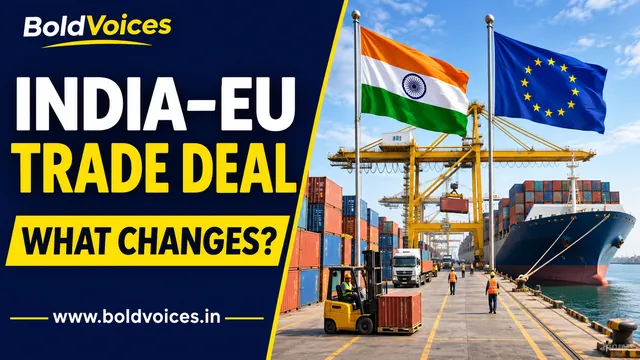
India and the European Union could sign their free trade agreement in December, with the pact potentially taking effect by mid-2027, EU Ambassador to India Jean-Eric Paquet said on Monday. The timing depends on approvals on both sides. For businesses, the practical question is when the new duty rate will apply to a specific shipment and what paperwork will be needed to claim it.
The European Commission says India and the EU already trade more than €180 billion in goods and services annually. The agreement could make some Indian exports more competitive in Europe and lower the cost of importing eligible European goods into India. The amount saved will depend on the product, the tariff schedule and whether the shipment meets the agreement’s rules.
What still has to happen before tariffs change?
Negotiations concluded in January 2026. The European Commission put forward its proposals for signing the agreement in September. The ambassador’s update gives businesses a timetable to plan around, with several formal steps still ahead.
Milestone
What it means for businesses
Negotiations concluded in January 2026
Both sides reached agreement on the negotiated terms.
European Commission submitted proposals in September
The proposed signing and conclusion moved to the EU Council process.
December signing envisaged
If approved, India and the EU would formally sign the agreement.
Possible entry into force by mid-2027
The European Parliament’s consent, the Council’s conclusion decision and India’s ratification are among the steps required before implementation.
Tariff reductions begin
The schedule for each product determines when and by how much its duty falls.
A purchase order placed in anticipation of the agreement may still be subject to the existing tariff. Importers and exporters will need the effective date and the applicable product schedule before quoting prices that assume preferential duty.
Where Indian exporters could gain
India’s Commerce Ministry expects labour-intensive sectors such as textiles, apparel, leather, footwear, marine products, and gems and jewellery to benefit. A tariff reduction can lower the cost paid by an EU importer and give an Indian supplier more room to compete on price, negotiate a better margin or bid for a larger order.
Consider an Indian garment maker selling to a European retailer. If the shipment qualifies for a lower tariff, the retailer may ask the supplier to share the savings through a lower quote. The manufacturer could also use that negotiating room to secure a larger order or agree on a longer contract. Which outcome is more likely depends on competing suppliers, delivery reliability and the retailer’s bargaining power.
Rules of origin decide whether a product qualifies for a trade preference. A garment shipped from India may still need to meet requirements tied to its fabric, yarn or stages of production. The relevant rule varies by product. An exporter preparing for the deal can start by confirming the customs classification, documenting where inputs came from and identifying which production steps took place in India.
AI-generated illustration · A textile team checks fabric and shipment paperwork. Supplier and production records can help exporters demonstrate where a product was made.
What European exporters could gain in India
The European Commission says India would eliminate or reduce duties on 90% of tariff lines under the agreement. A tariff line is a customs category, so the figure describes the breadth of the schedule. The saving on an individual shipment depends on its classification and when the applicable reduction takes effect.
The potential gains go beyond finished goods. Lower duties on eligible equipment or components could reduce costs for Indian businesses that use European inputs. The agreement also provides for preferential access in some services, including financial services and maritime transport. Individual providers would still need to check the terms for their activity and the licensing requirements that apply.
The EU also plans to maintain existing tariffs on a number of sensitive agricultural goods, including rice and sugar. Food imports would still have to meet EU health and safety requirements. A producer assessing the opportunity therefore needs to check both the tariff and the conditions for selling the product in Europe.
Could imported cars become cheaper in India?
A lower duty on an eligible vehicle could reduce the importer’s landed cost. The eventual showroom price also reflects freight, exchange rates, domestic taxes, the manufacturer’s pricing and how much of the saving reaches customers.
Eligibility can differ from one model to another. A European brand may build vehicles in several countries, so the place of production and the applicable origin rule matter. The timetable for a specific model is more useful to buyers than the headline announcement.
AI-generated illustration · A worker checks vehicles arriving at an Indian port. The final price depends on the model’s eligibility, its applicable duty and how the distributor prices it.
What to watch after the next announcement
Exporters can look for the EU tariff schedule by product code, the relevant origin rule and the proof needed to claim the lower duty.
Importers can check India’s schedule for the first effective rate, later reductions and any limits that apply to their product.
Small businesses can work with buyers and customs brokers to check origin records and decide who will claim the preference before committing to a price.
Consumers can compare actual quotes once eligible shipments arrive. The effect on prices will vary by product and seller.
The signing will be the next milestone. For a textile exporter quoting a European retailer or an Indian buyer comparing imported cars, the decisive details will be the effective date, the product-specific rate and the conditions for using it.
Like what you read? Help BoldVoices.in keep independent journalism going.
Manage Consent
To provide the best experiences, we use technologies like cookies to store and/or access device information. Consenting to these technologies will allow us to process data such as browsing behavior or unique IDs on this site. Not consenting or withdrawing consent, may adversely affect certain features and functions.
Functional
Always active
The technical storage or access is strictly necessary for the legitimate purpose of enabling the use of a specific service explicitly requested by the subscriber or user, or for the sole purpose of carrying out the transmission of a communication over an electronic communications network.
Preferences
The technical storage or access is necessary for the legitimate purpose of storing preferences that are not requested by the subscriber or user.
Statistics
The technical storage or access that is used exclusively for statistical purposes.The technical storage or access that is used exclusively for anonymous statistical purposes. Without a subpoena, voluntary compliance on the part of your Internet Service Provider, or additional records from a third party, information stored or retrieved for this purpose alone cannot usually be used to identify you.
Marketing
The technical storage or access is required to create user profiles to send advertising, or to track the user on a website or across several websites for similar marketing purposes.