
Curated by the Financial Desk of Boldvoices
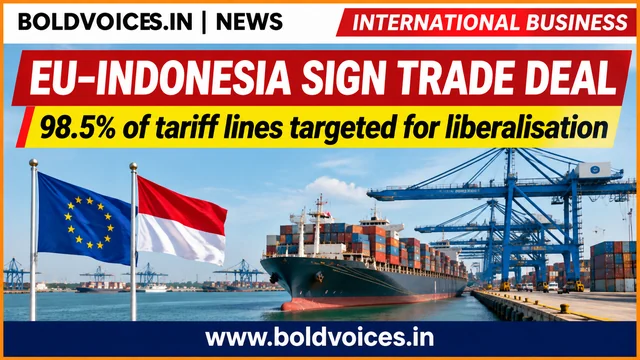
The European Union and Indonesia have signed a major trade and investment package that could reshape commercial ties between Europe and Southeast Asia. The Comprehensive Economic Partnership Agreement (CEPA) and Investment Protection Agreement (IPA) were signed in Brussels on 21 November 2026, concluding a negotiation process that began in 2016.
The headline figure is significant: once fully implemented, the CEPA is expected to liberalise up to 98.5% of tariff lines. The European Commission estimates that EU exporters could save more than €600 million a year in customs duties. The agreement is designed to widen market access, support investment and make supply chains more resilient.
What exactly have the two sides signed?
The package contains two separate agreements. The CEPA deals with trade in goods and services, customs procedures, market access and related rules. The IPA is intended to provide protections for investors from both sides, including safeguards against unjustified discrimination and unlawful expropriation, while preserving governments’ right to regulate.
The agreements were signed on 21 November 2026. They are not yet fully in force. Provisional application can begin after both sides complete and notify the necessary internal procedures. European Parliament consent is also required before the EU can formally conclude the agreements.
What does the 98.5% tariff figure mean?
The European Commission says that, once fully implemented, up to 98.5% of tariff lines will be liberalised. It expects 96% of Indonesian tariffs to disappear within five years. The Commission estimates annual customs-duty savings of more than €600 million for EU exporters.
There is also an important benefit for Indonesian exporters. Indonesia’s government says 90.4% of the relevant EU tariff lines for Indonesian products are scheduled for zero-duty treatment from the agreement’s entry into force, with a further 7.92% to be eliminated progressively over three to 15 years or through tariff-rate quotas. These figures describe different sides and schedules of the agreement and should not be treated as one identical tariff measure.
Which industries could gain?
1. Automobiles and machinery
European vehicle and machinery manufacturers could benefit from improved access to Indonesia. The European Commission says Indonesian import duties on EU automotive exports, which currently reach as high as 50% on certain vehicles, will be eliminated within five years under the agreed schedule.
2. Textiles, garments and footwear
Indonesian textile, garment, fabric, leather and footwear exporters could gain from better access to European buyers as tariff preferences take effect. This could strengthen Indonesia’s position in labour-intensive manufacturing, although companies will still need to meet EU product, safety, labour and sustainability requirements.
3. Agriculture and food products
The agreement is intended to improve market access for a range of European agri-food exports, including dairy products, meat and processed foods. Sensitive products are treated differently: the EU has retained protections for selected agricultural sectors, with some products excluded from tariff liberalisation and others subject to limited quotas.
4. Pharmaceuticals, chemicals and electronics
Lower trade barriers and clearer rules could create opportunities for pharmaceutical, chemical, electrical equipment and electronics businesses. The agreement also aims to improve conditions for trade in services, including computer and telecommunications services.
5. Electric vehicles, energy and critical minerals
Indonesia is seeking investment in electric vehicles, batteries, electronics and renewable energy. The EU, meanwhile, is looking to diversify sources of energy and critical raw materials. The agreements provide a framework for closer cooperation and investment in these strategic areas.
What could the agreement mean for economic growth?
European Commission projections suggest that EU exports to Indonesia could rise by almost 40% over 15 years. Indonesian exports of goods and services to the EU are projected to increase by more than 14% over the same period.
The Commission’s modelling also estimates that EU GDP could be €16 billion higher and Indonesia’s GDP €27 billion higher than in a scenario without the agreement. These are projected long-term differences against a baseline, not guaranteed gains or money already added to either economy.
Why Indonesia matters to European businesses
Indonesia is Southeast Asia’s largest economy and has a population of more than 280 million. Its domestic consumer market, manufacturing base and natural resources make it an important partner for companies seeking to expand across the Indo-Pacific.
For the EU, the deal supports a broader effort to diversify trade relationships and reduce overdependence on a narrow group of markets and suppliers. For Indonesia, it offers an opportunity to attract capital, technology and industrial partnerships while expanding exports to Europe.
Could Indian businesses feel the impact?
India is not a party to this agreement, but the effects could still matter for Indian exporters. Indonesian producers in textiles, footwear, processed goods and other sectors may gain more favourable access to the European market as the agreed tariff schedules are implemented.
That could increase competition for Indian suppliers in some product categories. At the same time, stronger EU–Indonesia investment and supply-chain links may create opportunities for Indian companies that provide components, services, logistics or technology to businesses operating across Asia.
Indian exporters should therefore track the product-by-product tariff schedules, rules of origin and implementation dates rather than assume that every Indonesian product will receive immediate duty-free access. Competitiveness will continue to depend on quality, cost, delivery reliability and compliance with European standards.
What happens next?
- Both sides must complete the internal procedures needed for provisional application and notify each other.
- The European Parliament must give its consent before the EU formally concludes the agreements.
- Businesses will need to study the detailed tariff schedules, rules of origin and product-specific requirements.
- Investors will watch whether the agreements translate into new projects in manufacturing, EVs, electronics, pharmaceuticals and energy.
The bigger picture: The EU–Indonesia agreements are a major step towards deeper trade and investment links between Europe and Southeast Asia. Their real economic value will depend on how quickly the procedures are completed, how businesses use the new access and whether investment commitments lead to productive projects and jobs.
Official sources and further information
- European Commission – EU and Indonesia sign trade and investment agreements, 21 November 2026
- European Commission – EU–Indonesia agreements and trade details
- Council of the European Union – Signature and provisional application process
- Indonesia Ministry of Foreign Affairs – IEU-CEPA and IPA signing announcement
Disclaimer: This article is for general information only. Trade and economic projections are estimates and may change as implementation proceeds. Readers and businesses should consult the official agreement texts and relevant authorities before making commercial or investment decisions.
#InternationalBusiness #GlobalTrade #EuropeanUnion #Indonesia #TradeAgreement #GlobalEconomy #ForeignInvestment #SupplyChains #BoldVoices


