
Curated by the Financial Desk of Boldvoices
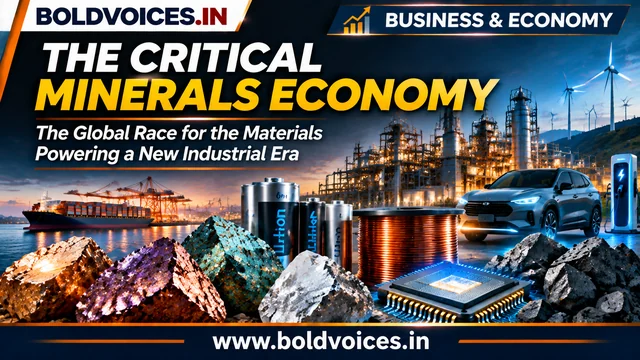
The next major economic competition may not be about oil, natural gas or even artificial intelligence. It could be about the minerals hidden inside the technologies that power the modern world.
From semiconductor chips and electric vehicles to fighter aircraft, wind turbines, batteries and advanced telecommunications, modern industries depend on a group of specialised materials known as critical minerals.
Countries that control their extraction, refining and processing can gain considerable economic and strategic influence. This is why China, the United States, Europe and other industrial economies are investing heavily in alternative mineral supply chains.
A fresh development on November 24, 2026, brought this competition back into focus. China extended the suspension of certain export restrictions on gallium, germanium, antimony and superhard-material dual-use items destined for the United States until January 27, 2027. The extension also continues eased end-user and end-use reviews for specified graphite shipments.
What are critical minerals and why do they matter?
Critical minerals are materials considered essential for important industries but potentially vulnerable to supply disruptions. Their importance depends on their economic use, strategic value, availability and the difficulty of finding substitutes.
- Lithium: Used in rechargeable batteries for electric vehicles and energy storage.
- Cobalt: Used in certain battery chemistries and high-performance industrial applications.
- Graphite: A major material in battery anodes.
- Gallium: Used in advanced semiconductors, radio-frequency systems and power electronics.
- Germanium: Important for fibre-optic communications, infrared technology and specialised electronics.
- Antimony: Used in flame retardants, alloys, batteries and defence-related applications.
- Rare earth elements: Essential for permanent magnets used in electric motors, wind turbines, electronics and defence equipment.
- Copper: Fundamental to electricity networks, renewable energy, data centres and industrial infrastructure.
These materials are not equally scarce. The bigger concern is often the concentration of their processing and refining capacity in a small number of countries.
Why does China have such an important position?
China has developed a powerful industrial ecosystem around mineral processing, refining, chemical production and advanced manufacturing.
The International Energy Agency’s Global Critical Minerals Outlook 2026 shows that China accounts for around 70% of lithium refining, 75% of cobalt refining, 85% of magnet rare-earth separation and more than 90% of battery-grade graphite production. China also holds a major position in several other mineral-processing chains.
This concentration gives China considerable influence over the availability of materials used by international manufacturers. Other countries may have mineral deposits, but developing a commercially competitive refining industry requires substantial capital, technical expertise, environmental approvals, infrastructure and years of development.
Mining a mineral and converting it into a usable industrial material are two very different stages of the supply chain.
Why did China extend the export-control suspension?
On November 24, China’s Ministry of Commerce announced that the suspension of part of its export-control measures on specified dual-use items destined for the United States would continue from November 28, 2026, until January 27, 2027.
The extension covers the suspended provision affecting gallium-, germanium-, antimony- and superhard-material-related dual-use items, and continues the eased review arrangements for specified graphite dual-use exports to the US. It does not remove China’s wider export-control system. Separate restrictions, including controls concerning military end users and military purposes, remain distinct and applicable.
The earlier measures were introduced amid escalating tensions between Washington and Beijing over semiconductor technology and export controls. The extension provides additional time for economic discussions between the two countries.
For manufacturers, the important point is that access to essential materials can be affected by licensing decisions, end-use reviews and changing trade arrangements. A temporary suspension should not be mistaken for a permanent guarantee of supply.
Why are the United States and Europe investing in alternative supplies?
The United States and European economies recognise that depending heavily on one source for strategically important materials creates industrial and national-security risks. Their priorities include:
- Domestic mining: Supporting exploration and development of mineral deposits within their own territories.
- Local refining: Building processing facilities so that mining does not remain dependent on overseas processors.
- International partnerships: Developing agreements with resource-rich economies to diversify supply.
- Recycling: Recovering valuable minerals from used batteries, electronics and industrial waste.
- Strategic reserves: Stockpiling selected materials to provide temporary protection against supply disruptions.
France announced on November 24 that it plans to establish strategic reserves of rare earths and other critical minerals from 2027 and encourage companies to coordinate purchases. Such initiatives reflect the growing recognition that secure access to materials is an industrial and economic priority.
Why is the world facing a supply-chain problem?
The IEA’s 2026 assessment identifies a growing imbalance between mineral extraction and downstream processing. Mining capacity is becoming more geographically diversified, but refining and processing remain concentrated.
A country may successfully develop a new lithium or rare-earth mine, but without suitable refining facilities it may still depend on overseas processors to turn the extracted material into usable industrial products.
The IEA also highlights the importance of investment, specialised equipment, technical expertise and the time required to establish alternative processing ecosystems. Diversification therefore involves much more than opening new mines.
What does this mean for India?
India has an opportunity to become an important participant in the emerging critical-minerals economy. The National Critical Mineral Mission, approved by the Union Cabinet in January 2025, provides a framework for strengthening India’s critical-mineral capabilities across the value chain. It carries a government expenditure of ₹16,300 crore and envisages expected investment of ₹18,000 crore by public-sector undertakings and others over seven years.
India’s potential opportunities include:
- Exploration and development of domestic mineral resources.
- Lithium-ion battery recycling and recovery of valuable materials.
- Rare-earth processing and permanent-magnet manufacturing.
- Advanced materials for electric vehicles and energy storage.
- Semiconductor and electronics supply chains.
- Copper and other industrial mineral processing.
- International partnerships with mineral-producing countries.
However, India must overcome challenges involving technology, investment, environmental clearances, specialised skills and commercially competitive refining facilities. The real opportunity lies in developing complete industrial capabilities rather than relying only on importing raw minerals.
Which industries could benefit?
| Industry | Important materials |
|---|---|
| Electric vehicles | Lithium, graphite, nickel, cobalt |
| Semiconductors | Gallium, germanium, silicon |
| Renewable energy | Copper, rare earths, silver |
| Defence and aerospace | Titanium, tungsten, antimony |
| Telecommunications | Germanium, copper and specialised materials |
| Battery storage | Lithium, graphite, manganese |
| Electric motors | Rare-earth magnets and copper |
Businesses that develop recycling technologies, mineral-processing equipment, specialised chemicals and material-traceability systems could also benefit.
What should businesses watch next?
- The January 2027 deadlines for certain suspended Chinese export restrictions.
- New mining and refining projects outside China.
- Government stockpiling programmes and international mineral partnerships.
- Investment in battery recycling and alternative materials.
- Changes in global copper, lithium, graphite and rare-earth supply.
Manufacturers should assess their dependence on single-source suppliers, map critical inputs and identify alternative materials wherever technically possible. They should also distinguish between temporary policy suspensions and durable supply agreements.
The bigger picture
Critical minerals are becoming a central part of international economic security. The countries that successfully develop reliable supplies, advanced refining capabilities and competitive manufacturing industries could gain a significant advantage in the next generation of technology.
For India, this is an opportunity to strengthen domestic manufacturing, attract investment, develop new industrial capabilities and become a more important participant in global supply chains.
The competition is no longer simply about who owns the mineral deposits. It is about who can extract, refine, process and manufacture the materials that the modern economy cannot function without.
#CriticalMinerals #RareEarthElements #GlobalTrade #ChinaUSRelations #Semiconductors #ElectricVehicles #BatteryTechnology #IndianManufacturing #GlobalEconomy #MiningIndustry #SupplyChainSecurity #BoldVoices


