7 November 2026 | Curated by Gurdeep Singh, Amritsar, Punjab
Bajaj Finserv reported higher consolidated income and profit for the July–September quarter of FY2026–27, supported by its lending and life insurance businesses. The group’s results, however, were not uniform across all segments: general insurance profit declined, while the life insurance business recorded a sharp increase in new-business value.
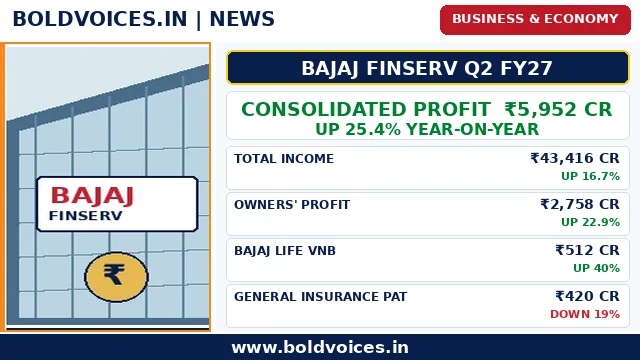
For Q2 FY27, consolidated total income rose 16.7% year-on-year to ₹43,416 crore, while consolidated profit after tax (PAT) increased 25.4% to ₹5,952 crore. Profit attributable to owners of Bajaj Finserv was ₹2,758 crore, up 22.9% from the year-ago quarter.
Why are there two different profit figures?
Bajaj Finserv is a financial-services holding company with major businesses in lending, general insurance and life insurance. Its consolidated results include the full financial performance of subsidiaries, but part of those subsidiaries may belong to other shareholders.
That is why the group’s consolidated PAT of ₹5,952 crore is higher than the ₹2,758 crore attributable to owners of Bajaj Finserv. The latter represents the portion of profit belonging to the parent company’s shareholders after accounting for non-controlling interests. Both figures are valid, but they measure different things and should not be interchanged.
Group income and profit move higher
Consolidated total income increased from ₹37,215 crore in Q2 FY26 to ₹43,416 crore in Q2 FY27. Consolidated PAT rose from ₹4,746 crore to ₹5,952 crore. The year-on-year increase was 17% in total income and 25% in group profit after tax.
For the first half of FY27, consolidated total income reached approximately ₹85,453 crore, up 17.8%, while PAT increased 21.6% to ₹12,249 crore. Profit attributable to owners for the half-year was ₹5,890 crore, up 17%.
Bajaj Finance remains a major earnings contributor
Bajaj Finance continued to report strong growth in its lending business. Its consolidated PAT rose 29% to ₹6,367 crore, while assets under management reached ₹5,84,624 crore, up 26% year-on-year. The lending business also reported improving gross and net NPA ratios.
These figures are the performance of Bajaj Finance, a material subsidiary, and are already included within the Bajaj Finserv group’s consolidated results. They should not be added again to the holding company’s consolidated profit. The group’s performance depends on how its subsidiaries perform together, not on a simple addition of headline figures.
General insurance faces higher claims pressure
Bajaj General Insurance reported Q2 FY27 profit after tax of ₹420 crore, compared with ₹517 crore a year earlier, a decline of approximately 18.8%. The combined ratio increased to 104.5% from 102.3% in Q2 FY26. Excluding the impact of natural catastrophe claims, the combined ratio was 102%.
The combined ratio compares claims and operating expenses with premiums earned. A ratio above 100% generally indicates an underwriting loss before investment income. Bajaj General Insurance reported an underwriting loss of ₹115 crore during the quarter, compared with ₹92 crore in the year-ago period.
The company’s solvency ratio stood at 229% as of 30 September 2026, above the regulatory minimum of 150%. Solvency is a measure of an insurer’s capital buffer against its obligations. Investors should track claims trends, pricing discipline, catastrophe exposure and investment income when evaluating the general insurance business.
Life insurance records higher new-business value
Bajaj Life Insurance reported new business premium of ₹5,170 crore, up 29% year-on-year. Renewal premium increased 17% to ₹5,106 crore, while gross written premium rose 23% to ₹10,276 crore.
Net value of new business (VNB), a key measure of expected profitability from new life insurance business, increased 40% to ₹512 crore from ₹367 crore. The life insurer’s solvency ratio was 255%, comfortably above the regulatory minimum of 150%.
VNB growth is useful because premium growth alone does not show how profitable new policies are expected to be. Product mix, distribution costs, persistency, claims experience and assumptions about future returns can all affect the measure.
Capital and group strategy
Bajaj Finserv’s consolidated net worth stood at approximately ₹83,974 crore. The company also expressed its intention to subscribe to Bajaj Finance’s proposed preferential issue of warrants for an amount of up to ₹5,800 crore, subject to regulatory and statutory approvals.
The proposed investment would reinforce the group’s lending subsidiary, but it remains subject to the relevant transaction steps. It should not be treated as a completed capital infusion until the company confirms completion.
General insurance: Claims inflation, catastrophe losses, combined ratio and underwriting profitability.
Life insurance: VNB growth, new-business margins, premium mix and persistency.
Group profit attribution: The difference between total consolidated PAT and profit attributable to parent shareholders.
Capital allocation: The proposed investment in Bajaj Finance and the group’s ability to fund growth across businesses.
The bigger picture
Bajaj Finserv’s Q2 FY27 results show a diversified financial-services group growing overall, but with different trends across its businesses. Lending and life insurance supported group performance, while general insurance faced higher claims pressure and a weaker underwriting result.
The next test is whether the group can maintain growth while improving insurance profitability and preserving strong capital positions. Investors should look beyond the consolidated profit headline and examine the quality, risk and contribution of each major business.
This article is for news and general information only. It is not investment advice or a recommendation to buy or sell any security. Readers should review official company disclosures and consider their own financial circumstances before making investment decisions.
Like what you read? Help BoldVoices.in keep independent journalism going.
Manage Consent
To provide the best experiences, we use technologies like cookies to store and/or access device information. Consenting to these technologies will allow us to process data such as browsing behavior or unique IDs on this site. Not consenting or withdrawing consent, may adversely affect certain features and functions.
Functional
Always active
The technical storage or access is strictly necessary for the legitimate purpose of enabling the use of a specific service explicitly requested by the subscriber or user, or for the sole purpose of carrying out the transmission of a communication over an electronic communications network.
Preferences
The technical storage or access is necessary for the legitimate purpose of storing preferences that are not requested by the subscriber or user.
Statistics
The technical storage or access that is used exclusively for statistical purposes.The technical storage or access that is used exclusively for anonymous statistical purposes. Without a subpoena, voluntary compliance on the part of your Internet Service Provider, or additional records from a third party, information stored or retrieved for this purpose alone cannot usually be used to identify you.
Marketing
The technical storage or access is required to create user profiles to send advertising, or to track the user on a website or across several websites for similar marketing purposes.