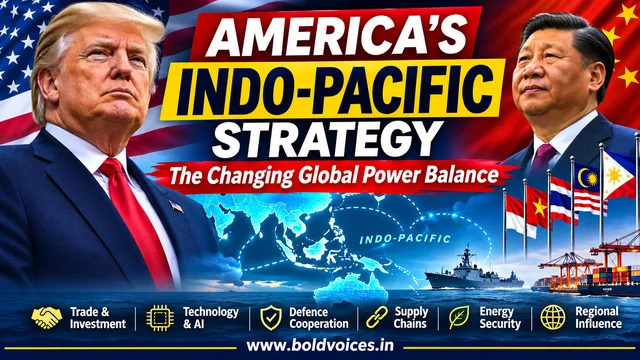
The United States is linking economic partnerships, technology and regional security more closely in its Indo-Pacific policy. President Donald Trump’s November 2026 visit to Asia illustrates how Washington is pursuing commercial opportunities alongside diplomacy and strategic competition with China.
America’s $17 billion economic push
On November 18, 2026, the White House announced commercial deals and investment opportunities exceeding $17 billion. They span energy, communications, industry and security. Some are still proposals or negotiations, rather than completed investments.
In the Philippines, initiatives include potential cooperation on civil nuclear technology and satellite connectivity. In Indonesia, negotiations involve a proposed $2 billion energy project. A separate US-Thailand joint statement confirms that trade negotiations have substantially concluded, but domestic procedures remain before signature and entry into force.
The growing competition between America and China
Advanced computing, semiconductor supply chains, trade, critical minerals and maritime security are central areas of competition. Washington prioritises economic and national security, while Beijing has its own interests in trade access, technological development and regional influence. Strategic competition does not preclude diplomatic engagement or commercial cooperation.
Why Southeast Asia matters
Indonesia, Vietnam, Thailand, Malaysia and the Philippines connect important manufacturing networks and maritime routes. Their governments have their own economic and security priorities, and their relationships with Washington and Beijing need not be mutually exclusive.
India’s strategic opportunity
At the November 17 Quad summit in Manila, India, Australia, Japan and the United States reaffirmed cooperation on maritime transport, technology and resilient supply chains. A business leaders’ forum is planned for early 2027. India could benefit from stronger industrial partnerships, subject to commercial feasibility and policy agreements, while maintaining an independent foreign policy.
American domestic politics and global diplomacy
Congressional oversight, appropriations and legislative decisions influence the resources available for US foreign policy. The executive branch directs diplomacy, but implementing international commitments can require cooperation across institutions.
What the world should watch
The key questions are whether proposed investments materialise, whether trade agreements enter into force, and whether regional governments can strengthen economic resilience while managing security disagreements. Technology, energy and commercial networks will remain important alongside traditional diplomacy.
The bigger picture
The long-term impact of America’s Indo-Pacific engagement will depend on implementation, regional cooperation and how governments manage competing interests. Announcements alone do not establish durable economic or strategic outcomes.
Like what you read? Help BoldVoices.in keep independent journalism going.
Manage Consent
To provide the best experiences, we use technologies like cookies to store and/or access device information. Consenting to these technologies will allow us to process data such as browsing behavior or unique IDs on this site. Not consenting or withdrawing consent, may adversely affect certain features and functions.
Functional
Always active
The technical storage or access is strictly necessary for the legitimate purpose of enabling the use of a specific service explicitly requested by the subscriber or user, or for the sole purpose of carrying out the transmission of a communication over an electronic communications network.
Preferences
The technical storage or access is necessary for the legitimate purpose of storing preferences that are not requested by the subscriber or user.
Statistics
The technical storage or access that is used exclusively for statistical purposes.The technical storage or access that is used exclusively for anonymous statistical purposes. Without a subpoena, voluntary compliance on the part of your Internet Service Provider, or additional records from a third party, information stored or retrieved for this purpose alone cannot usually be used to identify you.
Marketing
The technical storage or access is required to create user profiles to send advertising, or to track the user on a website or across several websites for similar marketing purposes.