
Curated by the Team of Boldvoices · 22 November 2026
Korea was divided after Japan surrendered in 1945. The Soviet Union accepted the Japanese surrender in the north, and the United States did so in the south. The two powers used the 38th parallel to divide those responsibilities. By 1948, two rival governments had formed. Each claimed the right to govern Korea. The Korean War then turned a line chosen for a military occupation into a division that has lasted for generations.
Three dates explain how it happened. 1945 brought the end of Japanese colonial rule and the start of separate occupation zones. 1948 brought two governments, based in Seoul and Pyongyang. 1953 brought an armistice that stopped the fighting and created a buffer zone along a new military line. The two Koreas later joined the United Nations separately, but the armistice has never been replaced by a comprehensive peace treaty.
What was Korea before the division?
For centuries, most of the peninsula was governed as a single political unit, including under the Joseon dynasty. In 1910, Japan formally annexed Korea. Japanese colonial rule lasted 35 years. Korean resistance took different forms, from the mass independence demonstrations of 1919 to political organising in exile and armed resistance abroad.
By the end of the Second World War, Koreans had a common goal of ending colonial rule and different ideas about who should lead an independent country. Communists, nationalists and other political groups had organised under different conditions, inside Korea and abroad. Liberation gave these groups an opening to shape the peninsula’s future. It also brought two outside powers with different plans for postwar East Asia.
Why did the United States and Soviet Union choose the 38th parallel?
In August 1945, the Soviet Union entered the war against Japan and moved forces into northern Korea. As Japan’s surrender approached, American officials proposed the 38th parallel as the dividing line for accepting the surrender of Japanese forces. The Soviet Union accepted. The arrangement placed Seoul, the peninsula’s largest city, in the American zone.
The parallel was a convenient line of latitude drawn across the peninsula. It cut through a country with established communities and economic ties on both sides. Decisions about surrender and occupation moved faster than decisions about how Koreans would choose a government.
The United States and Soviet Union discussed arrangements that could lead to a unified Korea, but they disagreed over which Korean political groups should participate and how a government should be formed. As relations between Washington and Moscow deteriorated, each occupation zone developed its own institutions, security forces and political leadership. A temporary administrative division became harder to reverse with each year that passed.
How did two Korean governments form in 1948?
The United Nations backed an election process, but its commission could operate only in the south because Soviet authorities denied it access to the north. Elections went ahead in the south in May 1948. The Republic of Korea, commonly called South Korea, was established in August, with Syngman Rhee as president. In September, the Democratic People’s Republic of Korea, commonly called North Korea, was established, with Kim Il Sung as its first premier.
Both governments claimed authority over the entire peninsula. The north developed a Soviet-backed communist system, and the south developed an American-backed anti-communist government. South Korea’s transition to competitive democracy came decades later. Understanding that history helps explain why the early division involved repression and political conflict within Korea as well as rivalry between outside powers.
The emergence of separate governments meant there were now two administrations, two armed forces and competing claims to legitimacy. A settlement would have required each leadership to accept limits on its authority or agree on who would govern a reunited country. Neither did.
Who started the Korean War, and why did other countries join?
On 25 June 1950, North Korean forces crossed the 38th parallel and invaded South Korea. The UN Security Council called for the withdrawal of North Korean forces and recommended that member states assist South Korea. A US-led United Nations Command directed the international military effort supporting the South.
The fighting expanded as the armies advanced and retreated across the peninsula. UN Command and South Korean forces pushed north after reversing the initial advance. China then entered the war on North Korea’s side as the fighting approached its border. The Soviet Union backed the North with equipment and other assistance. The war became both a struggle over who would rule Korea and a major confrontation involving powers with interests across East Asia.
By 1951, the front had stabilised near the original dividing line, and negotiations began. Fighting continued during the talks. The war devastated cities and villages, caused enormous civilian suffering and separated families. The final military line reflected where the opposing forces stood when the ceasefire was agreed.
What did the 1953 armistice actually do?
The Korean Armistice Agreement was signed on 27 July 1953 by military representatives of the United Nations Command, the Korean People’s Army and the Chinese People’s Volunteers. The South Korean government did not sign. President Rhee opposed a settlement that would leave the peninsula divided. South Korean forces were part of the UN Command war effort, so the absence of a South Korean signature does not mean the ceasefire left those forces outside its operation.
The agreement suspended hostilities, set rules for a buffer zone and established mechanisms for supervising the truce. It also recommended political talks toward a broader settlement. Those efforts failed to produce a comprehensive peace treaty.
An armistice answers an immediate military question. It tells the forces where to stop and how to manage the ceasefire. A peace treaty could address political questions the armistice left open, such as what lasting security arrangements would look like and how the parties would manage their relations. The difference explains why a conflict can remain politically unresolved for decades after large-scale fighting has ended.
Is the Korean DMZ the same as the 38th parallel?
The names refer to different things. The 38th parallel is the straight line of latitude used to divide the original occupation zones. The Military Demarcation Line follows the final positions broadly agreed in 1953. It bends around the old dividing line, lying north of it in some places and south in others.
The Demilitarized Zone, or DMZ, is the buffer around the Military Demarcation Line. The agreement called for a withdrawal of roughly two kilometres on either side, creating a zone about four kilometres wide. Despite its name, the area is closely watched and the surrounding border region remains heavily fortified.
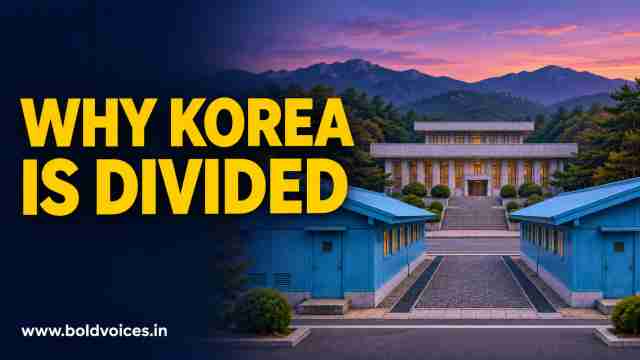
Panmunjom is associated with the armistice talks and the Joint Security Area, where representatives from the two sides have met. The familiar blue meeting buildings are one small part of the border region. Separate disputes over maritime boundaries illustrate another limit of the agreement. The line and buffer zone that it established on land did not resolve every question at sea.
| Term | What it means |
|---|---|
| 38th parallel | The latitude line used to divide the Soviet and American occupation zones in 1945. |
| Military Demarcation Line | The line established under the 1953 armistice. It generally follows the front as it stood at the end of the fighting. |
| DMZ | The buffer zone on both sides of the Military Demarcation Line. |
| Panmunjom | The area associated with armistice talks and the Joint Security Area. |
Why did the two countries develop so differently?
After the war, both governments had to rebuild. North Korea pursued a centrally planned system and received assistance from the Soviet Union, China and other communist countries. Political power became concentrated around Kim Il Sung, and leadership later passed to his son Kim Jong Il and then to his grandson Kim Jong Un.
South Korea also received outside assistance, particularly from the United States. Successive governments encouraged export-oriented industrialisation, helping transform the country into a major producer of ships, cars and electronics. For much of this period, South Korea was governed by authoritarian leaders. Mass mobilisation and political reforms in 1987 opened the way to direct presidential elections and a more competitive democratic system.
These differences affected far more than national income. They produced distinct laws, education systems, political institutions and approaches to relations with the outside world. Families separated during the war lived under different governments for generations. Reunions, when arranged, gave some people a chance to meet relatives they had been unable to see for decades.
Can two countries join the UN while the division remains unresolved?
Yes. In September 1991, the UN General Assembly admitted North Korea and South Korea as separate members. They have their own governments and participate in international organisations in their own names.
UN membership did not settle how the two governments regarded one another or what the future of the peninsula should be. South Korea’s constitution defines its territory as the Korean Peninsula and adjacent islands and provides for pursuing peaceful unification. In 2024, North Korean state media described South Korea as a hostile state under the North’s constitution, reflecting a shift away from its previous language about eventual reunification.
Those positions matter when assessing diplomatic statements. A practical agreement on communication, family visits or reducing military tensions can be reached without a shared view about sovereignty or reunification.
Why has reunification been so difficult?
The first question is who would govern and under what political system. A shared historical identity can create support for closer relations. It cannot by itself determine what institutions a common state would have, what rights it would protect or how political power would be transferred.
The second question is security. The US–South Korea alliance and North Korea’s nuclear weapons programme shape how each government assesses risk. China, Japan, Russia and the United States also have interests in what happens on the peninsula. An agreement about how Koreans govern themselves would interact with decisions about alliances, foreign forces and weapons.
The third question is how people would live under a new arrangement. The two economies operate under different rules. A reunification plan would have to address property, pensions, public services, movement across the peninsula and representation for people on both sides. Those are practical decisions that can affect public support even when there is agreement on the desirability of peace.
Past diplomacy shows that progress can happen in steps. The two Koreas held a landmark summit in 2000 and have at times arranged family reunions. Talks and exchanges have also broken down during periods of tension. Measures that reduce the risk of conflict can have immediate value even when a comprehensive settlement remains distant.
A short timeline of Korea’s division
| Year | What happened |
|---|---|
| 1910 | Japan annexed Korea. |
| 1945 | Japanese rule ended. Soviet and American occupation zones were established north and south of the 38th parallel. |
| 1948 | Separate governments formed in Seoul and Pyongyang. |
| 1950 | North Korea invaded South Korea. UN Command forces intervened in support of the South, and China entered the war on the North’s side. |
| 1953 | An armistice suspended fighting and established the Military Demarcation Line and DMZ. |
| 1991 | North Korea and South Korea joined the United Nations separately. |
| 2000 | The leaders of North and South Korea held the first inter-Korean summit. |
Frequently asked questions
Did the Korean War create North Korea and South Korea?
The two governments had already formed in 1948. The war began in 1950 and entrenched their separation. It also produced the military line and buffer zone used after 1953.
Did South Korea sign the 1953 armistice?
South Korea did not sign in its own name. The military signatories represented the UN Command, the Korean People’s Army and the Chinese People’s Volunteers.
Are the two Koreas still at war?
The armistice stopped large-scale fighting in 1953. A comprehensive peace treaty has never replaced it. That is why news reports sometimes say the war never formally ended.
Why does the division matter outside Korea?
The peninsula sits near China, Japan and Russia, and the United States is allied with South Korea. Border tensions or changes in North Korea’s nuclear policy can affect the security decisions of several countries at once.
#NorthKorea #SouthKorea #KoreanWar #KoreanPeninsula #Geopolitics #InternationalRelations


