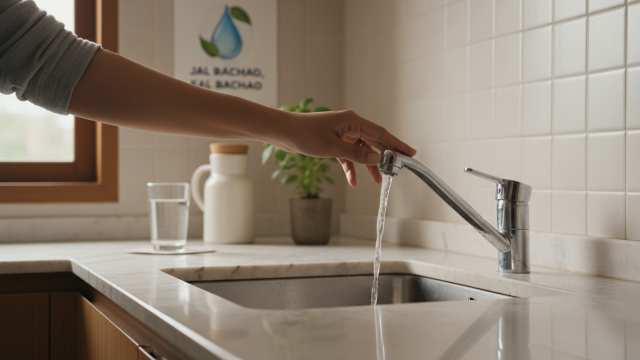
Water security is often discussed through dams, rivers and large infrastructure, but household behaviour matters too. A dripping tap, an overflowing tank or a running shower can waste treated water quietly. India’s Jal Shakti Abhiyan and the Catch the Rain campaign emphasise conservation, community participation and capturing rain where it falls. At home, the most effective plan combines fixing losses, using water thoughtfully and supporting recharge.
Start with a quick home water audit
For one week, note where water is used: bathing, toilets, kitchen, laundry, cleaning, gardening and vehicle washing. Check taps, pipes, flush tanks and overhead tanks for leaks or overflow. A simple meter reading before and after a period when no water is used can help reveal hidden leakage, if your supply has an individual meter. Repair faults promptly; a small leak repeated every day becomes a large waste over time.
Bathroom habits that make a difference
Turn off the tap while brushing or shaving. Prefer a bucket when it uses less water than a long shower. Install efficient showerheads or tap aerators where compatible with your plumbing. Check toilet flush mechanisms for continuous flow. Do not flush tissues, wrappers or other waste, as they can create blockages and unnecessary flushing.
Smarter kitchen and laundry routines
Wash vegetables in a bowl rather than under a continuously running tap, then use that clean rinse water for suitable plants. Run washing machines with full loads when practical and select water-efficient settings. Scrape plates before washing instead of using running water to remove every food particle. Never reuse water that contains harsh chemicals, grease or unsafe contaminants on edible plants.
Reuse carefully and safely
Some lightly used water can serve a second purpose: water from rinsing vegetables may be suitable for ornamental plants, and air-conditioner condensate may be used for cleaning if collected hygienically. This is not drinking water. Keep greywater separate from potable supplies and follow local plumbing and public-health guidance. Do not store untreated water for long periods, where mosquitoes or microbes can multiply.
Make rainwater harvesting part of the plan
A roof, courtyard or paved area may help collect rainwater. A basic system can include a clean catchment surface, gutters, a first-flush arrangement, a filter and a storage tank or recharge structure. Design depends on rainfall, roof area, soil conditions and local rules. Clean the roof and gutters before the monsoon, keep tanks covered and arrange periodic maintenance. Recharge pits and wells should be designed by qualified people; poorly designed systems can contaminate groundwater.
Build a family water routine
Assign simple responsibilities: one person checks leaks, another monitors tank overflow, and everyone follows tap and shower habits. In apartments, raise common-area leaks with the maintenance team. In neighbourhoods, support restoration of ponds, recharge structures and responsible rainwater systems. Collective action can achieve what individual households cannot.
Measure progress, not perfection
Compare water bills or meter readings month to month, allowing for occupancy and seasonal changes. Set a realistic goal, such as reducing avoidable use or repairing every leak within a week. Water conservation is not about making daily life difficult; it is about preventing waste and protecting a shared resource.
Like what you read? Help BoldVoices.in keep independent journalism going.
Manage Consent
To provide the best experiences, we use technologies like cookies to store and/or access device information. Consenting to these technologies will allow us to process data such as browsing behavior or unique IDs on this site. Not consenting or withdrawing consent, may adversely affect certain features and functions.
Functional
Always active
The technical storage or access is strictly necessary for the legitimate purpose of enabling the use of a specific service explicitly requested by the subscriber or user, or for the sole purpose of carrying out the transmission of a communication over an electronic communications network.
Preferences
The technical storage or access is necessary for the legitimate purpose of storing preferences that are not requested by the subscriber or user.
Statistics
The technical storage or access that is used exclusively for statistical purposes.The technical storage or access that is used exclusively for anonymous statistical purposes. Without a subpoena, voluntary compliance on the part of your Internet Service Provider, or additional records from a third party, information stored or retrieved for this purpose alone cannot usually be used to identify you.
Marketing
The technical storage or access is required to create user profiles to send advertising, or to track the user on a website or across several websites for similar marketing purposes.