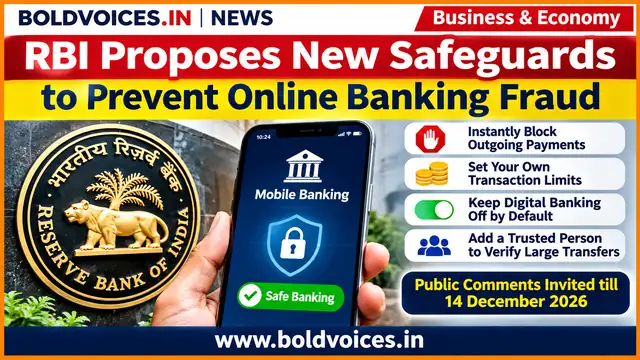
The Reserve Bank of India has proposed new safeguards to give customers greater control over digital banking and reduce losses from online fraud. Public comments on the draft are invited until 14 December 2026. The measures are proposals, not final rules.
Emergency stop switch
Customers could immediately block new outgoing digital payments when they suspect fraud, without waiting for a bank representative. Incoming payments and certain existing mandates may remain unaffected under the draft.
Customers could choose limits suited to their needs, including transaction, beneficiary and channel limits. For example, someone who spends ₹5,000 daily could set a lower limit to reduce exposure. Time-based restrictions could provide additional protection.
Switch off unused digital banking services
Keeping unused payment channels disabled until needed could reduce exposure to unauthorized transactions, particularly for customers who rarely use online banking.
AI-generated illustration: Digital banking security controls
Trusted person verification
A customer-selected trusted person could provide an additional check for large transfers above a chosen threshold. For example, a customer could choose ₹50,000 as a threshold and request verification for a ₹75,000 transfer. These amounts are illustrative, not RBI-mandated limits.
AI-generated illustration: Trusted person reviewing a digital payment
Bank accountability and customer protection
Effective implementation of customer-selected safeguards and authentication will be important. The proposals could help reduce fraud involving impersonation, digital arrest scams and fake investments, but cannot eliminate every risk.
What customers should do now
Never share OTPs, UPI PINs or passwords. Avoid installing screen-sharing apps at a stranger’s request. Enable transaction alerts and use existing bank limits. Report suspected financial cyber fraud promptly to 1930 and your bank.
Public consultation
The deadline for comments is 14 December 2026. Customers can consult the RBI’s draft directions through its official website and public consultation facility. Final requirements and implementation dates will depend on the regulatory process.
The bottom line
Greater customer control could complement existing fraud detection and authentication. Accessibility, reliable implementation and customer awareness will determine how effective these measures are.
Like what you read? Help BoldVoices.in keep independent journalism going.
Manage Consent
To provide the best experiences, we use technologies like cookies to store and/or access device information. Consenting to these technologies will allow us to process data such as browsing behavior or unique IDs on this site. Not consenting or withdrawing consent, may adversely affect certain features and functions.
Functional
Always active
The technical storage or access is strictly necessary for the legitimate purpose of enabling the use of a specific service explicitly requested by the subscriber or user, or for the sole purpose of carrying out the transmission of a communication over an electronic communications network.
Preferences
The technical storage or access is necessary for the legitimate purpose of storing preferences that are not requested by the subscriber or user.
Statistics
The technical storage or access that is used exclusively for statistical purposes.The technical storage or access that is used exclusively for anonymous statistical purposes. Without a subpoena, voluntary compliance on the part of your Internet Service Provider, or additional records from a third party, information stored or retrieved for this purpose alone cannot usually be used to identify you.
Marketing
The technical storage or access is required to create user profiles to send advertising, or to track the user on a website or across several websites for similar marketing purposes.