7 November 2026 | Curated by Gurdeep Singh, Amritsar, Punjab
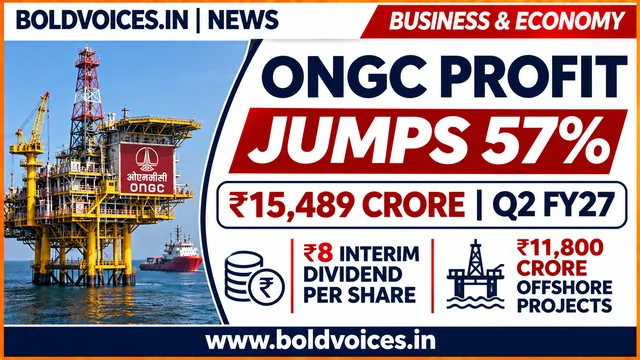
State-owned Oil and Natural Gas Corporation (ONGC) reported a sharp increase in standalone profit for the July–September quarter of FY2026–27, supported by stronger oil and gas realisations. The company’s standalone net profit rose 57.3% year on year to ₹15,489 crore, while standalone gross revenue increased 32.8% to ₹43,875 crore.
The consolidated picture was also stronger: ONGC reported net profit of approximately ₹18,535 crore, up 46.9%, on consolidated gross revenue of ₹1,98,263 crore, an increase of 25.6%. Alongside the results, the board declared an interim dividend of ₹8 per equity share and approved major offshore development projects worth ₹11,800 crore.
Standalone profit rises, but production remains a key watchpoint
ONGC’s standalone net profit increased from ₹9,848 crore in the corresponding quarter last year to ₹15,489 crore in Q2 FY27. Gross revenue rose from ₹33,030 crore to ₹43,875 crore over the same period.
Higher crude oil realisations played an important role. ONGC’s nominated crude oil realisation increased to about US$92.33 per barrel in Q2 FY27, compared with US$67.34 a year earlier. The company also reported higher gas prices, including a rise in the price for new-well gas.
However, the increase in earnings did not come from a comparable rise in production. Standalone crude oil output was 4.437 million metric tonnes during the quarter, against 4.630 million tonnes a year earlier. Natural gas production was 4.839 billion cubic metres, compared with 4.918 billion cubic metres.
ONGC said the year-on-year moderation in quarterly production was mainly linked to reservoir behaviour complexities in the KG-DWN-98/2 asset in the eastern offshore basin, monsoon-related operational challenges and delays associated with the PRP-8 and PRP-9 pipeline replacement projects. Lower customer offtake also affected gas production from some onshore fields.
Consolidated earnings reflect the wider group
At the consolidated level, ONGC reported gross revenue of ₹1,98,263 crore, up 25.6% year on year, and net profit of ₹18,535 crore, up 46.9%. These figures include the wider group’s businesses and should not be confused with the standalone results of the parent company.
The distinction matters for investors because ONGC’s group performance includes subsidiaries and associated businesses operating across exploration, overseas energy assets and refining-related activities. The consolidated result therefore offers a broader view of the group, while standalone figures show the performance of the parent company’s own operations.
₹8 interim dividend: record date is 12 November
The board approved an interim dividend of ₹8 per equity share with a face value of ₹5. This is equivalent to a 160% dividend on the face value. ONGC said the total payout would be approximately ₹10,064 crore, its highest-ever dividend paid in a single instalment.
The company fixed 12 November 2026 as the record date for determining shareholder eligibility. Investors should check the applicable exchange and depository timelines rather than relying only on the announcement date when assessing eligibility.
₹11,800 crore offshore projects aim to support future output
ONGC also announced that two major development projects worth around ₹11,800 crore had been awarded in the Western Offshore region. The projects are intended to unlock future production and strengthen the company’s development pipeline.
Offshore projects typically require substantial investment, engineering work and coordination across platforms, pipelines and production systems. Their contribution to output depends on execution schedules, reservoir performance, equipment availability and the time required to bring facilities into operation. The announced project value should therefore be viewed as planned development investment, not as production already delivered.
The company also notified two new hydrocarbon discoveries during Q2. Discoveries can add to exploration potential, but their commercial value depends on appraisal, recoverable reserves, development economics and regulatory approvals.
What the results mean for ONGC and the energy sector
The quarter shows how sensitive an upstream energy company’s earnings can be to commodity prices. Higher crude realisations supported ONGC’s profit growth even as oil and gas production was lower than a year earlier. That makes the durability of earnings dependent on both market prices and the company’s ability to stabilise and expand output.
For India, reliable domestic oil and gas production remains strategically important because it can reduce some exposure to imported energy. Yet new offshore capacity takes time and capital to develop. Production improvements will depend on resolving field-level challenges, completing infrastructure work and bringing new projects online efficiently.
Key risks investors should monitor
Crude oil prices: A decline in international prices or lower realised prices could reduce upstream earnings.
Production trends: Investors will watch whether oil and gas output stabilises and whether KG-DWN-98/2 operational issues are addressed.
Project execution: Timely delivery of Western Offshore development work will be important for future production.
Capital allocation: Dividend payments, investment requirements and funding support for group companies need to be assessed together.
Gas demand: Customer offtake and the pace of industrial demand can influence the utilisation of domestic gas production.
The bigger picture
ONGC’s Q2 FY27 results are strong on the headline numbers: standalone profit rose 57.3%, consolidated profit increased 46.9% and shareholders were offered an interim dividend of ₹8 per share. But the underlying story is more nuanced. Higher oil realisations supported earnings while production remained below the year-ago level.
The next phase for ONGC will depend on converting offshore investment and new discoveries into dependable production, while managing the effect of changing global energy prices. For investors, the dividend is an immediate corporate action; the longer-term test is whether production and project execution can sustain operating performance across different commodity-price conditions.
Like what you read? Help BoldVoices.in keep independent journalism going.
Manage Consent
To provide the best experiences, we use technologies like cookies to store and/or access device information. Consenting to these technologies will allow us to process data such as browsing behavior or unique IDs on this site. Not consenting or withdrawing consent, may adversely affect certain features and functions.
Functional
Always active
The technical storage or access is strictly necessary for the legitimate purpose of enabling the use of a specific service explicitly requested by the subscriber or user, or for the sole purpose of carrying out the transmission of a communication over an electronic communications network.
Preferences
The technical storage or access is necessary for the legitimate purpose of storing preferences that are not requested by the subscriber or user.
Statistics
The technical storage or access that is used exclusively for statistical purposes.The technical storage or access that is used exclusively for anonymous statistical purposes. Without a subpoena, voluntary compliance on the part of your Internet Service Provider, or additional records from a third party, information stored or retrieved for this purpose alone cannot usually be used to identify you.
Marketing
The technical storage or access is required to create user profiles to send advertising, or to track the user on a website or across several websites for similar marketing purposes.