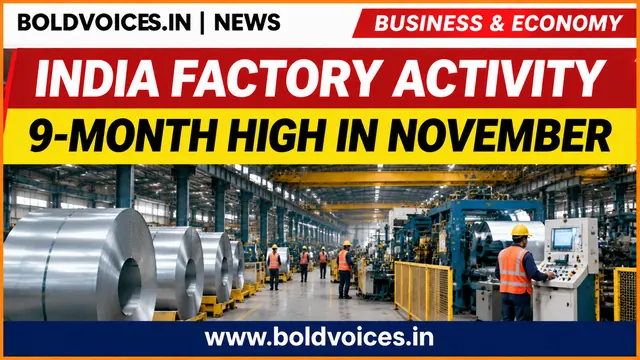
India’s manufacturing sector gathered fresh momentum in November 2026, with factory activity reaching its strongest level in nine months. The HSBC Flash India Manufacturing Purchasing Managers’ Index (PMI) rose to 56.0 from 54.7 in October, while the wider private sector continued to expand, according to the survey compiled by S&P Global.
The improvement was led by stronger factory output and new orders. However, the latest numbers also show that growth is not uniform across the economy: services activity moderated, even as it remained firmly in expansion territory. The figures are preliminary, or flash, survey readings rather than official measures of GDP or industrial production.
November PMI at a glance
Indicator
October 2026
November 2026
Composite PMI Output Index
56.2
56.3
Manufacturing PMI
54.7
56.0
Manufacturing Output Index
57.0
58.3
Services Business Activity Index
55.8
55.3
A PMI reading above 50 indicates that activity is expanding compared with the previous month; a reading below 50 indicates contraction. The composite output index edged up to 56.3 from 56.2, its highest level since June, showing that private-sector activity improved slightly rather than accelerating sharply across every sector.
Manufacturing leads the improvement
The manufacturing PMI climbed to 56.0, a nine-month high. The manufacturing output index increased to 58.3 from 57.0, pointing to faster growth in factory production. Survey respondents reported stronger domestic demand and an acceleration in new orders.
The improvement was broad enough to be visible across several industries, including pharmaceuticals and healthcare, chemicals, electronic components, metals, power-transmission equipment and infrastructure-related businesses. These sectors supply both consumer markets and the investment cycle, so stronger orders can support production, procurement and logistics activity.
Services continue to grow, but at a slower pace
The services business activity index eased to 55.3 in November from 55.8 in October. This does not indicate contraction: the reading remains above 50. It does, however, show that the pace of expansion moderated.
Services firms continued to report demand and new business, while international demand for Indian services strengthened. The contrast is important because services remain a major part of India’s economic output and employment. A strong manufacturing reading alone cannot describe the performance of the entire economy.
New orders and exports provide support
Across the private sector, total new business expanded at its fastest pace since June. New export orders for Indian goods and services increased at the strongest pace in four months. The export picture was not identical across sectors: manufacturers continued to record stronger foreign-sales growth than service providers, but the pace of manufacturing export-order growth moderated slightly. Services exporters, meanwhile, reported a sharper improvement in international business.
For Indian businesses, this combination points to the importance of both domestic demand and overseas customers. Exporters will still need to manage currency movements, global competition, shipping costs and changing demand in major markets.
Employment trends are mixed
Manufacturing companies increased hiring at the fastest pace in seven months. Services firms, in contrast, marginally reduced their workforce for the first time in nearly a year. Overall private-sector employment rose only slightly.
This divergence deserves attention. If stronger factory orders are sustained, manufacturers may need additional workers and suppliers. But the softer services employment picture shows why headline business activity should not be mistaken for equally strong job creation across all industries.
Survey respondents reported only mild increases in operating expenses and input costs during November. At the same time, companies raised selling prices at a faster pace than in October, although the rate of increase remained modest by historical standards.
For businesses, relatively contained input-cost pressure can help protect margins. The position can change quickly, however, if energy, metals, freight, wages or imported components become more expensive. The PMI survey is an early indicator of price trends, not a substitute for official inflation data.
Business confidence improves, but caution remains
Companies became more optimistic about activity over the coming 12 months. Business confidence reached its highest level since May 2026, although it remained below its long-run average. The improvement suggests that firms see opportunities ahead, but it does not remove uncertainty around demand, financing costs and global conditions.
What the PMI reading means for India’s economy
The November survey is encouraging for manufacturing, especially because output, orders and factory hiring strengthened together. It also suggests that domestic demand is supporting industrial activity and that international business remains an important source of orders.
There are limits to what can be concluded. PMI is a survey-based, seasonally adjusted indicator of month-to-month direction. The flash estimate is based on an early share of responses and may differ from the final reading. It does not measure the exact percentage growth of production, GDP or employment.
What businesses and policymakers should watch next
Final November PMI: The full survey will show whether the flash manufacturing and services readings are confirmed.
Industrial production: Official factory output data will help establish whether the survey improvement is translating into measured production.
Employment: The gap between manufacturing hiring and services job trends needs monitoring.
Exports: Businesses will watch whether stronger overall export orders continue into December.
Inflation and interest rates: Input costs, selling prices and the RBI’s policy decision will influence business borrowing and investment plans.
The bigger picture: India’s manufacturing sector entered November on a stronger footing, helping keep private-sector activity in expansion. The next test is whether this factory momentum can continue, support wider job creation and spread into other parts of the economy. The softer services reading is a reminder that sustainable growth needs strength across sectors, not just a single encouraging factory survey.
Disclaimer: PMI figures are survey-based indicators and may be revised in the final release. They should not be treated as official GDP or industrial production figures. This article is for general information only and does not constitute investment advice or a recommendation to buy or sell any security.
Like what you read? Help BoldVoices.in keep independent journalism going.
Manage Consent
To provide the best experiences, we use technologies like cookies to store and/or access device information. Consenting to these technologies will allow us to process data such as browsing behavior or unique IDs on this site. Not consenting or withdrawing consent, may adversely affect certain features and functions.
Functional
Always active
The technical storage or access is strictly necessary for the legitimate purpose of enabling the use of a specific service explicitly requested by the subscriber or user, or for the sole purpose of carrying out the transmission of a communication over an electronic communications network.
Preferences
The technical storage or access is necessary for the legitimate purpose of storing preferences that are not requested by the subscriber or user.
Statistics
The technical storage or access that is used exclusively for statistical purposes.The technical storage or access that is used exclusively for anonymous statistical purposes. Without a subpoena, voluntary compliance on the part of your Internet Service Provider, or additional records from a third party, information stored or retrieved for this purpose alone cannot usually be used to identify you.
Marketing
The technical storage or access is required to create user profiles to send advertising, or to track the user on a website or across several websites for similar marketing purposes.