November 9, 2026 | Curated by the Business Desk of BoldVoices
Latest verified update — November 9, 2026
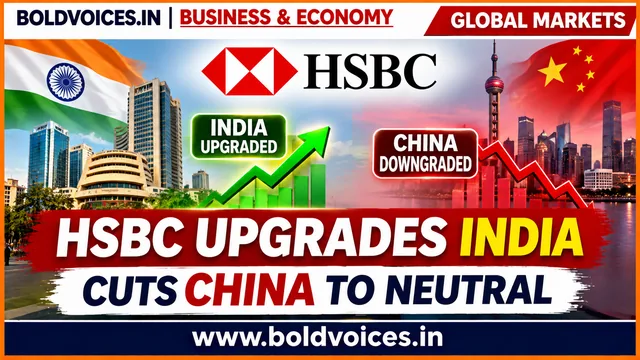
Based on the latest equity-strategy reports from Moneycontrol, The Economic Times, Investing.com, Fortune India and The Times of India, HSBC has upgraded Indian equities from Neutral to Overweight and downgraded mainland Chinese equities from Overweight to Neutral. This is an equity-allocation view, not a change in any country’s sovereign credit rating and not personal investment advice.
For India, HSBC cited improved valuations, resilient corporate earnings, stronger credit growth and supportive policy measures, and it expressed a preference for sectors such as financials, automobiles, industrials and consumer discretionary.
For China, HSBC pointed to weak consumer confidence, ongoing property-market stress and limited catalysts for a sustained re-rating of equities. It also noted that only about 22% of global emerging-market funds were overweight India at the time of its assessment, and highlighted higher energy prices and inflation as key risks to the outlook.
India has received an encouraging signal from one of the world’s leading financial institutions. HSBC has upgraded its investment recommendation on Indian equities from Neutral to Overweight, while simultaneously reducing its recommendation on mainland Chinese equities from Overweight to Neutral.
The decision, announced on November 9, 2026, reflects changing investment priorities across Asian markets. HSBC believes India’s improving corporate earnings, stronger credit growth and more reasonable stock valuations have created better investment opportunities.
For India, the announcement comes after an extended period of stock-market correction and relatively weaker performance compared with several emerging markets.
The development could also attract renewed attention from international investors who are reassessing where to allocate their money across Asia.
But what exactly does this upgrade mean, and why has HSBC become more positive about India while taking a more cautious position on China?
1. What exactly has HSBC changed?
In its latest Asia-Pacific equity strategy assessment, HSBC made two important changes:
Market
Previous recommendation
New recommendation
India
Neutral
Overweight
Mainland China
Overweight
Neutral
In investment terminology, an Overweight recommendation means that investors may consider allocating a larger proportion of their portfolio to that market compared with its representation in a benchmark index.
Neutral generally indicates maintaining an allocation closer to the benchmark.
This is an investment recommendation, not a change in India’s or China’s sovereign credit rating.
The decision indicates that HSBC currently sees relatively more attractive equity investment opportunities in India than in mainland China.
2. Why is HSBC becoming more positive about India?
HSBC has identified several developments supporting its improved outlook.
A. Indian stock valuations have become more reasonable
Indian equities had experienced a prolonged period of underperformance and valuation correction.
During previous years, Indian stocks often traded at relatively high valuations compared with other emerging markets.
That premium became harder to justify as investors became concerned about expensive shares, earnings growth and global uncertainty.
However, the subsequent correction has made several segments of the market more reasonably valued.
HSBC believes this valuation reset has improved India’s investment appeal, particularly among large-cap companies.
The bank also highlighted that only around 22% of global emerging-market funds were overweight on India, suggesting potential room for additional international investment.
B. Strong credit growth is supporting economic activity
Another important factor is the expansion of bank lending.
According to HSBC’s assessment, India’s system-wide credit growth reached approximately 21% year-on-year in October 2026.
Corporate lending reportedly increased around 24%, while lending to micro, small and medium enterprises grew approximately 25%.
These developments suggest that businesses are continuing to seek financing for expansion, investment and working-capital requirements.
Credit growth is important because it supports economic activity across several sectors.
When businesses borrow to expand production, purchase machinery or establish new facilities, it can generate additional demand, investment and employment.
HSBC has also raised its estimate for India’s FY27 loan growth to approximately 18%, compared with its earlier estimate of 14%.
C. Corporate earnings are showing resilience
Stock markets ultimately depend on the ability of companies to generate sustainable profits.
HSBC believes Indian corporate earnings have remained relatively resilient despite challenges such as higher interest rates, elevated energy costs and global economic uncertainty.
The pace of earnings downgrades has also become more moderate.
This is important because investors are generally more comfortable paying reasonable valuations for companies when their future earnings outlook is improving.
D. India offers diversification beyond the AI investment boom
Artificial intelligence has attracted enormous investment across global financial markets.
However, the concentration of capital in a relatively small group of technology companies has also created concerns about market concentration and valuations.
HSBC believes India offers international investors exposure to a broader set of economic activities, including banking, manufacturing, infrastructure, consumption and healthcare.
This diversification could make Indian equities attractive to investors looking beyond technology-heavy markets.
3. Which Indian sectors does HSBC prefer?
HSBC has identified several sectors where it sees comparatively attractive opportunities.
Banking and Financial Services
Banks are among HSBC’s preferred areas because of improving credit growth and the outlook for lending activity.
A growing economy generally requires more financing for businesses, housing, infrastructure and consumer spending.
Industrial and Capital Goods
HSBC sees opportunities in capital goods, cement, ports and electronic manufacturing services.
These industries are connected to India’s infrastructure development, industrial investment and manufacturing expansion.
Automobiles and Retail
Within the consumption sector, HSBC prefers consumer discretionary businesses over consumer staples.
Retailers and automobile companies are among its preferred segments.
This reflects expectations of continued demand for discretionary products and services.
Insurance and Hospitals
HSBC also maintains a positive view of insurance companies and hospitals.
Healthcare demand, insurance penetration and changing consumer preferences could support growth in these businesses.
These are sector-level investment preferences, not guarantees of returns or recommendations to purchase individual shares.
4. Why has HSBC downgraded China?
While HSBC has become more positive about India, its assessment of mainland China has become more cautious.
The bank reduced its recommendation from Overweight to Neutral.
Importantly, this does not mean HSBC believes the Chinese economy has no growth opportunities. Its assessment focuses on the outlook for Chinese equities and the catalysts needed to support a sustained improvement in market valuations.
HSBC has identified several concerns.
A. Weak consumer confidence
Consumer confidence remains an important challenge for China.
When households become cautious about their financial future, they may reduce discretionary spending and increase savings.
This can affect retail businesses, consumer companies and the broader domestic economy.
B. Continued pressure in the property market
China’s property sector has experienced prolonged difficulties.
Property development, construction and related industries have historically played a significant role in the country’s economic activity.
Continuing weakness in this sector can affect household confidence, investment and demand for construction-related products.
C. Softer domestic investment
HSBC also highlighted weaker domestic investment as a concern.
Lower investment can reduce demand for machinery, construction materials and industrial products.
It can also affect the pace of economic expansion.
D. Weaker investor appetite
The bank pointed to subdued southbound investment flows and declining margin financing as signs of weaker investor interest.
These indicators suggest that investors are becoming more selective about their exposure to Chinese equities.
Despite these concerns, HSBC continues to identify opportunities in selected Chinese sectors, including banks, biotechnology and technology hardware businesses linked to artificial intelligence.
5. Could HSBC’s decision bring more foreign money into India?
This is one of the most important implications of the announcement.
International investment funds regularly review their allocations across countries and regions.
When a large financial institution becomes more positive about a particular market, its assessment can influence discussions among institutional investors.
India may benefit if global emerging-market funds increase their allocations to Indian shares.
However, an upgrade does not automatically mean that billions of dollars will enter the country immediately.
Actual investment decisions depend on several factors:
Global interest-rate movements.
Corporate earnings.
Stock-market valuations.
Currency stability.
Geopolitical developments.
Competing investment opportunities.
The fact that only around 22% of global emerging-market funds were overweight on India, according to HSBC, suggests that there may be room for additional investment allocations.
6. What does this mean for the Indian economy?
The significance of HSBC’s decision extends beyond the stock market.
India needs international capital to support infrastructure, manufacturing, technology, healthcare and other productive sectors.
Greater foreign investment can improve market liquidity and support capital formation.
It can also strengthen confidence in India’s long-term economic prospects.
However, foreign portfolio investment should not be confused with long-term industrial investment.
Money entering the stock market can move out relatively quickly when global financial conditions change.
For sustainable economic development, India also needs continued domestic investment, higher productivity, stronger exports and employment generation.
7. HSBC has also highlighted risks for India
Despite upgrading Indian equities, HSBC has not ignored the challenges facing the economy.
The bank has identified elevated crude oil prices and the possibility of an El Niño weather pattern as important risks.
Higher oil prices could increase India’s import expenditure, put pressure on the rupee and raise transportation and manufacturing costs.
This could affect inflation and consumer demand.
The risk is particularly important for rural households, where higher food and fuel expenses can reduce money available for discretionary spending.
A prolonged period of expensive energy could also affect corporate profit margins.
Therefore, HSBC’s positive investment outlook is based on India’s relative opportunities, not an assumption that the economy is free from risks.
8. India and China: Two different investment stories
India and China remain two of Asia’s most important economies, but their equity markets currently present different challenges and opportunities.
India’s investment case is being supported by domestic consumption, credit expansion, infrastructure development and improving corporate earnings.
China continues to offer opportunities in selected industries, particularly technology hardware, biotechnology and banking, but weak consumer confidence and property-market difficulties remain concerns.
HSBC’s decision represents a change in relative investment preference rather than a declaration that one country’s economy has overtaken the other.
Both countries will continue to play significant roles in global trade, manufacturing and financial markets.
Conclusion: A positive signal for Indian markets, but execution matters
HSBC’s decision to upgrade Indian equities to Overweight is an encouraging development for the country’s financial markets.
The bank has highlighted improving valuations, stronger credit growth, resilient corporate earnings and opportunities across several domestic industries.
At the same time, its decision to downgrade Chinese equities to Neutral reflects concerns about consumer confidence, property-market weakness and limited catalysts for a sustained market re-rating.
For India, the opportunity is significant, but long-term success will depend on whether the economy can convert investor confidence into stronger industrial investment, employment, exports and sustainable corporate growth.
The message from global financial markets is becoming clearer: India is attracting renewed attention as investors reassess opportunities across Asia. The challenge now is to turn that confidence into lasting economic progress.
Like what you read? Help BoldVoices.in keep independent journalism going.
Manage Consent
To provide the best experiences, we use technologies like cookies to store and/or access device information. Consenting to these technologies will allow us to process data such as browsing behavior or unique IDs on this site. Not consenting or withdrawing consent, may adversely affect certain features and functions.
Functional
Always active
The technical storage or access is strictly necessary for the legitimate purpose of enabling the use of a specific service explicitly requested by the subscriber or user, or for the sole purpose of carrying out the transmission of a communication over an electronic communications network.
Preferences
The technical storage or access is necessary for the legitimate purpose of storing preferences that are not requested by the subscriber or user.
Statistics
The technical storage or access that is used exclusively for statistical purposes.The technical storage or access that is used exclusively for anonymous statistical purposes. Without a subpoena, voluntary compliance on the part of your Internet Service Provider, or additional records from a third party, information stored or retrieved for this purpose alone cannot usually be used to identify you.
Marketing
The technical storage or access is required to create user profiles to send advertising, or to track the user on a website or across several websites for similar marketing purposes.