
Curated by the Financial Desk of Boldvoices
India has spent years negotiating trade agreements to open international markets for its manufacturers, exporters and service providers. Yet a significant gap remains between securing preferential access and actually using it.
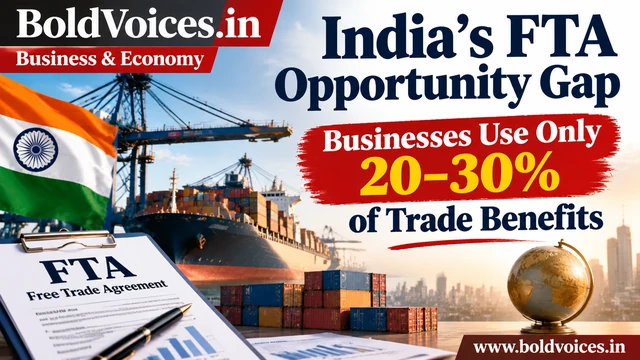
Reserve Bank of India Governor Sanjay Malhotra said on November 27, 2026, that Indian businesses use only around 20–30% of the benefits available through free trade agreements (FTAs), according to reporting from the event in Mumbai. The observation points to a practical challenge for India’s export ambitions: a trade agreement creates an opportunity, but businesses must be able to navigate its rules and claim the benefit.
What does FTA utilisation mean?
A Free Trade Agreement is a pact between countries to reduce or remove customs duties on eligible products and improve access to each other’s markets. When an Indian exporter ships a qualifying product to an FTA partner, it may be able to claim a lower tariff than a competitor shipping from a country without the same preference.
But the lower duty is not automatic. The exporter and importer must follow the agreement’s conditions, including product-specific rules of origin and documentation requirements. The utilisation rate describes how much of the available preferential treatment is actually claimed.
Why businesses may leave benefits unused
- Limited awareness: Smaller exporters may not know which products qualify or which destination markets offer preferential tariffs.
- Rules of origin: Products must meet the agreement’s requirements on where they are made, the materials used and the value added in eligible countries.
- Documentation: Certificates of origin, product classifications and supporting records can add time and administrative cost.
- Compliance capacity: MSMEs may not have in-house customs specialists or dedicated export teams to interpret multiple agreements.
- Commercial calculations: For some shipments, the cost and effort of claiming a preference may outweigh the tariff saving.

Why this matters for India’s economy
Better use of existing FTAs could help Indian companies compete in overseas markets without waiting for new agreements to be negotiated. Potential beneficiaries include textile and garment makers, engineering and auto-component suppliers, pharmaceutical companies, food processors, electronics manufacturers, leather and footwear exporters, and other businesses that can meet the relevant product standards.
For MSMEs in particular, a modest tariff advantage can matter when competing on price. Higher exports can support factory utilisation, investment, jobs and foreign-exchange earnings, provided firms can meet buyers’ quality, delivery and regulatory expectations.
India’s trade environment is changing
India’s agreement with New Zealand entered into force on October 20, 2026, with the Commerce Ministry describing it as providing duty-free access for Indian exports across sectors, subject to the agreement’s terms. The government has also continued trade outreach: DGFT Chennai organised a workshop on leveraging FTAs to boost exports from Puducherry on November 19, while a state-level FTA outreach programme was held in Telangana on November 2.
These initiatives matter because exporters need practical, product-level guidance—not just announcements about signed agreements. Businesses must understand tariff schedules, rules of origin, standards, customs procedures and how to identify buyers in partner markets.
The international picture: more barriers, but trade is still growing
The World Trade Organization’s November 23, 2026 G20 monitoring update recorded 206 new restrictive and other non-facilitating trade measures in the first half of 2026, compared with 194 during all of 2025. The measures covered an estimated US$2 trillion of imports during the first six months of 2026.
At the same time, G20 economies introduced 282 trade-facilitating measures in that period. The WTO also revised its forecast for world merchandise trade volume growth in 2026 to 3.9%, up from its March baseline forecast of 1.9%, reflecting stronger-than-expected trade, particularly in AI-related goods.
The message for Indian exporters is clear: global trade remains an opportunity, but tariffs, regulations and geopolitical uncertainty make it more important to understand the precise terms of market access.
What should happen next?
- Make product-wise FTA tariff information easier for exporters to find and understand.
- Expand practical workshops and advisory support for MSMEs in manufacturing and export clusters.
- Simplify certificates of origin and documentation wherever agreement rules allow.
- Train banks, customs brokers and export promotion councils to help businesses identify eligible preferences.
- Track utilisation by agreement, product and company size so support reaches the sectors facing the biggest barriers.
The real test is business participation
India’s trade ambitions will not be measured only by the number of agreements signed. They will also depend on whether businesses—especially smaller exporters—can turn negotiated access into actual orders and sustained exports.
The RBI Governor’s observation is a reminder that market access on paper is only the first step. The bigger economic opportunity lies in helping Indian companies understand the rules, meet standards and use the trade preferences already available to them.
#IndiaTrade #FreeTradeAgreements #IndianExports #GlobalTrade #IndianEconomy #RBI #MSME #ExportGrowth #TradePolicy #BusinessAndEconomy #BoldVoices


