
7 November 2026 | Curated by Gurdeep Singh, Amritsar, Punjab
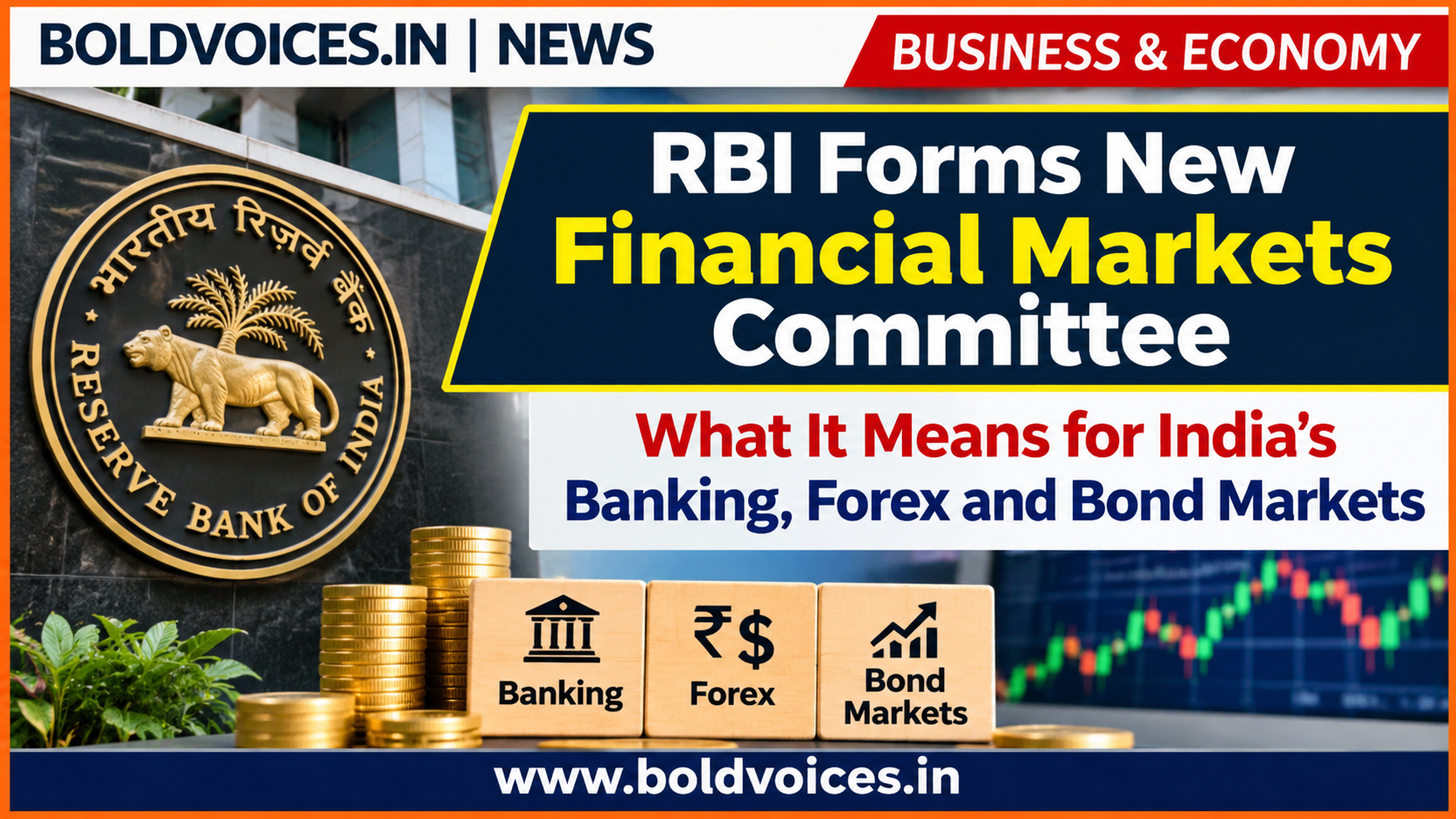
The Reserve Bank of India (RBI) has constituted a Technical Consultative Committee for Financial Markets (TCCFM), creating a formal channel for structured engagement with market participants on policy and operational issues affecting India’s money, government securities and foreign exchange markets. Announced on 4 November 2026, the committee will also cover related derivatives markets and the infrastructure that supports trading, clearing, settlement and reporting.
The move follows an announcement in RBI’s Statement on Developmental and Regulatory Policies dated 7 October 2026. It comes against a backdrop of rapidly evolving financial markets and infrastructure. The committee is intended to help the central bank hear market participants’ views on how markets function in practice, where operational frictions arise and what developments may create new risks.
What is the new RBI committee?
The Technical Consultative Committee for Financial Markets is a consultative forum chaired by the RBI Deputy Governor in charge of the Financial Markets Regulation Department (FMRD). It brings together senior representatives from banking, market infrastructure, financial services and market-policy backgrounds.
Its role is to discuss policy and operational matters with the Reserve Bank. The committee’s constitution does not, by itself, change any trading rule, interest rate, currency policy or regulatory requirement. Any formal regulatory action would still need to be taken through the relevant authority and process.
Who are the seven external members?
RBI has named seven external members, each bringing experience from a different part of the financial system:
- Ananth Narayan — Former Whole Time Member of SEBI and Professor of Practice at IIT Bombay.
- Shamsher Singh — Chairman of the Fixed Income Money Market and Derivatives Association of India (FIMMDA) and Deputy Managing Director of State Bank of India.
- Neeraj Gambhir — Executive Director, Axis Bank.
- Shailendra Jhingan — Head of Treasury and Economic Research, ICICI Bank.
- Aditya Bagree — Managing Director and Head (Markets), Citibank India.
- Nand Kishore — Managing Director, Clearing Corporation of India Limited.
- Ridham Desai — Managing Director, Morgan Stanley India.
The range of backgrounds matters. Banks participate in funding, lending and market-making; clearing institutions help manage counterparty and settlement processes; and market specialists bring experience of investor behaviour, pricing and risk. Their perspectives can help the RBI understand how policy and operational changes are experienced across the financial system.
Five areas covered by the committee’s mandate
1. Money market functioning and liquidity
Money markets allow banks and other eligible participants to manage short-term funding and liquidity. The committee will consider the functioning, efficiency, liquidity and resilience of these markets, along with measures that could deepen and broaden them.
Efficient money markets matter for monetary-policy transmission. When short-term funding markets function smoothly, changes in policy conditions can flow more effectively through financial institutions and into the wider economy. The committee’s discussions may help identify market frictions, although the RBI has not announced any specific liquidity measure through the committee’s formation.
2. Government securities and bond markets
Government securities are used by the Union and state governments to raise funds and are important holdings for banks, insurers, pension funds and other investors. Their yields also serve as reference points for pricing other forms of borrowing.
By examining market efficiency, liquidity and resilience, the committee can provide a forum to discuss how government securities markets operate and what may be needed to deepen participation. Better liquidity and price discovery can make it easier for market participants to transact, but the committee’s creation does not guarantee lower bond yields or cheaper borrowing costs.
3. Foreign exchange markets
Foreign exchange markets are essential to importers, exporters, banks and investors with international exposure. Currency movements can change the rupee cost of imported fuel, machinery and components, as well as the domestic value of export receipts and overseas investments.
The committee will examine issues concerning the functioning and resilience of foreign exchange markets. This could provide a channel to discuss market access, operational processes and the practical effects of policy implementation. It should not be interpreted as a promise that the rupee will become less volatile or that hedging will automatically become cheaper.
4. Derivatives markets and risk management
Derivatives linked to currencies, interest rates and other financial variables allow eligible participants to manage or transfer financial risks. They can be useful tools, but they also require sound risk controls, transparent reporting and reliable market infrastructure.
The committee’s remit includes the respective derivative markets. Discussions may consider how these markets function, how risks are identified and managed, and whether operational or regulatory arrangements create unintended frictions.
5. Trading, clearing, settlement and reporting infrastructure
A financial transaction involves more than agreeing on a price. Trading systems must record transactions, clearing arrangements must establish obligations, settlement processes must complete the exchange of funds or securities, and reporting systems must provide the required information.
RBI has specifically included these activities and their associated regulatory and operational frameworks in the committee’s terms of reference. The committee will also consider domestic and international developments, financial innovations and emerging risks that may affect Indian financial markets.
What could this mean for banks?
Banks are active participants in money, bond and foreign exchange markets. They manage liquidity, hold government securities, provide currency services and use derivatives for risk management. A structured consultation forum gives the RBI an opportunity to hear directly about operational challenges and the practical effects of its measures.
For example, a market-wide change may affect institutions differently depending on their funding models, customer mix, technology and trading activity. Feedback from a range of participants can help the regulator understand those differences. The committee is a forum for discussion, however, not a guarantee of preferential treatment or a relaxation of prudential requirements for any institution.
What could businesses and exporters watch?
Businesses with overseas suppliers or customers are exposed to exchange-rate movements. An importer paying a dollar invoice may face a higher rupee bill if the rupee weakens before payment. An exporter may see the rupee value of overseas receipts change as exchange rates move.
More efficient and resilient foreign exchange and derivatives markets can support the ability of eligible businesses to manage such exposure. The committee may provide a place to raise operational issues affecting these markets. But no immediate change to currency prices, hedging costs or access conditions follows simply from the committee being formed.
Why bond-market developments matter beyond investors
Government bond yields influence the wider interest-rate environment because they help shape the pricing of other debt instruments. Banks, insurers, pension funds and asset managers also use government securities for investment, liquidity and portfolio management.
Improvements in market depth, liquidity and price discovery could support more orderly transactions. Yet bond yields are influenced by many factors, including inflation expectations, government borrowing, monetary policy, global interest rates and investor demand. The committee’s establishment is not a forecast for the direction of yields or equity markets.
How often will the committee meet?
RBI has stated that meetings will be convened at least once every quarter. The announcement establishes this minimum meeting frequency but does not provide a date for the first meeting or publish a detailed meeting calendar.
What the announcement does not mean
It is important to separate the committee’s consultative role from formal regulatory action. The announcement does not itself:
- Change the RBI’s policy rates or monetary-policy stance.
- Announce a new rupee trading band or guarantee currency stability.
- Alter government bond yields or prescribe borrowing rates.
- Introduce a new derivatives rule or remove existing compliance requirements.
- Give the committee independent authority to issue binding regulations.
The RBI’s announcement sets out the committee’s composition, terms of reference and minimum meeting frequency. It does not specify whether recommendations will be binding, whether deliberations will be made public, or when the first meeting will take place. Those details should not be assumed until the Reserve Bank provides further information.
What should the financial sector watch next?
The practical significance of the TCCFM will become clearer through its work over time. Market participants will be watching whether discussions identify recurring operational bottlenecks, whether implementation concerns are addressed and whether market infrastructure becomes more resilient.
Other important questions include how the committee approaches emerging financial innovations, how international developments are assessed and whether its discussions lead to proposals that can be considered through the RBI’s established regulatory processes.
The bigger picture: A consultation channel for a changing financial system
India’s financial markets are becoming more interconnected with global capital flows, trade and technology. Their long-term strength depends not only on the size of the banking system but also on reliable infrastructure, sound risk management, transparent processes and effective regulation.
The new Technical Consultative Committee gives the RBI a regular forum to engage with people and institutions that work in these markets. Its value will ultimately depend on the quality of the issues raised, the usefulness of the discussions and whether practical improvements emerge through the appropriate policy and regulatory channels.
Frequently asked questions
What is the full name of the RBI’s new financial markets committee?
It is the Technical Consultative Committee for Financial Markets, abbreviated as TCCFM.
Who will chair the TCCFM?
It will be chaired by the RBI Deputy Governor in charge of the Financial Markets Regulation Department.
Who are the external members?
The seven external members are Ananth Narayan, Shamsher Singh, Neeraj Gambhir, Shailendra Jhingan, Aditya Bagree, Nand Kishore and Ridham Desai.
How often will the committee meet?
RBI says meetings will be convened at least once every quarter.
Does the committee immediately change financial-market rules?
No. Its formation creates a structured consultation forum. The announcement does not itself introduce a new market rule or change an existing regulation.
#RBI #FinancialMarkets #IndianEconomy #BankingSector #ForexMarket #BondMarket #GovernmentSecurities #Derivatives #FinancialStability #BusinessAndEconomy #BoldVoices


