
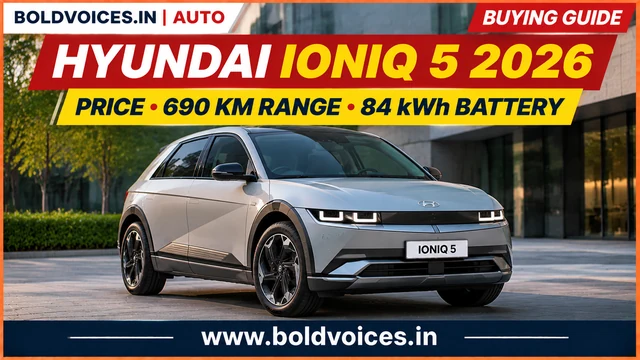
The Hyundai IONIQ 5 is the brand’s premium electric SUV in India, built on the dedicated E-GMP electric-vehicle platform. The 2026 update brings a larger 84 kWh battery, a claimed ARAI range of up to 690 km, revised exterior details, an updated cabin and additional technology. It is positioned for buyers looking for a spacious, premium electric vehicle for everyday use as well as longer inter-city journeys. This guide covers the current official price, powertrain, range, charging, design, interior, safety, warranty, ownership costs and the key checks to complete before booking.

Hyundai IONIQ 5 price in India
Hyundai India’s official website lists the IONIQ 5 at ₹55,70,600 ex-showroom. This is the manufacturer-listed price checked on 24 November 2026. The 2026 model is currently presented as a single rear-wheel-drive configuration on Hyundai India’s public model page. The final on-road amount will depend on the state, registration and road-tax treatment, insurance, optional accessories and any applicable dealer offer.
The ex-showroom price does not include registration, road tax, insurance, FASTag or optional accessories. EV incentives, road-tax concessions and registration rules can vary by state and may change. Ask the dealer for a dated, itemised on-road quotation for your registration address. Also confirm the manufacturing month, model year, charger package and delivery timeline in writing.
What changed in the 2026 update?
The most significant mechanical change is the move to an 84 kWh battery pack, replacing the earlier 72.6 kWh pack offered in India. Hyundai now quotes an ARAI-certified range of up to 690 km. The update also brings revised front and rear bumpers, updated alloy wheels and a redesigned rear spoiler. Inside, the steering wheel, centre fascia and connected infotainment experience have been refreshed.
Hyundai has also added or highlighted updated convenience and safety technology, including wireless smartphone connectivity, controller over-the-air updates, in-car payment support for EV charging and rear parking collision-avoidance assistance. The 2026 model should therefore be evaluated separately from older 72.6 kWh IONIQ 5 listings and used-car advertisements.
Battery, motor and performance
The India-spec IONIQ 5 uses a liquid-cooled 84 kWh lithium-ion battery with a battery heating system. It is paired with a rear-mounted Permanent Magnet Synchronous Motor (PMSM) and rear-wheel drive. Hyundai’s technical specification page lists maximum output at 168 kW (228.5 PS). Torque is approximately 350 Nm. Power is sent to the rear wheels through a single-speed reduction gear rather than a conventional multi-speed gearbox.
The rear-wheel-drive layout gives the IONIQ 5 a different driving character from dual-motor all-wheel-drive electric SUVs. It is designed to balance smooth performance, efficiency and premium long-distance comfort. Electric torque is available immediately, which helps with quick acceleration from low speeds and overtaking. However, acceleration and energy use depend on battery charge, temperature, road conditions, driving mode and vehicle load.
ARAI range versus real-world driving range
Hyundai quotes a range of up to 690 km on the ARAI test cycle. This is a certified laboratory/test-cycle figure and should not be treated as a guaranteed everyday distance. Real-world range changes with cruising speed, traffic, temperature, air-conditioning, tyre pressure, road gradient, passenger load, luggage and driving style.
In an independent road test of the 2026 model, Autocar India reported an estimated range of around 523 km in city conditions and 479 km on the highway, with a combined extrapolated figure of about 501 km. Those results belong to that publication’s test route and conditions; they are useful as an additional reference, not a promise for every owner. For long trips, plan using a conservative range estimate and identify reliable charging stops before departure.
Charging time and charging options
The IONIQ 5 supports AC home/workplace charging and high-power DC fast charging through a CCS-compatible charging system. Hyundai lists an estimated AC charging time of approximately 7 hours 35 minutes from 10% to 100% using an 11 kW AC charger. With a compatible 350 kW DC ultra-fast charger, Hyundai quotes approximately 18 minutes from 10% to 80%.
The 18-minute figure is a manufacturer estimate under specified conditions. It requires a suitable high-output charger and can vary with battery temperature, starting state of charge, charger output, charging-station load and other factors. The car will not charge at its maximum advertised rate throughout the entire session; charging power normally reduces as the battery fills.
Hyundai’s feature page lists an 11 kW wallbox charger and a portable charging cable. Confirm the exact equipment supplied with your vehicle, installation scope and any additional electrical or civil work charges. Before booking, arrange a site assessment to check sanctioned load, earthing, cable routing, parking access, meter requirements and apartment-society or landlord permissions.
Exterior design: pixel lighting and aerodynamic details
The IONIQ 5 stands apart from conventional SUVs with its geometric design, long wheelbase and distinctive parametric pixel lighting. Hyundai lists pixel-style LED headlamps and tail lamps, LED daytime-running lights, an active air flap, auto flush door handles, a rear spoiler with high-mounted stop lamp and 20-inch aero alloy wheels. The 2026 update revises the bumpers, wheels and rear spoiler while retaining the model’s recognisable design language.
Hyundai lists exterior colours including Titan Grey, Gravity Gold Matte, Midnight Black Pearl and Optic White on the current page. Availability may vary by production batch and dealer stock. Matte finishes can need different care from conventional paint, so ask the dealer for the recommended washing and maintenance procedure before choosing one.
Interior, comfort and cabin technology

The IONIQ 5’s flat-floor E-GMP architecture helps create a spacious cabin. Hyundai lists relaxation seats, a sliding centre console, a vision roof, ventilated and heated front seats, powered seat adjustment, a heated steering wheel, dual-zone automatic climate control and a power tailgate. The updated model uses a three-spoke leather steering wheel with an illuminated four-dot design and a revised centre fascia.
The infotainment and instrument displays are each 12.3 inches. Other listed equipment includes Hyundai Bluelink connected-car technology, wireless Android Auto and Apple CarPlay, controller OTA updates, in-car payment features and an eight-speaker Bose premium sound system. Some connected services depend on network availability, subscription or compatible devices. Check the feature list and trial/subscription conditions with Hyundai.
Dimensions, seating and luggage space
Hyundai lists the IONIQ 5 at 4,655 mm long, 1,890 mm wide and 1,625 mm high, with a long 3,000 mm wheelbase. It is a five-door, five-seat SUV. The official highlights page also lists a 57-litre front trunk (frunk). Independent specification listings quote approximately 527 litres of rear boot space, but buyers should check the usable luggage area in person and confirm the precise measurement method.
The long wheelbase and flat floor contribute to generous cabin space, especially for rear passengers. During a test drive, check the rear-seat cushion, headroom, under-thigh support, visibility and ease of entry. Load the luggage you normally carry and assess the rear boot as well as the frunk. The vehicle is wide, so measure your parking bay and check access through basement ramps and narrow residential lanes.
Safety equipment and Hyundai SmartSense
Hyundai’s current feature chart lists six airbags, Electronic Stability Control (ESC), Vehicle Stability Management (VSM), Hill-start Assist Control (HAC), Multi Collision-Avoidance Brake, an electric parking brake, highline tyre-pressure monitoring, ISOFIX child-seat anchors and front, rear and side parking sensors. The updated model also highlights rear parking collision-avoidance assistance and side parking distance warning.
Hyundai lists SmartSense Level 2 ADAS with 22 features. Depending on the function, the package can include forward collision warning and avoidance assistance, junction-turning assistance, cyclist detection, blind-spot collision warning and avoidance assistance, lane keeping and lane following assistance, driver attention warning, safe exit warning/assist, smart cruise control with Stop & Go, rear cross-traffic collision warning and avoidance assistance, blind-spot view monitor and surround-view monitor.
ADAS features are driver-support systems, not autonomous driving. Their effectiveness can be affected by weather, road markings, visibility, traffic and sensor conditions. The driver must remain attentive and in control. Manufacturer-listed safety equipment should not be confused with an independent Bharat NCAP or Global NCAP star rating; check for a published test result that specifically applies to the India-spec vehicle before relying on any rating claim.
Vehicle-to-Load (V2L) and useful EV features
Hyundai lists Vehicle-to-Load (V2L) functionality for inside and outside the vehicle. V2L allows the traction battery to supply power to compatible external electrical devices using the required adapter and equipment. It can be useful for selected appliances or devices during travel, but it is not a replacement for a professionally installed home backup system. Confirm power limits, adapter requirements and safety instructions in the owner’s manual.
Other features include smart regenerative braking, drive-mode selection, rain-sensing wipers, heated outside mirrors, wireless phone charging, a rear window sunshade and a column-mounted shift-by-wire selector. Regenerative braking can recover some energy during deceleration, but the amount depends on driving conditions and selected settings.
Battery warranty and maintenance
Hyundai’s April 2026 brochure states battery warranty coverage of up to 8 years or 160,000 km, whichever occurs earlier, subject to the applicable terms and conditions. Read the warranty booklet for battery capacity-retention conditions, exclusions, servicing requirements, transferability and coverage of other high-voltage components. Confirm the warranty start date and exact coverage for the vehicle being delivered.
An electric vehicle does not need engine oil, spark plugs or conventional exhaust-system servicing, but it still requires regular maintenance. Tyres, brakes, suspension, cabin filters, coolant circuits, the 12V battery, software and high-voltage system inspections remain important. The 20-inch tyres may cost more to replace than smaller SUV tyre sizes. Ask Hyundai for a written periodic maintenance schedule and service-cost estimate.
IONIQ 5 running cost: what should buyers calculate?
Electricity cost depends on home tariff, charging losses, public charging rates and driving efficiency. A useful calculation is grid electricity consumed in kWh multiplied by the applicable tariff. As a simple illustration, if charging from the grid uses 18 kWh for a 100 km journey and the effective tariff is ₹8 per kWh, the energy cost would be approximately ₹144 for that distance. This is only an example, not a claimed IONIQ 5 consumption figure or a guaranteed running cost.
For a realistic ownership budget, include the purchase price, insurance, registration, home charger installation, electricity, public charging, tyres, scheduled servicing and any financing cost. Compare the total with a similarly priced petrol or diesel vehicle using your own annual kilometres and expected ownership period. If you depend heavily on public fast charging, use the rates and availability on your regular routes rather than assuming home electricity tariffs.
Pros and points to consider
- Potential strengths: 84 kWh battery; up to 690 km ARAI-claimed range; 228.5 PS rear-wheel-drive motor; 350 Nm torque; 18-minute 10–80% DC charging claim with a compatible 350 kW charger; spacious flat-floor cabin; 57-litre frunk; V2L; premium audio and comfort equipment; six airbags and extensive ADAS functions.
- Points to consider: premium purchase price; real-world range differs from the certified figure; fastest charging requires compatible high-power infrastructure; 20-inch tyre replacements can be expensive; home-charging installation needs planning; public charger availability and uptime vary by route.
Who should consider the Hyundai IONIQ 5?
The IONIQ 5 is worth considering if you want a premium five-seat electric SUV, regularly travel with family, value rear-seat space and can arrange convenient charging. Its large battery and high claimed range make it suitable for buyers who undertake inter-city journeys, provided their routes have reliable fast-charging options.
It may be less suitable if your budget is closer to mass-market electric SUVs, you do not have dependable home or workplace charging, or your regular routes lack reliable public charging. Buyers should also compare the vehicle’s size with their parking space and the cost of replacing its 20-inch tyres.
Rivals to compare before booking
Compare the IONIQ 5 with the Kia EV6, BYD Sealion 7 and BMW iX1, subject to the variants and prices available when you purchase. The Kia EV6 is a related premium electric model but has a different body shape and powertrain configuration. The BYD Sealion 7 offers a different balance of battery, performance and equipment, while the BMW iX1 brings a premium-brand compact SUV proposition. Compare equivalent price points, certified range cycles, charging curves, warranty, cabin space, service network and actual on-road costs rather than relying on headline range alone.
A recent independent comparison by Autocar India tested the IONIQ 5 against the BYD Sealion 7 and reported a higher real-world range for the Hyundai in its test conditions. This should be treated as one controlled comparison, not a universal result for every owner or driving route.
Test-drive and delivery checklist
- Confirm the 2026 model year and 84 kWh battery on the booking documents.
- Ask for a dated, itemised on-road quotation for your registration city.
- Check the 11 kW wallbox and portable charging cable included with the car.
- Arrange a home electrical-site assessment and confirm installation costs.
- Check CCS-compatible public fast-charger availability on regular routes.
- Test drive modes and regenerative-braking settings in safe conditions.
- Check rear-seat comfort, boot capacity and the 57-litre frunk.
- Test infotainment, wireless phone connectivity, cameras and connected services.
- Understand ADAS limitations and confirm the features listed for the delivered vehicle.
- Read the battery warranty and scheduled maintenance documents.
- Inspect 20-inch tyres, spare-tyre mobility kit, charging accessories and cables.
- At delivery, verify VIN, manufacturing date, battery specification, paint, odometer, accessories and warranty documents.
Official Hyundai links and further details
- Hyundai India — official model and price listing
- IONIQ 5 official highlights
- Official technical specifications
- Official feature and equipment list
- Official exterior gallery
- Official interior gallery
- Official safety and SmartSense details
- Official IONIQ 5 brochure
- Hyundai India warranty information
Important note: The ex-showroom price shown above is the Hyundai India website price checked on 24 November 2026. Prices, offers, specifications, colours, equipment, charger availability and warranty terms may change. Ex-showroom prices exclude registration, road tax, insurance and other applicable charges. ARAI range and manufacturer charging times are test-condition claims, not guarantees of real-world results. The featured thumbnail is an illustrative editorial graphic; the two vehicle photographs embedded in this article are from Hyundai India’s official galleries.
Curated by the team of BoldVoices
#HyundaiIONIQ5 #IONIQ52026 #HyundaiIndia #ElectricSUV #PremiumEV #690KmRange #84kWhBattery #EVCharging #ElectricCarsIndia #EVBuyingGuide


