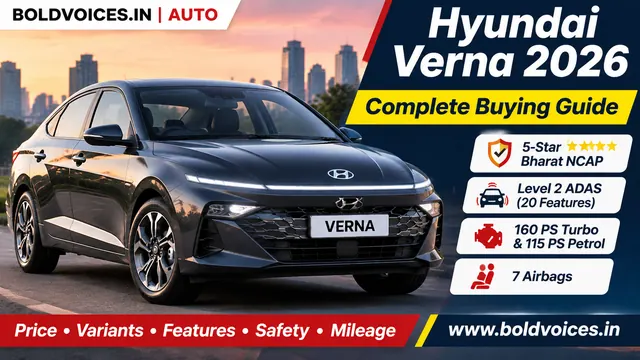
The Hyundai Verna is a five-seat mid-size sedan for buyers who want a spacious cabin, a proper boot, premium technology and a choice between a naturally aspirated petrol engine and a powerful turbo-petrol. The 2026 update brought a revised HX variant structure, updated design and equipment, and a major safety milestone: the Verna earned a five-star Bharat NCAP rating in November 2026. This guide explains the variants, engines, transmissions, safety-rating scope, features, fuel economy and the questions buyers should ask before booking.
Official Hyundai India photograph — Verna front exterior
Hyundai Verna 2026 price in India
Hyundai India’s official price page currently lists the Verna with a starting ex-showroom price of ₹10,99,200. The final price depends on the selected HX trim, engine, transmission, city and applicable offers. The official price selector should be used for the latest exact amount for each configuration.
Price reference date: 24 November 2026. The figure above is the manufacturer-listed starting price, not an on-road quotation. Registration, road tax, insurance and optional accessories are additional. Hyundai states that prices and variants may change without prior notice, so ask an authorised dealer for an itemised written quotation before paying a booking amount.
2026 Hyundai Verna variants explained
The revised range uses six trim names: HX 2, HX 4, HX 6, HX 6+, HX 8 and HX 10. The available engine and gearbox combinations differ by trim. The 1.5-litre MPi petrol is offered with a six-speed manual or iVT automatic, while the 1.5-litre Turbo GDi is offered with a six-speed manual and seven-speed DCT on selected higher variants.
HX 2: Entry-level 1.5 MPi petrol with six-speed manual. A value-focused choice with the essential safety package and simpler cabin equipment.
HX 4: Adds selected exterior and convenience upgrades over HX 2 while retaining the MPi manual powertrain.
HX 6: A key step up in equipment. Available with MPi manual and iVT, and brings more parking assistance, convenience and cabin technology.
HX 6+: Builds on HX 6 with additional equipment and is available with MPi manual or iVT.
HX 8: The important upper-mid trim. It is offered with MPi manual/iVT and also with Turbo GDi manual/DCT, depending on the selected powertrain.
HX 10: The top trim, offered with MPi iVT or Turbo GDi DCT. It brings the most comprehensive technology and convenience package in the range.
Hyundai’s current feature chart shows that the turbo-petrol engine is limited to HX 8 and HX 10, with the manual turbo offered on HX 8 and DCT automatic available on HX 8 and HX 10. The MPi manual is available on HX 2 through HX 8; MPi iVT is available from HX 6 through HX 10. Always confirm the exact combination on the official price selector because trim and stock availability can change.
Engine, power and transmission options
1.5-litre MPi naturally aspirated petrol: The 1,497 cc four-cylinder engine produces 115 PS at 6,300 rpm and 143.8 Nm at 4,500 rpm. It is paired with a six-speed manual or Hyundai’s iVT (Intelligent Variable Transmission). This engine is aimed at smooth everyday driving and buyers who do not need the stronger acceleration of the turbo version.
1.5-litre Turbo GDi petrol: The 1,482 cc turbocharged direct-injection engine produces 160 PS at 5,500 rpm and 253 Nm between 1,500 and 3,500 rpm. It is available with a six-speed manual or seven-speed DCT. The strong low- and mid-range torque makes this the performance-focused option for highway overtaking and quicker acceleration.
The iVT is designed for smooth, continuous ratio changes and relaxed urban use; it is not a conventional stepped automatic. The DCT uses two clutches and is designed for quick gear changes. Its behaviour in crawling traffic can feel different from a torque-converter automatic, so test it in slow-moving traffic, while parking and on an incline. The manual is the most direct choice for drivers who prefer control over gear selection.
Dimensions, cabin space and boot practicality
Hyundai lists the Verna at 4,565 mm long, 1,765 mm wide and 1,475 mm high, with a 2,670 mm wheelbase. The sedan seats five and has a 45-litre fuel tank. It uses front McPherson strut suspension and a rear coupled torsion-beam axle. Hyundai’s current public technical table does not state a boot-capacity figure in the accessible specification panel, so this guide does not insert an unverified number.
The long wheelbase is intended to support rear-seat space, while the sedan body gives luggage a separate boot compartment. Before choosing, sit in the rear seat behind your normal driving position, check headroom and under-thigh support, and test boot opening and loading with the suitcases you normally carry. Also check the turning circle, front-end visibility and ease of parking in your regular locations.
Exterior design and colour choices
The 2026 Verna features a black-chrome radiator grille, dual LED projector headlamps, connected LED positioning lamps, LED tail lamps, a redesigned front and rear bumper, satin-chrome window detailing and an aerodynamic rear spoiler. Higher trims use R16 diamond-cut alloy wheels, while wheel design and finish depend on the variant and powertrain. Turbo versions have a darker, sportier wheel treatment.
Hyundai’s current colour palette includes options such as Atlas White, Titanium Black, Titan Grey, Starry Night, Titan Grey Matte and Classy Blue, with Atlas White and a black roof shown for selected turbo configurations. Colour availability can differ by trim. Check the official configurator and view the actual car in daylight before finalising the booking.
Official Hyundai India photograph — Verna side profile
Interior, infotainment and comfort features
A key cabin highlight is the pair of integrated 26.03 cm (10.25-inch) displays for infotainment and the digital instrument cluster on equipped variants. Other available features include a D-cut steering wheel, leatherette upholstery, sliding front centre armrest with storage, smart key with push-button start, switchable infotainment and climate-control interface, rear window sunshade and an eight-speaker Bose premium sound system on selected trims.
Official Hyundai India photograph — Verna rear designOfficial Hyundai India photograph — Verna dashboard and cabin
The higher HX 10 trim adds premium convenience equipment such as an electrically adjustable driver’s seat with memory, powered co-driver seat and additional camera-based assistance features. The exact equipment varies with trim and powertrain. Some features are restricted to the turbo or DCT configurations; for example, Hyundai’s feature chart marks several ADAS and convenience functions as turbo-only or DCT-only. Do not assume that every item advertised for the model is standard on HX 2 or HX 4.
Five-star Bharat NCAP rating: what buyers should know
On 20 November 2026, Hyundai announced that the new Verna had achieved a five-star Bharat NCAP rating. The official Bharat NCAP fact sheet records 28.22 out of 32 for Adult Occupant Protection and 44.00 out of 49 for Child Occupant Protection. The tested vehicles were the 1.5 Turbo GDi DCT HX 8 and 1.5 MPi iVT HX 8. The Bharat NCAP annexure lists the rating as applicable to the specified variants across the HX range and powertrain combinations shown in its table.
This is an independently assessed crash-test result, not merely a manufacturer claim. The official fact sheet is the right reference for the exact test variants, scores and applicability. Buyers should still check the equipment on the particular vehicle they are booking because the feature package differs by trim.
Airbags, ADAS and other safety equipment
Hyundai’s current feature chart lists driver and passenger airbags plus side and curtain airbags across the range. The centre-side airbag is shown on HX 10, giving that trim a seven-airbag configuration. Other listed safety equipment includes ESC, VSM, ABS with EBD, Hill-start Assist Control, ISOFIX, seatbelt reminders for all seats, highline TPMS and rear parking sensors. Rear camera, front parking sensors and Driver Rear View Monitor are available on selected higher trims.
On eligible turbo variants, Hyundai SmartSense Level 2 ADAS includes driver assistance functions such as forward collision warning and avoidance assistance, lane keeping and lane departure functions, blind-spot collision warning/avoidance, lane following assistance, high-beam assist and rear cross-traffic alerts. Some functions, including Smart Cruise Control with Stop & Go, are DCT-specific in the variant chart. HX 10 adds features such as Surround View Monitor and Blind-spot View Monitor. These systems assist the driver; they do not replace attentive driving.
Hyundai also lists a dashcam, rain-sensing wipers, electronic parking brake with Auto Hold and all-four-wheel disc brakes on selected configurations. The feature chart differentiates by trim and gearbox, so check the official matrix for the exact HX version rather than relying on a generic model-level feature list.
Mileage and fuel economy
Independent automotive reporting lists certified fuel-efficiency figures of approximately 18.6 km/l for MPi manual, 19.6 km/l for MPi iVT, 20.0 km/l for Turbo manual and 20.6 km/l for Turbo DCT. These are test-cycle figures, not a promise of real-world consumption. Actual mileage depends on traffic, speed, driving style, air-conditioning, tyre pressure, passenger load and road conditions. Confirm the certified figure for the exact current variant with Hyundai before purchase.
For mostly urban driving, compare the MPi iVT with the manual based on your traffic conditions and test-drive preference. Buyers who regularly drive on highways or want stronger acceleration may prefer the turbo, but should budget for fuel consumption that can rise with enthusiastic driving. Compare the gearbox and engine that you will actually buy rather than comparing headline mileage figures from different powertrains.
Warranty and ownership costs
Hyundai’s November 2026 digital brochure refers to a standard warranty and extended-warranty options of up to seven years or 1,40,000 km, whichever occurs earlier, subject to the applicable terms and eligibility. It also refers to complimentary roadside assistance for up to three years. Confirm the standard warranty period, exclusions, service intervals, extended-warranty price and roadside-assistance terms in the current warranty booklet and written dealer quotation.
Plan for scheduled servicing, insurance renewals, tyres, brake components, battery, fuel and any optional maintenance package. The turbo DCT and higher-spec variants have different hardware from the entry MPi manual, so obtain a service-cost estimate for the exact engine and gearbox. Check tyre size and replacement costs before choosing the higher alloy-wheel trims.
Pros and points to consider
Potential strengths
Five-star Bharat NCAP result with published adult and child protection scores.
Choice of 115 PS MPi petrol and 160 PS turbo-petrol engines.
Manual, iVT and DCT transmission options across selected trims.
Level 2 ADAS on eligible turbo configurations.
Dual 10.25-inch displays, Bose audio and premium cabin features on selected variants.
Long 2,670 mm wheelbase and spacious five-seat sedan layout.
Points to consider
Turbo-petrol and DCT options are restricted to higher trims.
Seven airbags are not listed on every variant; the centre-side airbag is shown on HX 10.
Several ADAS features are limited to turbo versions, and some are DCT-specific.
Higher variants and larger alloy wheels can increase purchase and replacement costs.
Confirm the current variant-specific price and equipment before booking.
Which Hyundai Verna variant should you buy?
HX 2 or HX 4 MPi manual suits buyers focused on the entry price who want a mid-size sedan and do not need the full premium feature package. HX 6 or HX 6+ MPi is worth comparing if you want more convenience equipment, and the iVT option is available for buyers who prefer an automatic-style drive for city use.
HX 8 MPi offers a higher equipment level without moving to the turbo engine. HX 8 Turbo manual is for drivers who want the 160 PS engine and manual control. HX 8 Turbo DCT brings the turbo engine with a dual-clutch automatic. HX 10 MPi iVT or Turbo DCT is the top-end choice for buyers who prioritise the widest technology and convenience package, including the centre-side airbag and camera-based features listed for HX 10. Test-drive before deciding, and compare the final on-road cost.
Rivals to compare before booking
Compare the Verna with the Honda City, Volkswagen Virtus and Skoda Slavia. Match similar engine and gearbox options where possible. Evaluate rear-seat comfort, ride quality, steering feel, highway stability, visibility, cabin noise, boot usability, service reach, warranty and safety equipment. A test drive on the roads you use every day is more valuable than relying only on specification tables.
Test-drive and delivery checklist
Drive both MPi and Turbo versions if you are undecided about performance.
Compare the manual, iVT and DCT in the traffic conditions you regularly face.
Check rear-seat space, headroom, seat comfort and boot access.
Test both screens, smartphone pairing, camera systems, audio and connected features.
On ADAS-equipped versions, understand the alerts and settings; do not treat assistance systems as autonomous driving.
Confirm the exact airbags, ADAS, camera and parking equipment on the chosen trim.
Ask for written details of price, insurance, warranty, service intervals and roadside assistance.
At delivery, verify VIN, manufacturing month, variant, engine, gearbox, paint, tyres, spare wheel, tools and accessories.
Important note: Prices, variant availability, equipment, colours and warranty terms may change. Ex-showroom prices exclude registration, road tax, insurance and other applicable charges. The thumbnail is an AI-generated illustrative visual, not an official Hyundai photograph. For actual vehicle photographs, use Hyundai’s official exterior and interior galleries linked above. Confirm the latest details and obtain a written dealer quotation before booking.
Like what you read? Help BoldVoices.in keep independent journalism going.
Manage Consent
To provide the best experiences, we use technologies like cookies to store and/or access device information. Consenting to these technologies will allow us to process data such as browsing behavior or unique IDs on this site. Not consenting or withdrawing consent, may adversely affect certain features and functions.
Functional
Always active
The technical storage or access is strictly necessary for the legitimate purpose of enabling the use of a specific service explicitly requested by the subscriber or user, or for the sole purpose of carrying out the transmission of a communication over an electronic communications network.
Preferences
The technical storage or access is necessary for the legitimate purpose of storing preferences that are not requested by the subscriber or user.
Statistics
The technical storage or access that is used exclusively for statistical purposes.The technical storage or access that is used exclusively for anonymous statistical purposes. Without a subpoena, voluntary compliance on the part of your Internet Service Provider, or additional records from a third party, information stored or retrieved for this purpose alone cannot usually be used to identify you.
Marketing
The technical storage or access is required to create user profiles to send advertising, or to track the user on a website or across several websites for similar marketing purposes.