
Curated by the Financial Desk of Boldvoices
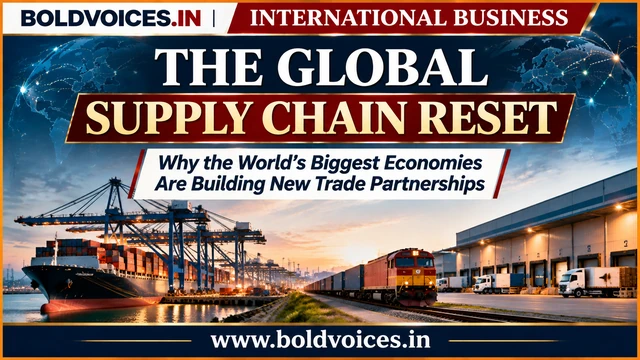
For decades, global manufacturers built supply chains around cost, scale and speed. Components were sourced from the most competitive locations, assembled across borders and delivered through highly connected transport networks. That model helped lower prices and expand international trade, but it also created vulnerabilities when production or logistics became concentrated in a small number of places.
Now governments and businesses are putting greater emphasis on resilience. A new development on November 26, 2026, illustrates the shift: the European Union and members of the Comprehensive and Progressive Agreement for Trans-Pacific Partnership (CPTPP) launched a Supply Chain Early Warning Network to improve information-sharing and identify possible disruptions earlier.
Why global supply chains are being redesigned
Modern products often depend on materials, components, software, energy and transport services from multiple countries. A disruption at one critical supplier can delay production far beyond the location where the problem began.
Geopolitical tensions, export controls, trade restrictions, extreme weather, port congestion and shortages of specialised components have all highlighted the risks of relying too heavily on a single source or route. For businesses, the cost of a disruption can include idle factories, missed deliveries, lost customers and higher working-capital requirements.
The response is not necessarily to abandon globalisation. Instead, many companies are trying to build supply networks that remain international but have more options when conditions change.

What is the EU–CPTPP Supply Chain Early Warning Network?
The EU and CPTPP partners announced the initiative to strengthen cooperation on supply-chain resilience. The network is intended to support earlier identification of potential disruptions, exchange relevant information and help participating economies coordinate responses where appropriate. Its first meeting is planned for early 2027.
The initiative is a cooperation and information-sharing framework, not a supranational body that directs private companies, guarantees supplies or controls trade flows. Its value will depend on the quality of information shared, the speed of communication and how effectively businesses and authorities can use the insights.
From lowest cost to resilience and diversification
Companies are increasingly reviewing sourcing strategies through several approaches:
- Multiple sourcing: Qualifying more than one supplier for critical materials or components can reduce dependence on a single factory or country.
- China Plus One: Some businesses are adding production or sourcing locations outside China while retaining existing operations where they remain competitive.
- Nearshoring and regionalisation: Locating some production closer to major customer markets can reduce transit time and exposure to long-distance shipping disruptions.
- Strategic inventories: Holding carefully selected buffers of critical inputs can protect production when replenishment is delayed, although it ties up working capital.
- Digital visibility: Better tracking of orders, inventory, suppliers and transport routes can help companies detect problems sooner.
None of these approaches is free. Additional suppliers require qualification, duplicated capacity can raise costs, and larger inventories can become obsolete. The commercial challenge is to identify which risks justify the extra expense.
Why India could gain from the supply-chain reset
India has an opportunity to deepen its role in international manufacturing and services networks. Its large domestic market, industrial base, engineering capabilities and expanding digital infrastructure can be advantages for companies seeking additional production and sourcing locations.
Potential opportunities span electronics, pharmaceuticals, automotive components, chemicals, textiles, engineering goods, renewable-energy equipment and logistics. However, investment decisions depend on practical execution: reliable power, efficient ports, predictable regulation, skilled workers, quality certification, access to finance and competitive end-to-end logistics.
For Indian MSMEs, becoming a supplier to a multinational company can open new markets, but it also requires consistent quality, traceability, delivery performance, cybersecurity and the ability to meet customer and regulatory standards.
What businesses should do now
- Map critical dependencies: Identify products that rely on a single supplier, country, port, shipping lane or specialised input.
- Assess business impact: Estimate how long the company can operate if a critical input is unavailable and what a disruption would cost.
- Qualify alternatives: Develop backup suppliers and test their capacity, quality, delivery times and financial reliability before an emergency.
- Improve visibility: Maintain accurate supplier records and use digital tools to monitor orders, inventory and transport status.
- Build realistic inventory plans: Set buffers for genuinely critical components rather than increasing stock indiscriminately.
- Review contracts: Clarify delivery obligations, force-majeure provisions, alternative sourcing rights and how additional costs are allocated.
- Test response plans: Run scenarios involving port closures, export restrictions, cyber incidents and supplier failures.
Who could benefit from the transformation?
Logistics operators may see demand for more flexible freight, warehousing and customs services. Technology providers can support shipment visibility, risk analytics and inventory planning. Industrial parks and manufacturing clusters may attract investment when they combine infrastructure with access to suppliers and transport. Smaller manufacturers can win new business if they meet the quality, documentation and reliability requirements of global buyers.
There are also risks. Duplicating supply chains can increase costs, trade restrictions can fragment markets, and companies may struggle to identify genuine alternatives for highly specialised materials. Resilience planning must therefore be based on evidence rather than simply moving every supplier to a different country.
How trade policy adds another layer of complexity
The World Trade Organization’s November 2026 monitoring has highlighted the coexistence of new trade restrictions and measures intended to facilitate commerce. This creates a complicated environment for international businesses: governments want secure access to essential goods, but tariffs, export controls and regulatory differences can make sourcing more difficult.
Companies must monitor the rules that apply to their products and markets, including customs classification, origin requirements, sanctions, export controls and product standards. A supplier that appears commercially attractive may not be a viable alternative if it cannot meet regulatory or customer requirements.
What to watch in 2027 and beyond
- The first meeting and practical work programme of the EU–CPTPP early-warning network.
- Whether participating economies develop useful procedures for sharing disruption information.
- New investment in alternative manufacturing locations and supplier ecosystems.
- Changes in shipping routes, port capacity and the cost of international freight.
- Trade-policy measures affecting critical minerals, semiconductors, medicines and industrial inputs.
- Whether Indian manufacturers and MSMEs can meet the reliability and traceability expectations of global buyers.
The bigger picture
The global supply-chain reset is not a simple retreat from international trade. It is a change in how businesses balance cost against reliability. Companies still need competitive suppliers and access to customers around the world, but they increasingly want alternatives when a route, factory or market becomes unavailable.
For India, the opportunity is significant—but it will be realised through dependable infrastructure, competitive manufacturing, capable suppliers and consistent execution. The strongest supply chains of the future will not necessarily be the cheapest on paper. They will be the ones that can keep delivering when unexpected events test the system.
#GlobalSupplyChain #SupplyChainResilience #InternationalTrade #GlobalManufacturing #CPTPP #EuropeanUnion #IndiaManufacturing #Logistics #GlobalBusiness #TradePolicy #MSME #BoldVoices


