
Curated by Team of Boldvoices | 28 November 2026
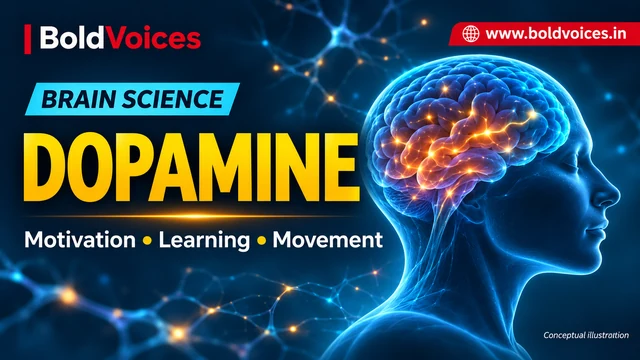
Dopamine helps the brain learn from experience, pursue goals and coordinate movement. It is often called the “pleasure chemical”, but that label leaves out much of its work. Dopamine is part of a network of chemical signals, brain circuits and bodily processes. It does not determine a person’s happiness, character or productivity on its own.
What is dopamine?
Dopamine is a neurotransmitter: a chemical messenger used by nerve cells. In some parts of the body it also acts as a hormone or local signalling molecule. Its effects depend on where it is released, which receptors receive it and what other signals are present. More dopamine everywhere is not a sensible health target. [1,2]
Cells make dopamine from the amino acid tyrosine, first producing L-DOPA and then dopamine. After release, dopamine can bind to receptors, be taken back up into cells or be broken down. The brain regulates these processes continuously; it is not a tank that simply empties after an enjoyable activity. [2]
Where does it work?
Several major pathways help explain its different roles. These are useful teaching categories, rather than four independent switches. [3]
Nigrostriatal pathway: neurons in the substantia nigra communicate with the dorsal striatum, supporting movement. Mesolimbic pathway: connections from the ventral tegmental area, including those to the nucleus accumbens, contribute to reward-related behaviour. Mesocortical pathway: connections to the cerebral cortex contribute to cognitive functions. Tuberoinfundibular pathway: hypothalamic dopamine helps inhibit prolactin release from the pituitary. Prolactin is important in milk production. [3,4]
Motivation, pleasure and learning
Enjoying something and wanting to pursue it are related but distinct. Dopamine contributes strongly to reinforcement and reward-seeking; pleasure itself involves additional chemical systems and brain regions. A dopamine response is not a direct happiness reading. Addiction research illustrates why strong wanting can persist even when enjoyment has diminished. [5]
Some dopamine neurons signal a reward prediction error: the difference between an expected outcome and what actually happens. An unexpectedly good outcome can produce a brief increase in activity; an expected reward that fails to arrive can produce a decrease. With learning, responses can shift toward a cue predicting the reward. These findings describe particular neurons and experimental conditions, not every dopamine signal in every situation. [6]
Imagine learning that a particular sound predicts a useful opportunity. Paying attention to that cue may become part of your behaviour. This is an everyday illustration of learning from predictions, not proof that a specific sound produces a measurable dopamine surge in every listener.
Dopamine is also involved in decisions about effort. Human research reported by NIH examined how dopamine-related differences influenced willingness to take on demanding tasks for rewards. It does not establish that everyone who procrastinates has low dopamine, or that increasing dopamine would make everyone more productive. [7]
Dopamine and addiction
Addictive drugs can alter reward signalling, and repeated exposure can change circuits involved in learning, motivation, stress and self-control. Dopamine is important, but addiction extends beyond one neurotransmitter. Biology, personal circumstances and the environment also matter. [5,8]
Tolerance and compulsive use should not be reduced to a universal story that “receptors are burned out”. Changes vary by substance, brain region and person. Likewise, enjoying music, food or exercise is not equivalent to having a substance use disorder. Persistent loss of control and harm deserve professional assessment. [5,8]
What medical conditions tell us—and what they do not
Parkinson’s disease: loss of dopamine-producing neurons in the substantia nigra is central to many movement symptoms. Parkinson’s also involves other systems and can cause non-movement symptoms. Levodopa enters the brain and is converted to dopamine; it is commonly paired with carbidopa. It can improve symptoms, but does not replace lost neurons or cure the disease. Dopamine itself does not readily cross the blood–brain barrier. [9]
ADHD: attention, impulsivity and activity regulation involve complex developmental and biological processes. ADHD cannot be diagnosed by calling someone “dopamine deficient”. Assessment considers symptom history, impairment and alternative explanations. Medication and psychological or behavioural approaches can help, depending on individual needs. [10]
Depression: reduced interest or pleasure can be part of depression, but the illness is not explained by one low chemical. Genetic, biological, psychological and environmental factors contribute. A person’s symptoms need assessment rather than a social-media diagnosis of a dopamine imbalance. [11]
Can you test your dopamine level?
Feeling tired, distracted or unmotivated does not establish a dopamine disorder. These experiences can have many explanations, including sleep problems, stress, other illnesses or medication effects. Routine mental-health assessment does not use a blood or urine dopamine number to determine a person’s motivation or diagnose ADHD. Clinicians evaluate the whole pattern of symptoms and functioning. [1,10]
Specialist investigations may be appropriate for particular diseases. For example, a dopamine transporter scan can assist evaluation of parkinsonism, but is not a general test of happiness or productivity. Such imaging also has diagnostic limits. [9]
Does a “dopamine detox” work?
You cannot detox from a neurotransmitter required for normal functioning. Avoiding pleasurable activities has not been shown to reset the brain’s dopamine system on a fixed timetable. Claims of a guaranteed 24-hour, seven-day or 30-day reset should not be presented as established medicine. [13]
Reducing exposure to triggers for unwanted habits can still be useful. Turning off nonessential notifications or setting boundaries around an activity changes the environment and behaviour; it does not demonstrate a chemical detox. Extreme pleasure avoidance can also undermine wellbeing. [13]
Food, supplements and everyday habits
Food provides raw materials for normal physiology, including amino acids used to make neurotransmitters. That does not mean a particular food predictably raises brain dopamine to a therapeutic level. Peripheral dopamine and brain dopamine are not interchangeable, and dopamine does not readily pass from blood into the brain. [2,9]
Be particularly careful with products sold as “natural dopamine boosters”. A 2022 laboratory study of 16 Mucuna pruriens supplements found no detectable levodopa in one product and widely varying amounts in the others. This small study does not describe every product currently sold, but shows why an herbal label is not a guarantee of a predictable drug exposure. Discuss such products with a clinician or pharmacist before use. [12]
Sleep, physical activity and nourishing meals belong in a sensible health routine. They should not be sold as a quantified dopamine prescription or a cure for neurological or mental-health conditions. Choose realistic routines and seek advice when symptoms persist. There is no need to chase a dopamine spike to justify an activity you enjoy. [10,13]
When to seek medical advice
Arrange an assessment for persistent low mood, loss of interest, concentration difficulties or compulsive behaviours that interfere with daily life. New tremor, stiffness or slowing of movement also warrants medical attention. Bring a list of medicines and supplements, and describe when symptoms began and how they affect you. [1,9–11]
Do not start, stop or change prescribed treatment to follow a dopamine trend. Treatment should address the diagnosed condition and the individual’s circumstances. This article is general health education; it does not provide a diagnosis or individual treatment plan.
References and evidence
Sources checked on 28 November 2026. Numbered references identify the evidence behind each section. This is an editorial evidence check, not an independent clinician’s review.
[1] Healthdirect Australia — Dopamine
[2] StatPearls, NCBI Bookshelf — Dopamine
[4] StatPearls, NCBI Bookshelf — Physiology, Prolactin
[5] Volkow et al. — The Neuroscience of Drug Reward and Addiction (2019)
[6] Schultz — Predictive reward signal of dopamine neurons (1998)
[7] NIH — Dopamine affects how brain decides whether a goal is worth the effort
[8] NIDA — Drugs, Brains, and Behavior: The Science of Addiction
[9] NINDS — Parkinson’s Disease
[10] NIMH — Attention-Deficit/Hyperactivity Disorder: What You Need to Know
[11] NIMH — Depression
[13] Cleveland Clinic — Dopamine Detoxes Don’t Work: Here’s What To Do Instead
#Dopamine #BrainScience #Neuroscience #BrainHealth #MentalHealth #BoldVoices


