
10 November 2026
Curated by Vishaljeet Singh, Lisbon, Portugal
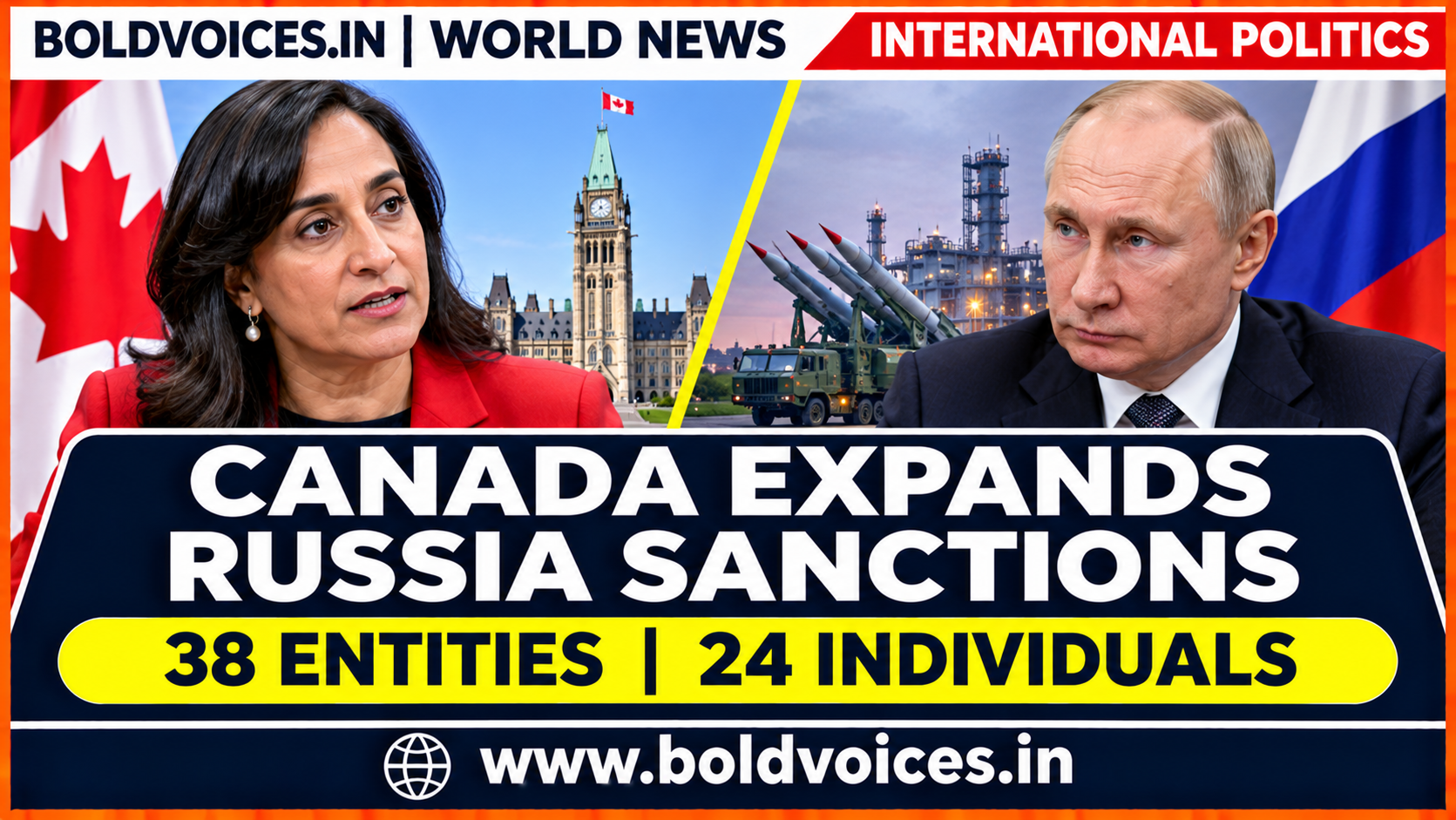
Canada has expanded its sanctions against Russia, adding 38 entities and 24 individuals to its restrictions list in a move aimed at weakening Moscow’s defence industry, ballistic-missile supply chains and cyber operations. The announcement was made by Canadian Foreign Minister Anita Anand on 9 November on the sidelines of the G7 Foreign Ministers’ Meeting in Paris.
The new measures also target financial enablers, including cryptocurrency exchanges that Canada says help sustain Russia’s war economy. Ottawa says the restrictions are intended to increase the economic cost of Russia’s invasion of Ukraine and constrain its ability to develop and deploy weapons used against Ukrainian cities.
What Canada’s new sanctions cover
The latest additions are being made under Canada’s Special Economic Measures (Russia) Regulations. They target parts of Russia’s defence-industrial base and networks that help supply or finance military activity.
According to Global Affairs Canada, the new listings focus on several areas:
- Ballistic-missile technology: Individuals and organisations connected with the development of Russian missile capabilities.
- Defence industry: Entities linked to the industrial base supporting Russia’s military operations.
- Cyber activities: Actors associated with Russian cyber operations and related activities.
- Financial networks: Financial intermediaries, including cryptocurrency exchanges, that can help move or facilitate funds supporting the war economy.
- Sanctions evasion: Networks and intermediaries that help restricted actors access resources, services or technology.
The government’s announcement identifies the broad categories targeted but does not provide a complete public explanation of every listed person or organisation in the news release. The legal schedules and the applicable regulations determine the specific restrictions for each designated party.
Anita Anand says Canada wants to restrict Russia’s missile capacity
Foreign Minister Anita Anand said the measures are intended to undermine Russian President Vladimir Putin’s ability to strike Ukrainian cities with missiles. She reiterated Canada’s support for Ukraine’s sovereignty and territorial integrity and said Ottawa would continue imposing costs on those supporting Russia’s military campaign.
The announcement was made during the G7 foreign ministers’ meeting in Paris, where Ukraine, Iran, maritime security and wider international crises were also on the agenda. Canada’s latest action places sanctions policy alongside the diplomatic discussions taking place among major industrialised democracies.
How sanctions affect targeted individuals and organisations
Canadian sanctions under the Special Economic Measures Act can prohibit dealings with listed persons and entities, restrict access to property under Canadian jurisdiction and limit the provision of certain financial or related services. The precise legal consequences depend on the relevant regulation and the status of the designated party.
By targeting financial intermediaries and cryptocurrency-related channels, Canada is seeking to make it harder for sanctioned networks to move money, obtain services or bypass restrictions. Such measures are part of a wider international effort to close loopholes that allow restricted entities to continue operating through third parties and alternative payment routes.
However, sanctions do not automatically stop all trade or military production. Their effectiveness depends on enforcement, cooperation among partner countries, the ability to trace ownership and transactions, and the availability of alternative suppliers or financial channels.
Canada’s sanctions record since 2014
Canada says it has sanctioned more than 3,500 individuals and entities and over 700 vessels since 2014 in connection with violations of Ukraine’s sovereignty and territorial integrity and serious human-rights violations.
The sanctions regime has expanded in stages since Russia’s annexation of Crimea and the start of the wider conflict in eastern Ukraine. It has since been strengthened following the full-scale Russian invasion in February 2022. Recent Canadian measures have included restrictions on defence suppliers, energy-related networks, financial intermediaries, vessels and individuals linked to the treatment and forced transfer of Ukrainian children.
The latest package adds to that pressure by focusing on missile development, cyber activity and the financial channels that can support military production and operations.
Why cryptocurrency networks are part of the sanctions strategy
Cryptocurrency can be used for legitimate payments and investment, but digital-asset services may also be exploited to transfer value across borders, obscure beneficial ownership or facilitate transactions involving sanctioned parties. Regulators and law-enforcement agencies in several countries have therefore increased scrutiny of exchanges and intermediaries suspected of helping restricted networks.
Canada’s latest announcement specifically identifies crypto exchanges among the financial enablers being targeted. It does not mean that all cryptocurrency businesses or ordinary digital-asset users are subject to the new sanctions. The restrictions apply to designated parties and activities covered by the relevant Canadian regulations.
What the new measures mean for Russia and the Ukraine war
The sanctions are intended to raise the cost of sustaining Russia’s military operations by restricting access to technology, industrial capacity and financial services. Missile production depends on specialised components, engineering expertise, industrial suppliers and complex procurement networks. Disrupting even some of those links can increase costs and complicate supply arrangements.
Still, the practical impact will take time to assess. Russia has sought to adapt to international restrictions by developing alternative supply routes, using intermediaries and expanding domestic production. The effect of Canada’s measures will depend partly on whether other countries coordinate enforcement and whether the listed networks can be replaced.
Why the announcement matters for the G7
The timing of the announcement is significant because G7 ministers are discussing the future of support for Ukraine and the terms of any eventual peace settlement. Canada’s move signals that Ottawa intends to maintain economic pressure even as diplomatic channels remain active.
For Ukraine, sanctions are one part of a broader effort that also includes military assistance, financial support, reconstruction planning and diplomatic backing. For the G7, the challenge is to maintain a common approach while managing different domestic economic priorities and the wider risks created by the war.
What to watch next
- Whether Canada publishes further details about the newly designated individuals and entities.
- Whether other G7 countries announce coordinated measures against missile, cyber or financial networks.
- How cryptocurrency exchanges and financial intermediaries respond to the new restrictions.
- Whether enforcement disrupts procurement routes used by Russia’s defence industry.
- Whether sanctions policy becomes part of a wider framework in future Russia–Ukraine negotiations.
Bottom line
Canada’s latest sanctions package adds 38 entities and 24 individuals to its Russia-related restrictions, targeting missile technology, defence production, cyber activities and financial channels including cryptocurrency exchanges. The announcement reinforces Ottawa’s support for Ukraine and its effort to make it harder for Russia to sustain its war economy. The real test will be enforcement and whether coordinated international pressure can produce measurable constraints on the networks supporting Russia’s military capabilities.
This report is based on the Canadian government announcement of 9 November 2026 and information available on 10 November 2026. The sanctions were adopted through amendments to Canada’s Russia regulations; specific legal restrictions depend on the relevant designation and regulation.
#Canada #RussiaSanctions #AnitaAnand #VladimirPutin #UkraineWar #BallisticMissiles #CyberSecurity #CryptoExchanges #G7 #InternationalPolitics #WorldNews #BoldVoices


