
10 November 2026
Curated by Vishaljeet Singh, Lisbon, Portugal
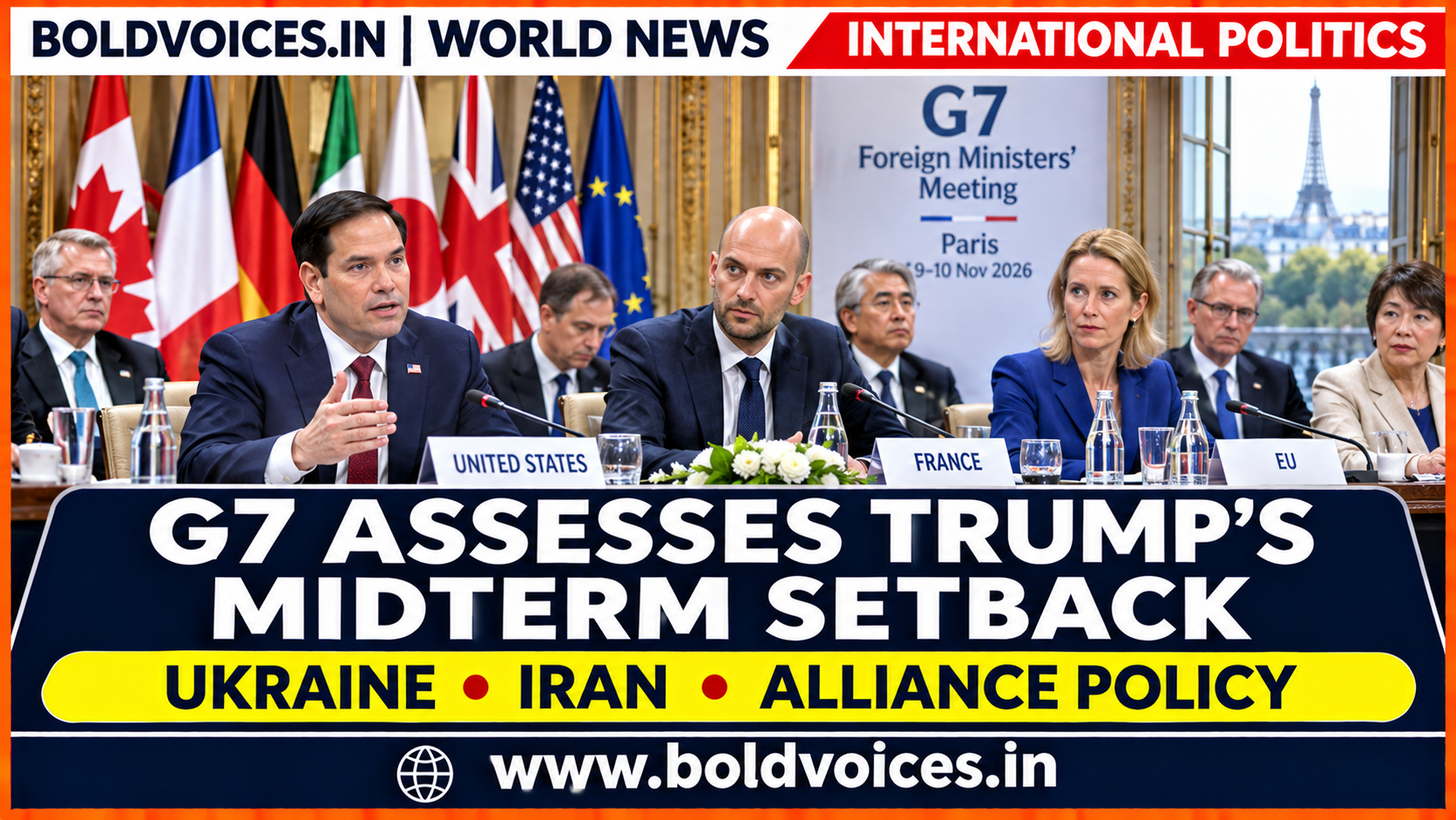
Foreign ministers from the Group of Seven (G7) are using their meeting in France to assess how the latest US midterm election setback for President Donald Trump could influence Washington’s approach to the war in Ukraine, the Iran conflict and relations with its closest allies. The discussions come at a moment when European governments are concerned about the durability of American commitments and the direction of US foreign policy.
The two-day gathering, which began on 9 November, brings together ministers from the United States, Canada, France, Germany, Italy, Japan and the United Kingdom, alongside the European Union’s foreign policy leadership. Officials from Ukraine, Saudi Arabia, Egypt, South Korea and Brazil are also taking part in related discussions, reflecting the wider international stakes.
Why the US midterm result matters to G7 allies
The US election setback has raised questions about the political room available to the Trump administration as it manages several international crises. A weakened domestic position can affect congressional support, budget negotiations, military assistance and the administration’s ability to sustain long-term diplomatic commitments.
For G7 governments, the central question is not simply whether Washington will change course. It is whether the election result will make US policy more cautious, more transactional or more difficult to predict. European officials are particularly focused on whether Washington will continue to support Ukraine and coordinate closely with NATO partners.
US Secretary of State Marco Rubio has continued to defend the administration’s positions in meetings with European counterparts. In talks with French Foreign Minister Jean-Noël Barrot, he raised American concerns about European Union trade preferences and what Washington describes as overregulation of US companies. The discussion also touched on US objections to the International Criminal Court.
Ukraine remains at the centre of the diplomatic agenda
The G7 meeting comes as Russia, Ukraine and the United States begin a new round of talks in Abu Dhabi, the first such peace discussions since February. US envoys Jared Kushner and Steve Witkoff are leading the renewed American effort, while officials from Kyiv and Moscow are testing whether a diplomatic opening can be developed.
Ukraine’s future security arrangements, the status of occupied territory, prisoner exchanges and the possibility of de-escalation remain among the most difficult issues. President Volodymyr Zelenskyy has rejected territorial concessions, while Moscow continues to demand control over the entire Donbas region and restrictions on Ukraine’s future alignment with NATO.
European governments want a meaningful role in any settlement that affects the continent’s security. France and other allies have argued that a durable agreement cannot be designed without European participation, particularly when the consequences would be felt along NATO’s eastern flank.
Europe worries about being sidelined in Ukraine negotiations
Differences among European governments have complicated efforts to establish a single negotiating position. Italian Prime Minister Giorgia Meloni has warned that Europe risks becoming irrelevant if member states continue to pursue separate diplomatic channels instead of agreeing on a common representative and strategy.
EU foreign policy chief Kaja Kallas has expressed scepticism about Moscow’s willingness to negotiate in good faith. European diplomats also remain concerned about Russia’s attacks on Ukrainian energy infrastructure as winter approaches, as well as shortages of air-defence interceptors and other military equipment available to Kyiv.
For the G7, the challenge is to maintain pressure on Russia while keeping diplomatic channels open. That includes continued military, financial and energy support for Ukraine, alongside efforts to prevent the war from destabilising wider European security.
Iran conflict adds another test for Western unity
The Iran conflict is another major issue confronting the ministers. Gulf governments have urged Washington to avoid renewed strikes and give negotiations more time, while Israel has reportedly continued pressing for stronger military action against Tehran. The US decision to hold off on fresh strikes for now has created a temporary opening for diplomacy, but the naval blockade and wider maritime confrontation remain unresolved.
European governments are concerned about the consequences for energy supplies, shipping routes and regional stability. The Strait of Hormuz is a critical passage for global oil and gas trade, and prolonged disruption could raise costs for importers, insurers and manufacturers. The G7 discussion therefore has implications well beyond the immediate military balance in the Middle East.
Ministers are also likely to consider how to coordinate diplomatic pressure, protect commercial shipping and limit the risk of further escalation. However, the G7 does not have a single agreed formula for resolving the conflict, and its members may differ over the balance between sanctions, security measures and negotiations.
Trade and technology tensions remain on the table
The meeting is not limited to wars and security. Trade relations, artificial intelligence and the regulation of technology companies are also important parts of the agenda. Rubio’s discussions with French officials highlighted continuing disagreements between Washington and European capitals over market access, digital regulation and the treatment of American technology firms.
These tensions matter because the G7 economies are deeply connected through investment, supply chains, financial markets and advanced technology. Disputes over tariffs or regulation can affect companies operating across the Atlantic, even when governments agree on broader security objectives.
At the same time, the rise of artificial intelligence and competition over strategic technologies are pushing allies to consider cooperation on research, standards, critical infrastructure and supply-chain resilience. The challenge is to find common ground without ignoring differences in domestic regulation and industrial policy.
What the G7 wants to achieve
The meeting is an opportunity for allies to compare assessments and coordinate positions, rather than a forum expected to settle every conflict. The main priorities include:
- Ukraine: Coordinate support for Kyiv and assess the implications of the new US-backed peace talks.
- Middle East: Encourage de-escalation and protect international shipping and energy infrastructure.
- Transatlantic relations: Address trade and regulatory disputes between the United States and Europe.
- Technology: Discuss artificial intelligence and cooperation on strategic industries.
- Global security: Respond to cyber threats, hybrid operations and risks to critical infrastructure.
What this means for India and other emerging economies
Although India is not a G7 member, decisions and diplomatic signals from the group can affect its strategic and economic environment. A shift in US policy on Ukraine or Iran can influence energy prices, defence supply chains, sanctions exposure and the wider balance of power.
India has important relationships with the United States, Europe, Russia and Gulf countries. It therefore has an interest in predictable global trade, freedom of navigation, stable energy supplies and diplomatic efforts that reduce the risk of wider conflict. Any disruption in the Strait of Hormuz or sharp change in sanctions policy could have consequences for Indian businesses and consumers.
For emerging economies more broadly, the G7’s approach to technology, trade and security can influence investment conditions and international standards. The meeting is being watched not only for its statements on conflict but also for signs of how major economies intend to manage an increasingly fragmented global order.
What to watch after the meeting
- Whether G7 ministers issue a common statement on continued support for Ukraine.
- Whether European governments secure a stronger role in the Abu Dhabi peace process.
- Whether the US administration clarifies its approach to Iran and maritime security.
- Whether Washington and European allies show any movement on trade and technology disputes.
- Whether the midterm result changes congressional debate on foreign aid and international commitments.
Bottom line
The G7 foreign ministers’ meeting is taking place at a sensitive moment for Western diplomacy. Trump’s midterm setback has added uncertainty to US policy just as allies face simultaneous challenges in Ukraine, the Middle East and transatlantic trade. The key issue for Europe and other partners is whether Washington can maintain a predictable international strategy while dealing with domestic political pressure. The discussions in France may not produce immediate breakthroughs, but they will offer important signals about the future of Western coordination.
This report reflects developments reported on 10 November 2026. Diplomatic positions and assessments are attributed to the officials and reporting cited; the meeting itself does not imply that the G7 has reached a unified settlement on Ukraine or the Middle East.
#G7 #InternationalPolitics #DonaldTrump #USForeignPolicy #UkraineWar #IranConflict #EuropeanUnion #MarcoRubio #GlobalDiplomacy #WorldNews #BoldVoices


