Curated by the Team of Boldvoices 21 November 2026 | International Politics
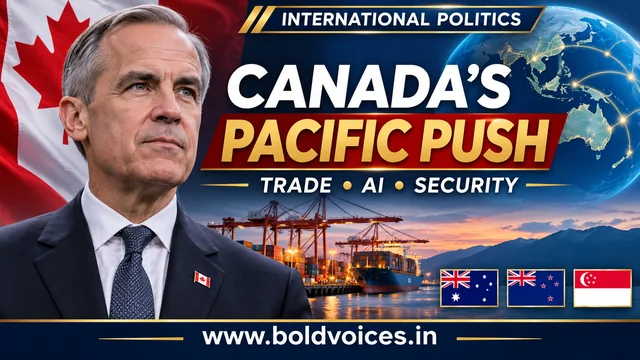
Canadian Prime Minister Mark Carney has discussed closer economic and security cooperation with Australia, New Zealand and Singapore, as Ottawa works to broaden its international partnerships.
Carney met Australian Prime Minister Anthony Albanese, New Zealand Prime Minister Christopher Luxon and Singapore Prime Minister Lawrence Wong on 19 November, alongside the APEC leaders’ meeting in Shenzhen, China. Canada’s official account identifies trade, supply chains, artificial intelligence governance and Indo-Pacific security as priorities.
What the leaders discussed
The four prime ministers reaffirmed support for predictable markets and international trade rules. They explored stronger commercial links, including through the Comprehensive and Progressive Agreement for Trans-Pacific Partnership, or CPTPP.
According to Ottawa, Canada’s combined merchandise trade with the three partners exceeded C$15 billion in 2025. The leaders also agreed to pursue closer defence and security cooperation.
The readout describes shared priorities and continued engagement. It does not announce a new four-country free-trade treaty or military alliance.
Why Canada is widening its options
Analysis: Building relationships across several markets can give Canada more room to manoeuvre when a major trading relationship becomes uncertain. It also creates alternative destinations for exports and potential sources of investment.
However, diplomatic engagement alone cannot redirect trade. Businesses need competitive prices, reliable transport, clear regulations and customers willing to buy.
The practical test will be whether these discussions produce measures that companies can use.
Trade and security increasingly overlap
Analysis: Supply chains are now a political concern because disruption can affect both economic activity and access to strategically important goods.
The inclusion of AI governance alongside commercial and defence discussions illustrates how technology policy increasingly crosses traditional boundaries. Governments are considering not only where investment goes, but also how emerging technologies should be governed.
The meeting’s stated priorities suggest cooperation across these areas. They do not establish that the four countries have adopted identical policies.
Part of a broader APEC strategy
Canada’s government says the wider APEC meeting advanced work on transport connections, paperless trade and protecting food supplies from disruption.
Ottawa also reported that negotiations toward an ASEAN–Canada trade agreement had been substantially concluded, while negotiations with the Philippines had concluded. Its stated ambition is to sign both agreements in 2027—a future step that should be distinguished from agreements already operating.
Why Indian readers should watch
Analysis: Canada’s outreach offers a useful example of how countries are trying to protect economic choices through multiple partnerships.
For Indian businesses, the developments are worth following for possible changes in regional competition, supply networks and technology cooperation. Any commercial opportunity would depend on the rules eventually adopted and the markets involved.
The meeting itself does not create new Canadian immigration routes, work permits or employment guarantees.
What happens next
The next indicators of progress will be concrete follow-up announcements: investment projects, trade facilitation measures, AI cooperation initiatives or defined security activities.
Analysis: Carney’s Pacific outreach establishes a diplomatic direction. Its value will depend on implementation—whether the commitments make trade more dependable and cooperation more useful for businesses and citizens.
Like what you read? Help BoldVoices.in keep independent journalism going.
Manage Consent
To provide the best experiences, we use technologies like cookies to store and/or access device information. Consenting to these technologies will allow us to process data such as browsing behavior or unique IDs on this site. Not consenting or withdrawing consent, may adversely affect certain features and functions.
Functional
Always active
The technical storage or access is strictly necessary for the legitimate purpose of enabling the use of a specific service explicitly requested by the subscriber or user, or for the sole purpose of carrying out the transmission of a communication over an electronic communications network.
Preferences
The technical storage or access is necessary for the legitimate purpose of storing preferences that are not requested by the subscriber or user.
Statistics
The technical storage or access that is used exclusively for statistical purposes.The technical storage or access that is used exclusively for anonymous statistical purposes. Without a subpoena, voluntary compliance on the part of your Internet Service Provider, or additional records from a third party, information stored or retrieved for this purpose alone cannot usually be used to identify you.
Marketing
The technical storage or access is required to create user profiles to send advertising, or to track the user on a website or across several websites for similar marketing purposes.