Curated by the Team of Boldvoices 21 November 2026 | Canada Politics
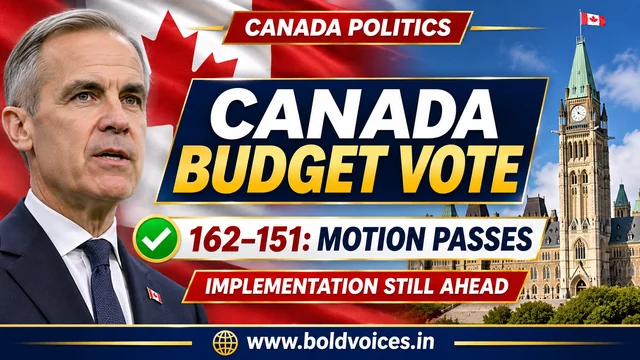
Prime Minister Mark Carney’s government has secured approval for its 2026 budget policy motion in Canada’s House of Commons, winning the 19 November vote by 162 to 151.
The result gives the government parliamentary backing for its fiscal direction. It does not, by itself, turn every budget proposal into an operational programme or a new law.
What Parliament approved
The motion asked MPs to approve the government’s budgetary policy in general. Its passage is an important political milestone, while individual measures requiring legislation must proceed through further parliamentary stages.
For households and businesses, that distinction matters: a proposal appearing in a budget is different from a benefit becoming payable or a tax provision taking effect.
Implementation legislation, programme rules and commencement dates will determine when particular changes become available.
What the government wants to achieve
Finance Minister François-Philippe Champagne presented Budget 2026: Masters of Our Destiny on 5 November.
The Department of Finance describes its priorities as encouraging investment, improving productivity, diversifying trade and addressing household costs. Proposals include business investment incentives, electricity infrastructure, critical minerals and nuclear energy development.
On household support, the government proposes a 2027 supplement to the Canada Groceries and Essentials Benefit, a fully refundable Canada Caregiver Credit and support for energy-efficient home retrofits. These remain subject to the applicable implementation requirements.
Why the opposition objects
Reporting by Connect FM, drawing on The Canadian Press, says Conservative Leader Pierre Poilievre criticised the scale of borrowing. NDP Leader Avi Lewis argued that the budget favours large businesses over ordinary Canadians.
Analysis: The disagreement centres on how to improve living standards. The government’s approach relies partly on investment producing stronger economic capacity over time. Critics question the borrowing involved and whether households will receive enough immediate relief.
Those arguments will ultimately be tested against delivery, costs and measurable outcomes.
A political win with an economic test ahead
Analysis: Winning the vote allows Carney’s government to advance its programme. Delivering its objectives will be a longer task.
Investment incentives need businesses willing to invest. Infrastructure commitments need projects that can be approved and completed. Affordability measures need clear eligibility rules and effective administration.
The distinction between announced funding and completed results will therefore remain central to assessing this budget.
What Canadian residents should watch
Residents should check the implementation date and eligibility conditions for each measure before making financial plans.
Analysis: For Indian-origin families in Canada, as for other residents, the practical questions are specific: which benefit applies, what income or residency conditions govern it, and when an official application or payment process begins.
The budget vote alone should not be treated as confirmation that a particular household qualifies.
What happens next
Budget implementation legislation will provide the next major test, translating proposals into detailed provisions for parliamentary scrutiny.
Analysis: Carney has won backing for the government’s fiscal direction. The next phase is about execution—whether the measures deliver useful investment and household relief while keeping public finances manageable.
Like what you read? Help BoldVoices.in keep independent journalism going.
Manage Consent
To provide the best experiences, we use technologies like cookies to store and/or access device information. Consenting to these technologies will allow us to process data such as browsing behavior or unique IDs on this site. Not consenting or withdrawing consent, may adversely affect certain features and functions.
Functional
Always active
The technical storage or access is strictly necessary for the legitimate purpose of enabling the use of a specific service explicitly requested by the subscriber or user, or for the sole purpose of carrying out the transmission of a communication over an electronic communications network.
Preferences
The technical storage or access is necessary for the legitimate purpose of storing preferences that are not requested by the subscriber or user.
Statistics
The technical storage or access that is used exclusively for statistical purposes.The technical storage or access that is used exclusively for anonymous statistical purposes. Without a subpoena, voluntary compliance on the part of your Internet Service Provider, or additional records from a third party, information stored or retrieved for this purpose alone cannot usually be used to identify you.
Marketing
The technical storage or access is required to create user profiles to send advertising, or to track the user on a website or across several websites for similar marketing purposes.