Date: 30 October 2026 Curated by the team of boldvoices
Afghanistan is witnessing a sharp return of opium-poppy cultivation despite the Taliban’s nationwide ban, as farmers struggle with falling agricultural incomes, recurring drought and worsening food insecurity.
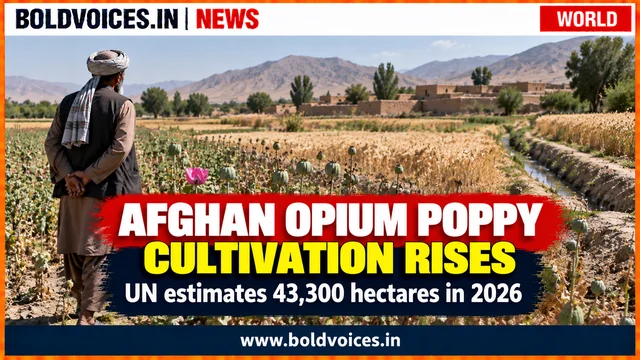
The UNODC survey estimates that opium-poppy cultivation reached approximately 43,300 hectares in 2026, up from about 10,200 hectares in 2025. Estimated opium production rose to nearly 1,500 tonnes, compared with around 300 tonnes a year earlier. Poppy cultivation was detected in 16 provinces, with roughly three-quarters of the area concentrated in the north-east. The figures indicate a sharp reversal, although cultivation remains far below the levels recorded before the 2022 ban.
The findings point to growing economic pressure in rural communities, where many farmers say legal crops such as wheat and cotton are no longer generating enough income to support their families.
The development could also have consequences for international drug markets if Afghanistan’s opium production continues to recover.
Poppy cultivation rises despite the ban
The Taliban introduced a strict ban on opium cultivation in 2022, following years in which Afghanistan was one of the world’s largest sources of illicit opium.
The restrictions initially caused poppy cultivation to fall dramatically.
However, the latest UN assessment indicates that the decline is being reversed. Cultivation reportedly increased from around 10,000 hectares in 2025 to 43,300 hectares this year.
The estimated area remains substantially below the approximately 177,000 hectares cultivated in 2021, before the ban was introduced.
The Taliban authorities have disputed the UN figures, saying the actual cultivation area is considerably lower and that eradication operations are continuing.
The difference between the UN estimate and the Taliban’s account highlights the difficulty of independently monitoring agricultural activity in parts of the country.
Farmers struggle to replace lost income
For many rural families, the central problem is economic survival.
Farmers who previously depended on poppy cultivation have been encouraged to switch to legal alternatives, including wheat, cotton, fruit and other agricultural products.
But those alternatives have not consistently provided comparable incomes.
In parts of northern Afghanistan, farmers report that wheat production barely covers costs, while cotton prices have fallen sharply.
Recurring drought has further reduced water availability. In some areas, declining water quality and damaged irrigation systems are making cultivation more difficult.
Higher-value alternatives such as orchards and nut plantations also require years to become productive and depend on reliable water supplies, investment and access to markets.
Without sufficient financial and technical support, some farmers are returning to poppy cultivation despite the risks of violating the ban.
Child malnutrition adds to the humanitarian crisis
The consequences extend beyond agricultural income.
Aid workers and medical personnel have reported increasing pressure on families struggling to afford sufficient food and healthcare.
UN agencies have warned that critical levels of child malnutrition, already affecting several Afghan provinces, could spread further in 2027.
Clinics in farming communities are treating children whose families cannot consistently afford nutritious food.
The situation is being worsened by reductions in foreign assistance, economic isolation and limited access to sustainable employment.
The latest reporting highlights a difficult reality: restrictions on one source of income have not automatically created viable alternatives for vulnerable farming households.
Opium sales remain economically significant
Despite the cultivation ban, Afghanistan’s opium economy has not disappeared.
UNODC estimates that opium sales generated approximately $525 million in 2026, the highest level since 2018 apart from 2022, when the ban contributed to a sharp rise in prices.
The agency has also warned that pre-ban opium stockpiles may be declining.
If those reserves become insufficient to meet demand, renewed cultivation could increase incentives for farmers to plant poppy again.
A sustained recovery in Afghan production could affect international heroin supply chains, trafficking networks and law-enforcement operations, particularly in markets historically supplied by Afghan opiates.
International concerns over the future
Afghanistan previously supplied a substantial share of the world’s illicit opium.
A renewed increase in cultivation could therefore have consequences well beyond the country’s borders.
International agencies face the challenge of supporting rural livelihoods while preventing the expansion of illegal drug production.
The issue also presents a difficult policy choice for the Taliban authorities: maintaining the cultivation ban will require more than enforcement operations if farmers cannot earn enough from legal crops.
UN officials have stressed the need for alternative-livelihood programmes, improved agricultural infrastructure, reliable water supplies and access to markets.
The challenge ahead
Afghanistan’s latest poppy figures show that restrictions alone cannot resolve the economic pressures facing rural communities.
A sustainable reduction in illegal cultivation will depend on whether farmers can earn a reliable income through legal agriculture.
Without better irrigation, market access, financial assistance and food security, the pressure to return to poppy cultivation may continue.
The situation is therefore both a challenge for Afghanistan’s rural economy and a concern for international efforts to limit illegal drug production.
Like what you read? Help BoldVoices.in keep independent journalism going.
Manage Consent
To provide the best experiences, we use technologies like cookies to store and/or access device information. Consenting to these technologies will allow us to process data such as browsing behavior or unique IDs on this site. Not consenting or withdrawing consent, may adversely affect certain features and functions.
Functional
Always active
The technical storage or access is strictly necessary for the legitimate purpose of enabling the use of a specific service explicitly requested by the subscriber or user, or for the sole purpose of carrying out the transmission of a communication over an electronic communications network.
Preferences
The technical storage or access is necessary for the legitimate purpose of storing preferences that are not requested by the subscriber or user.
Statistics
The technical storage or access that is used exclusively for statistical purposes.The technical storage or access that is used exclusively for anonymous statistical purposes. Without a subpoena, voluntary compliance on the part of your Internet Service Provider, or additional records from a third party, information stored or retrieved for this purpose alone cannot usually be used to identify you.
Marketing
The technical storage or access is required to create user profiles to send advertising, or to track the user on a website or across several websites for similar marketing purposes.