
28 October 2026
Curated by the team of Boldvoices
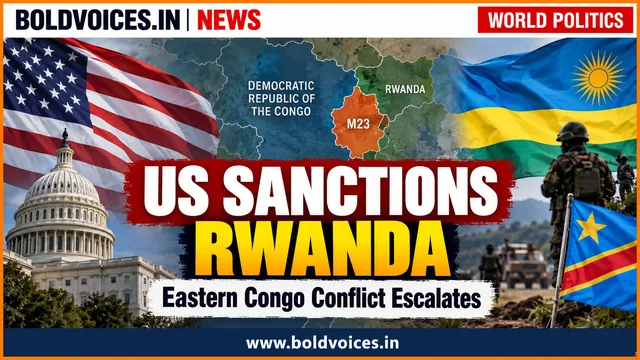
The United States has imposed sanctions on Rwanda’s Ministry of Defence and Zigama Credit and Savings Society, escalating pressure over the conflict in the eastern Democratic Republic of the Congo (DRC). Announced by the US Department of the Treasury on 28 October, the measures target institutions Washington accuses of supporting the March 23 Movement (M23) and its political wing.
What Washington Announced
The US Treasury’s Office of Foreign Assets Control said it had designated Rwanda’s Ministry of Defence and Zigama Credit and Savings Society under the US sanctions framework related to instability in the DRC. Under the measures, property and interests in property of designated parties that are in the United States or in the possession or control of US persons are generally blocked and must be reported. US persons are generally prohibited from transactions involving blocked property unless an exemption or licence applies. The scope and consequences depend on the applicable rules and authorisations.
US officials allege that Rwanda’s security apparatus has provided M23 with troops, military equipment, logistics and training. Treasury also alleges that Zigama facilitated payments for military equipment and transactions connected to M23 and mineral flows from areas under the group’s control. These are the US government’s stated grounds for the designations; the allegations should be clearly distinguished from independently adjudicated findings.
The Washington Accords and the Conflict
The sanctions follow the Washington Accords for Peace and Prosperity, signed by the Congolese and Rwandan presidents on 4 December 2025 after US-led mediation. The agreement aimed to support a peaceful resolution and establish a framework for regional trade and investment. Washington says the alleged support for M23 conflicts with those commitments.
The security situation remains complex. M23 has captured major population centres in North and South Kivu, including Goma and Bukavu in early 2025. The conflict involves competing security claims, armed groups operating in the border region, longstanding distrust between Kinshasa and Kigali, and the wider question of state authority in eastern Congo. Rwanda has denied supporting M23 and has argued that the DRC must address threats posed by the Democratic Forces for the Liberation of Rwanda (FDLR). The Congolese government, the United States and UN experts have made allegations concerning Rwanda’s role, which Kigali disputes.
Why Minerals and Financial Networks Matter
Eastern Congo contains important deposits of gold, coltan and other minerals used in electronics and industrial supply chains. Control over mines, roads and border trade can create revenue and strategic leverage for armed actors. Treasury alleges that gold and coltan from M23-controlled areas move through regional supply chains and that Zigama facilitated certain related financial transactions. These claims place mineral traceability and due diligence at the centre of the dispute.
Sanctions can restrict access to the US financial system and deter some transactions, but their practical impact depends on enforcement, the networks involved and the decisions of banks and businesses outside US jurisdiction. They can raise costs for designated institutions; they cannot, on their own, resolve the political and security disputes driving the conflict.
Diplomatic and Regional Consequences
For Washington, the move tests whether economic pressure can reinforce a peace agreement that has yet to end the fighting. For the DRC, the measures signal US backing for its demand that Rwanda withdraw forces and stop supporting M23. For Rwanda, the designations create financial and diplomatic pressure and add strain to relations with Western partners.
Regional governments and mediators face a difficult balance: press for compliance while keeping negotiations viable and limiting further harm to civilians. Any durable settlement will require verifiable steps on troop deployments, armed-group activity, security guarantees, humanitarian access and the implementation of agreed commitments by all relevant parties.
What to Watch Next
Three indicators will help show whether the sanctions are changing the diplomatic landscape: whether military activity or support for M23 changes on the ground; whether financial institutions and mineral buyers strengthen compliance and supply-chain checks; and whether the parties return to negotiations with measurable implementation steps. Further sanctions are possible, but should not be treated as certain without an official announcement.
The Bottom Line
The US sanctions announced on 28 October mark a new phase of pressure over eastern Congo. Their significance lies not only in the institutions targeted, but in Washington’s attempt to link the costs of alleged support for M23 to commitments made under the 2025 Washington Accords. Whether this pressure contributes to peace will depend on enforcement, diplomacy and concrete changes in the conflict—not the announcement alone.
#InternationalPolitics #Geopolitics #USForeignPolicy #Rwanda #DRC #EasternCongo #M23 #AfricaPolitics #WorldNews #BoldVoices


