Curated by the Team of Boldvoices 21 November 2026 | International Politics
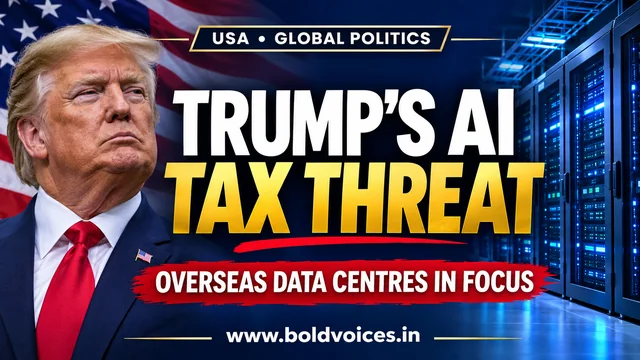
US President Donald Trump has threatened to penalise American companies that build artificial intelligence data centres overseas, bringing the location of computing infrastructure into Washington’s competition with China.
Speaking at the White House on Friday, 20 November, Trump said companies pursuing such projects abroad could face a “tremendous tax”. Reuters reported that he presented the move as a way to strengthen America’s position in artificial intelligence.
What Trump announced—and what remains unclear
Trump’s comments signal a push to keep more AI investment inside the United States. However, the announcement left major practical questions unanswered.
The Associated Press reported that he supplied no detailed plan and said he had not yet informed his own officials. The remarks therefore should not be treated as evidence that a new overseas data-centre tax has already taken effect.
Companies and foreign governments will need clarity on the proposed rate, the projects covered, possible exemptions and the implementation timetable.
Why this is an international political story
Analysis: AI infrastructure is becoming part of the contest over economic influence. A country hosting major computing facilities may gain investment and a stronger position in the digital economy.
Trump’s approach would put pressure on American companies to align their international expansion with Washington’s domestic priorities. Host countries, meanwhile, may want those same companies to invest locally.
That creates a potential conflict between national industrial policy and the international business models of US technology firms.
Why companies build overseas
Overseas expansion can serve practical purposes. Business Insider’s reporting identifies proximity to regional customers, local data requirements, reliability, and access to power and land among the reasons companies locate facilities abroad.
Analysis: This complicates the idea that every foreign project represents investment simply diverted from America. Some facilities serve needs tied to their location. The consequences of any penalty would depend heavily on how Washington defines its scope.
The political challenge inside America
Trump’s support for domestic construction also faces resistance at home. Residents have raised concerns about electricity bills, pollution and pressure on power grids.
Analysis: Keeping projects in America would not automatically resolve those disputes. Developers would still need suitable sites, infrastructure and community support.
The administration consequently faces two connected challenges: encouraging companies to build domestically and persuading communities that the benefits justify the costs.
What it could mean for India
Analysis: For India, the issue deserves attention because restrictions on overseas investment by American firms could influence future technology partnerships.
The impact cannot yet be calculated. It would depend on whether a formal measure emerges and whether it covers new construction, existing facilities, partnerships or particular kinds of AI computing.
There is currently insufficient detail to conclude that a specific Indian project will be affected.
What happens next
The next meaningful development would be a published proposal explaining the policy’s authority, coverage and implementation.
Until then, Trump’s remarks represent a significant political signal. The gap between that signal and an enforceable measure remains the central uncertainty.
Like what you read? Help BoldVoices.in keep independent journalism going.
Manage Consent
To provide the best experiences, we use technologies like cookies to store and/or access device information. Consenting to these technologies will allow us to process data such as browsing behavior or unique IDs on this site. Not consenting or withdrawing consent, may adversely affect certain features and functions.
Functional
Always active
The technical storage or access is strictly necessary for the legitimate purpose of enabling the use of a specific service explicitly requested by the subscriber or user, or for the sole purpose of carrying out the transmission of a communication over an electronic communications network.
Preferences
The technical storage or access is necessary for the legitimate purpose of storing preferences that are not requested by the subscriber or user.
Statistics
The technical storage or access that is used exclusively for statistical purposes.The technical storage or access that is used exclusively for anonymous statistical purposes. Without a subpoena, voluntary compliance on the part of your Internet Service Provider, or additional records from a third party, information stored or retrieved for this purpose alone cannot usually be used to identify you.
Marketing
The technical storage or access is required to create user profiles to send advertising, or to track the user on a website or across several websites for similar marketing purposes.