Updated: Saturday, 31 October 2026 at 6:02 PM IST Curated by the Team of Boldvoices
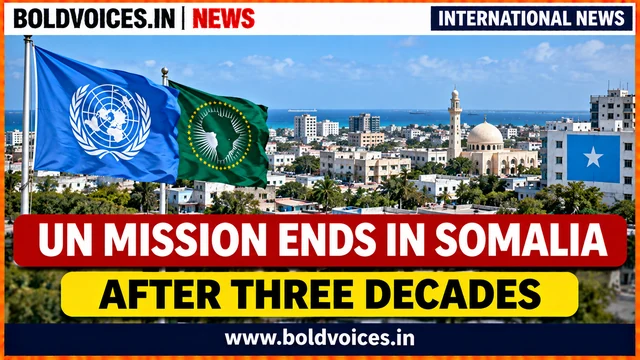
Closure confirmed — 31 October 2026: The United Nations’ peacekeeping office reported on 31 October that UNTMIS completed its two-year transition and ceased operations. Under the agreed roadmap, its mandated functions have been transferred to Somali institutions and continuing UN agencies, funds and programmes. The closure ends the political mission, not the wider UN presence in Somalia or the separate African Union Support and Stabilisation Mission in Somalia (AUSSOM). The handover will now be tested by the capacity of receiving institutions to sustain the work amid political, security and humanitarian pressures. For the earlier account of the political-mediation dispute, see our report on UNTMIS’s scheduled end.
The transition roadmap agreed by the Federal Government of Somalia and the United Nations transfers UNTMIS’s mandated functions to Somali institutions and continuing UN agencies, funds and programmes. The central issue now is whether the receiving institutions have the staffing, financing and coordination needed to maintain those functions.
The institutional handover
UNTMIS supported political processes, constitutional and governance work, reconciliation and institution-building. Those responsibilities are not being handed to a single replacement mission; they are being distributed among Somali institutions and UN entities according to their respective mandates.
UNTMIS was part of a gradual shift towards a more nationally led model. Its responsibilities included supporting political processes, constitutional and governance work, reconciliation and institutional development. The mission’s conclusion is therefore an institutional transition rather than the end of international engagement.
The UN says its remaining presence will operate through resident agencies, funds and programmes, in partnership with Somali authorities, the African Union and other international partners. Those organisations will continue supporting development, humanitarian assistance, human rights and stability.
African Union security mission remains separate
The end of UNTMIS should not be confused with the termination of the African Union’s security deployment.
The African Union Support and Stabilisation Mission in Somalia (AUSSOM) is a separate operation. Under Security Council Resolution 2809, adopted in December 2025, its authorisation was extended until 31 December 2026. The resolution authorised the deployment of up to 11,826 uniformed personnel, including 680 police personnel.
AUSSOM supports Somali security forces in efforts to stabilise the country and counter the threat posed by Al-Shabaab. The United Nations Support Office in Somalia (UNSOS) provides logistical assistance to the African Union mission, including essential operational support.
This distinction matters: the closure of UNTMIS does not itself terminate AUSSOM or the UN’s wider presence in Somalia. The security mission has its own mandate and support arrangements.
Security remains a major test
Despite years of international assistance, Somalia continues to face a persistent threat from Al-Shabaab, an armed group responsible for attacks against civilians, government institutions and security forces.
The long-term challenge is not limited to military operations. Somalia must strengthen the capacity of its national security institutions, improve coordination between federal and regional authorities, and ensure that areas cleared of militant control can be governed and protected over time.
The African Union mission and Somali forces remain important to this effort. However, the sustainability of security gains will depend on reliable financing, effective institutions and the ability of Somali authorities to assume greater responsibility.
Political disagreements add to the pressure
Somalia’s political environment also remains fragile. Disagreements between the federal government and opposition groups over constitutional changes, electoral arrangements and the distribution of authority have complicated efforts to build consensus.
The debate over changes to the country’s political framework has raised concerns about the timing and legitimacy of future elections. The UN has called for inclusive political dialogue and reconciliation, stressing that institutional progress will be difficult to sustain without cooperation among Somalia’s political stakeholders.
Political-mediation gap — 31 October 2026: An Associated Press report published on 29 October said there was no agreed replacement mechanism to mediate disputes between Somalia’s federal government and opposition leaders after UNTMIS closes. UN-backed talks in July did not resolve the dispute over constitutional changes extending presidential and parliamentary terms from four years to five. The government says the changes allow current officeholders to remain until 2027; opposition leaders reject applying the extensions to incumbents and say their mandates have expired. President Hassan Sheikh Mohamud has invited political leaders to election talks scheduled for 14–18 November, but the main opposition groups had not confirmed attendance at the time of that report. These are competing political positions, not a judicial determination of the mandates.
The transition of UN responsibilities to Somali institutions makes this domestic political cooperation even more important. National ownership can strengthen sovereignty, but it also requires institutions that are trusted, capable and broadly accepted.
Humanitarian needs remain severe
Somalia continues to face overlapping humanitarian pressures, including drought, flooding, displacement and food insecurity. Funding constraints have added to the difficulties faced by aid organisations working with vulnerable communities.
The UN has emphasised that humanitarian and development support must continue even as the political mission closes. The needs of displaced families and communities affected by conflict and climate-related shocks will not disappear with the end of UNTMIS.
What happens next?
The immediate test will be whether the responsibilities transferred from UNTMIS can be sustained effectively by Somali institutions and the UN agencies that remain. The transition will require continued coordination, funding and political commitment.
For Somalia, the end of the mission is both a milestone and a responsibility. It reflects a move towards greater national ownership, but it also places renewed emphasis on the ability of the country’s institutions to manage political dialogue, protect civilians, deliver public services and build lasting stability.
The United Nations has reaffirmed that it will continue supporting Somali-led efforts towards peace and development. The next phase will be judged not simply by the closure of a mission, but by whether Somalia can translate decades of international engagement into durable security, stronger governance and a more stable future.
Like what you read? Help BoldVoices.in keep independent journalism going.
Manage Consent
To provide the best experiences, we use technologies like cookies to store and/or access device information. Consenting to these technologies will allow us to process data such as browsing behavior or unique IDs on this site. Not consenting or withdrawing consent, may adversely affect certain features and functions.
Functional
Always active
The technical storage or access is strictly necessary for the legitimate purpose of enabling the use of a specific service explicitly requested by the subscriber or user, or for the sole purpose of carrying out the transmission of a communication over an electronic communications network.
Preferences
The technical storage or access is necessary for the legitimate purpose of storing preferences that are not requested by the subscriber or user.
Statistics
The technical storage or access that is used exclusively for statistical purposes.The technical storage or access that is used exclusively for anonymous statistical purposes. Without a subpoena, voluntary compliance on the part of your Internet Service Provider, or additional records from a third party, information stored or retrieved for this purpose alone cannot usually be used to identify you.
Marketing
The technical storage or access is required to create user profiles to send advertising, or to track the user on a website or across several websites for similar marketing purposes.