Curated by the Team of Boldvoices 22 November 2026
Singapore is preparing to release a fuller assessment of its third-quarter economy, providing businesses with fresh evidence about growth across manufacturing and services.
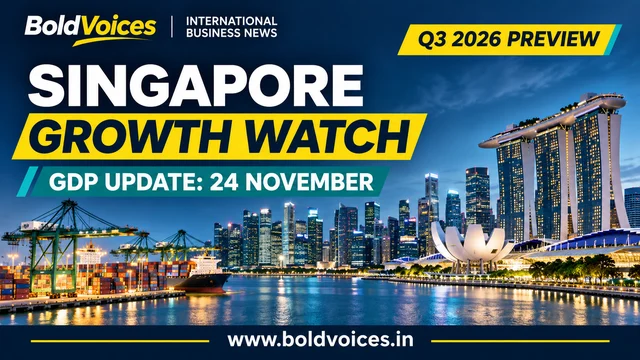
The Third Quarter 2026 Economic Survey of Singapore is scheduled for 24 November at 8:00 a.m. Singapore time—5:30 a.m. IST. The government says it will cover GDP, sectoral performance, sources of growth, inflation, employment and productivity.
The new results have not yet been released. This article explains the existing advance estimates and the questions to watch in the forthcoming report.
What the existing estimates show
Singapore’s advance estimates, published on 14 October, indicated continued expansion at a slower pace.
Measure
Q3 2026 advance estimate
Q2 2026 comparison
Real GDP growth, year on year
5.4%
6.2%
Real GDP growth, seasonally adjusted quarter on quarter
1.1%
1.5%
Manufacturing growth, year on year
7.5%
12.9%
Manufacturing growth, seasonally adjusted quarter on quarter
−0.9%
+6.3%
These figures describe different comparisons. Annual growth measures activity against the corresponding quarter last year; quarterly growth measures movement from the immediately preceding quarter.
Why the fuller report matters
Advance GDP estimates rely largely on information from the first two months of the quarter. They provide an early indication and can change when more comprehensive information becomes available.
Analysis: Businesses should therefore examine both revisions and the composition of growth.
An unchanged headline could conceal stronger activity in one industry and weaker conditions in another. A revised headline also needs context: the commercial implications depend on which sectors changed and whether the movement appears persistent.
For a supplier, the most useful information may be the performance of its customers’ industry rather than the national average.
Manufacturing: growth with a quarterly pullback
The advance release identified expansion in electronics, precision engineering, transport engineering and general manufacturing. Chemicals and biomedical manufacturing recorded declines.
Analysis: This mixed picture explains why “manufacturing grew” can be accurate without describing every producer’s experience.
The annual increase and quarterly contraction can also coexist. Output may remain above last year’s level while easing from a particularly strong preceding quarter.
The forthcoming report will help businesses assess whether the pullback reflects temporary production patterns or a broader change in momentum.
Look beyond the production headline
Analysis: Stronger output becomes more valuable when it supports sustainable orders, productive investment and employment.
Companies evaluating expansion should ask whether demand is broadening, whether customers are maintaining purchasing plans and whether additional capacity can earn an adequate return.
A rise in production alone does not establish stronger profitability. Input costs, selling prices, utilisation and financing conditions also affect the outcome.
The same applies to productivity: producing more with additional resources differs from producing more efficiently.
Services deserve equal attention
Analysis: A fuller economic assessment should examine services alongside manufacturing.
Businesses involved in trade, transport, finance and professional services can face different demand conditions from consumer-facing companies. Growth in one area may provide opportunities for suppliers without immediately improving sales across the wider economy.
Employment and productivity information can help clarify whether expansion is generating broader commercial benefits.
Readers should avoid assuming that a strong GDP figure means every company is hiring or that every household is experiencing higher purchasing power.
What Indian businesses should watch
Analysis: Indian companies with customers, suppliers or operations in Singapore can use the report to review specific commercial assumptions.
Exporters can assess demand in the industries they serve. Service providers can examine whether customers are continuing investment and operational projects. Businesses planning a presence should compare expected revenue with staffing, premises and other operating costs.
The useful response is to connect the economic evidence to actual contracts and customer discussions.
A national growth figure provides context; it cannot establish the viability of an individual expansion plan.
How to read the November 24 release
Analysis: Four questions will make the report easier to assess:
Were the advance GDP estimates revised? Check the size and source of any change.
Which sectors contributed most? Look for the breadth of growth.
What happened to employment and productivity? Examine how expansion is being achieved.
What does the official outlook say? Keep projections separate from completed results.
Until the release, the October advance estimates remain the published starting point for this assessment. The next report will provide a fuller basis for judging Singapore’s economic momentum.
Like what you read? Help BoldVoices.in keep independent journalism going.
Manage Consent
To provide the best experiences, we use technologies like cookies to store and/or access device information. Consenting to these technologies will allow us to process data such as browsing behavior or unique IDs on this site. Not consenting or withdrawing consent, may adversely affect certain features and functions.
Functional
Always active
The technical storage or access is strictly necessary for the legitimate purpose of enabling the use of a specific service explicitly requested by the subscriber or user, or for the sole purpose of carrying out the transmission of a communication over an electronic communications network.
Preferences
The technical storage or access is necessary for the legitimate purpose of storing preferences that are not requested by the subscriber or user.
Statistics
The technical storage or access that is used exclusively for statistical purposes.The technical storage or access that is used exclusively for anonymous statistical purposes. Without a subpoena, voluntary compliance on the part of your Internet Service Provider, or additional records from a third party, information stored or retrieved for this purpose alone cannot usually be used to identify you.
Marketing
The technical storage or access is required to create user profiles to send advertising, or to track the user on a website or across several websites for similar marketing purposes.