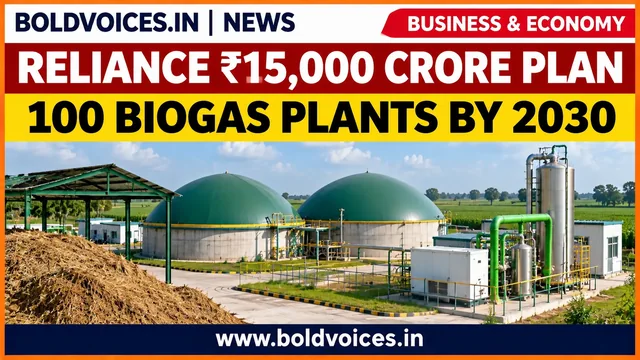
Reliance Industries plans to invest approximately ₹15,000 crore in around 100 compressed biogas (CBG) plants by 2030, according to a 17 November 2026 report citing Vikas Rathi, chief financial officer of Reliance’s Bio Energy Business. The plan highlights Reliance’s ambition to turn agricultural residue and other organic material into commercially useful fuel. It could create opportunities for farmers, transport businesses and waste-management suppliers, but the commercial outcome depends on project execution and viable supply chains.
What is the new ₹15,000 crore plan?
The reported investment covers about 100 plants through 2030. Dividing ₹15,000 crore by 100 gives a simple average of ₹150 crore per proposed plant; it is not a company-announced cost for each facility. Actual expenditure depends on plant capacity, land, feedstock arrangements, technology and infrastructure. An investment intention does not mean the full amount has already been spent or every proposed plant has been commissioned.
How does this compare with Reliance’s earlier targets?
Reliance’s corporate disclosures have set out a broader ambition of more than 500 CBG plants by 2030. Its FY2025–26 reporting referred to 55 plants under development, which is not the same as 55 fully operational facilities.
Reliance has also outlined substantial state-level investment in Andhra Pradesh. An earlier programme was described as ₹65,000 crore for 500 proposed plants. More recently, executive director Anant Ambani spoke of a ₹1 lakh crore proposed investment in CBG projects in Andhra Pradesh. The newer statement should not be overlooked when describing the group’s investment ambitions.
The relationship between these state-level plans, the company-wide 500-plus-plant ambition and the newly reported ₹15,000 crore programme has not been fully clarified. Their totals should not be added together as though they are separate, non-overlapping commitments.
Where does Reliance’s bioenergy business stand today?
Reliance began with demonstration CBG units at Jamnagar, Gujarat, and subsequently commissioned a commercial-scale plant at Barabanki, Uttar Pradesh. At an industry event on 17 November, Rathi described an operating network of 45 plants, while indicating that some facilities were running below capacity. The company intends to add more plants by March 2027. These latest operating figures differ from the earlier corporate disclosure of 55 plants under development because operational plants and development pipelines measure different things.
What is compressed biogas?
CBG is produced by processing biodegradable materials such as crop residue, cattle dung, sugarcane press mud and organic municipal waste. Microorganisms break down the feedstock without oxygen, producing biogas. The gas is purified and compressed into a methane-rich fuel suitable for certain transport and industrial uses. Reliance says its CBG can contain more than 96% methane.
CBG can substitute for fossil-derived natural gas in compatible applications. Production also generates digestate, which can be processed into organic manure. However, the climate benefits depend on feedstock sourcing, operational efficiency and control of methane leakage.
Why Reliance is investing in bioenergy
Reliance is expanding beyond its established refining, petrochemical, retail and telecom businesses into renewable energy, storage and low-carbon fuels. Bioenergy offers a fuel that can be stored and transported, unlike electricity generated directly by solar panels and wind turbines. The programme is aligned with Reliance’s stated net-zero operational carbon ambition for 2035, although actual emissions reductions will need to be measured rather than assumed.
How farmers could benefit
CBG plants can create markets for agricultural residue, manure and suitable biomass. Farmers and local suppliers may earn additional income by selling material that otherwise has limited commercial use. Some regions could also see opportunities in collection, baling, transport and storage.
But benefits are not automatic. Farmers need transparent procurement agreements, fair prices and timely payments. Crop residues are seasonal, and moving bulky material over long distances can be expensive. A successful plant requires reliable year-round feedstock supplies.
Could biogas help reduce crop burning?
Collecting suitable agricultural residue for energy offers an alternative to burning it in fields. That could contribute to cleaner air in regions where residue burning is a recurring problem. Yet building plants alone will not end the practice: harvesting schedules, machinery availability, storage and logistics must all work economically for farmers.
What are the employment opportunities?
Construction, plant operations, maintenance, biomass procurement, transportation and fertiliser distribution may create employment and small-business opportunities. However, no verified job count has been established for the newly reported 100-plant programme. Job projections from larger or older investment announcements should not be presented as confirmed hiring attributable to this specific plan.
Can CBG reduce dependence on imported gas?
Domestic CBG can replace some fossil-derived gas where fuel specifications and infrastructure permit. Reliance’s broader programme has previously been linked to the goal of reducing imported liquefied natural gas requirements. But the contribution of the new 100-plant plan cannot be calculated reliably without plant-level capacity, utilisation and actual sales figures.
Organic manure offers another business opportunity
Biogas production leaves digestate that can be processed into fertiliser and soil-improvement products. Reliance markets fermented organic manure under its Bhoovedyam brand. This can offer an additional revenue stream and support soil health when properly processed and used. Its value depends on quality, certification, logistics and demand; it is not necessarily a complete replacement for conventional fertilisers.
What will determine profitability?
Feedstock costs: biomass must be available at viable prices. Transport and storage: agricultural residues are bulky and seasonal. Plant utilisation: operating below capacity can weaken returns. Gas offtake: buyers and commercially viable pricing are essential. Technology and maintenance: reliable processing affects output. Financing: interest costs and construction delays can affect project economics.
Large scale may improve purchasing and operational efficiency, but it does not guarantee profitability.
What investors should watch
Investors following Reliance Industries should distinguish announcements from operating results. Key indicators include commissioned plants, actual CBG production, biomass supply contracts, gas sales, utilisation rates, capital expenditure and margins. Further clarification about the overlap between the 100-plant plan, Andhra Pradesh commitments and the 500-plus-plant ambition will be especially useful.
The biggest challenges
Biomass availability varies by region and season. Transport can be expensive, and plants must manage methane emissions and processing residues responsibly. Commercial demand for gas and manure must grow alongside production. Ultimately, announced investments must translate into completed, reliable and financially sustainable projects.
The bottom line
Reliance’s reported ₹15,000 crore investment in approximately 100 compressed biogas plants by 2030 could support India’s emerging bioenergy economy and create new markets for agricultural waste. However, it must be distinguished from Reliance’s broader 500-plus-plant ambition and newer state-level commitments. Success will be measured not by announced plant counts, but by facilities commissioned, fuel produced, rural income generated and long-term business performance.
Like what you read? Help BoldVoices.in keep independent journalism going.
Manage Consent
To provide the best experiences, we use technologies like cookies to store and/or access device information. Consenting to these technologies will allow us to process data such as browsing behavior or unique IDs on this site. Not consenting or withdrawing consent, may adversely affect certain features and functions.
Functional
Always active
The technical storage or access is strictly necessary for the legitimate purpose of enabling the use of a specific service explicitly requested by the subscriber or user, or for the sole purpose of carrying out the transmission of a communication over an electronic communications network.
Preferences
The technical storage or access is necessary for the legitimate purpose of storing preferences that are not requested by the subscriber or user.
Statistics
The technical storage or access that is used exclusively for statistical purposes.The technical storage or access that is used exclusively for anonymous statistical purposes. Without a subpoena, voluntary compliance on the part of your Internet Service Provider, or additional records from a third party, information stored or retrieved for this purpose alone cannot usually be used to identify you.
Marketing
The technical storage or access is required to create user profiles to send advertising, or to track the user on a website or across several websites for similar marketing purposes.