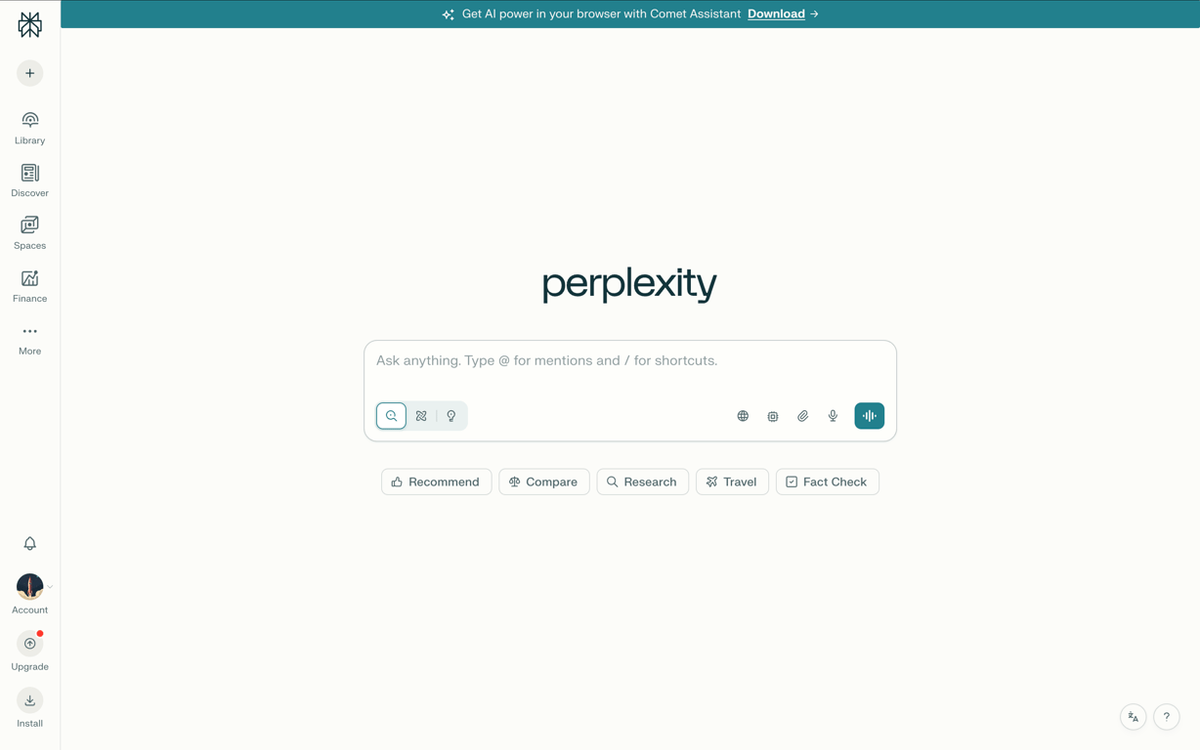
Perplexity is an AI answer engine built around web search and concise responses with inline citations. It can support quick lookups, comparisons, research reports, file analysis and, on eligible plans, model selection and tools for creating work products. Citations make claims easier to check, but they do not guarantee that an answer is complete or correct.
A question triggers searches across online sources; Perplexity synthesizes material into a conversational answer with links. Users can ask follow-ups, request a deeper report, or use modes such as Pro Search and Research. Paid plans may offer advanced models from different providers and model selection. Its product hub describes search, research, analysis and creation tools; names and limits evolve.
Useful tasks
Perplexity can help find current sources, compare products or positions, build a reading list and summarize what multiple pages say. Research mode is for more involved investigations; file uploads let users ask questions about documents; Projects or Spaces group related work. Some subscriptions include image or video generation and Computer-style workflows. Check the current plan page because capabilities and quotas change.
Plans and costs
Perplexity lists a free Standard plan, individual Pro and Max plans, Education Pro for verified users, and Enterprise offerings. The free tier focuses on basic search with limited advanced features; paid tiers add higher usage, advanced model access, deeper research, file analysis or creation tools. Prices and quotas can vary by country, billing channel and promotion. Review the current plan comparison before subscribing.
Privacy and data use
The plans do not all carry identical controls. Perplexity’s help page says Pro, Education Pro and Max users can opt out of data collection in settings; enterprise plans provide additional organization-level controls. Read the Privacy Policy and current plan terms, then set options before uploading sensitive material. Citations are not a confidentiality guarantee.
A good research workflow
Ask a focused question and specify the time period, geography and source types you need. For example: “Compare the latest official battery-recycling rules in India and the EU; link each rule and flag anything you could not verify.” Open the citations, prioritize official documents and original research, and check for disagreement among credible sources. Ask the tool to distinguish sourced facts from its synthesis.
Limitations
Search can miss relevant sources, over-rely on easily indexed pages or summarize a source incorrectly. A citation may support only part of a sentence, and an answer can omit context. Paywalled, local-language or very recent information may be incomplete. Verify high-impact facts against original sources and do not use generated text as the sole basis for legal, medical, financial or safety decisions.
Who may find Perplexity useful?
Perplexity may suit people whose main goal is web research with visible citations. It may be less useful if you need deep office integration, long-running personalized conversation or a particular software ecosystem. Compare it with ChatGPT, Gemini, Claude and Copilot using the same task, and check sourcing, privacy settings and usage limits.
Like what you read? Help BoldVoices.in keep independent journalism going.
Manage Consent
To provide the best experiences, we use technologies like cookies to store and/or access device information. Consenting to these technologies will allow us to process data such as browsing behavior or unique IDs on this site. Not consenting or withdrawing consent, may adversely affect certain features and functions.
Functional
Always active
The technical storage or access is strictly necessary for the legitimate purpose of enabling the use of a specific service explicitly requested by the subscriber or user, or for the sole purpose of carrying out the transmission of a communication over an electronic communications network.
Preferences
The technical storage or access is necessary for the legitimate purpose of storing preferences that are not requested by the subscriber or user.
Statistics
The technical storage or access that is used exclusively for statistical purposes.The technical storage or access that is used exclusively for anonymous statistical purposes. Without a subpoena, voluntary compliance on the part of your Internet Service Provider, or additional records from a third party, information stored or retrieved for this purpose alone cannot usually be used to identify you.
Marketing
The technical storage or access is required to create user profiles to send advertising, or to track the user on a website or across several websites for similar marketing purposes.