Updated: 2 November 2026 | Curated by the team of BoldVoices
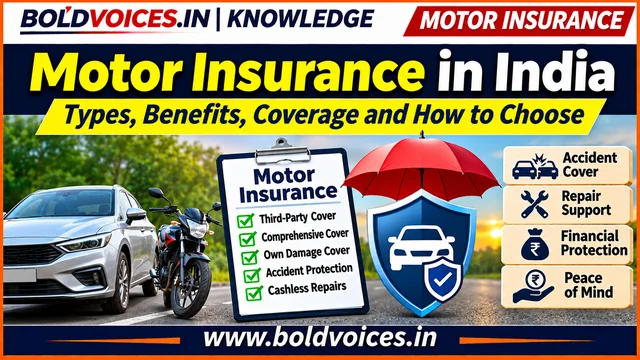
Motor insurance protects vehicle owners against specified financial losses and legal liabilities arising from the use of a vehicle. In India, third-party liability insurance is compulsory for vehicles used in public places under Section 146 of the Motor Vehicles Act, 1988. A valid policy does not remove the need to drive safely or comply with traffic law.
Three main forms of motor insurance
1. Third-party liability cover
This is the legally required minimum for vehicles used in public places. It covers specified legal liability for death, bodily injury or third-party property damage arising from use of the insured vehicle, subject to law and policy terms. It does not pay for damage to your own vehicle.
2. Standalone own-damage cover
This covers specified loss or damage to the insured vehicle from events such as accidents, fire, theft and natural calamities, subject to exclusions. It is generally purchased alongside a valid third-party policy.
3. Package or comprehensive policy
A package policy combines third-party liability and own-damage protection. The term “comprehensive” does not mean every loss is covered. Deductibles, exclusions, conditions and add-on limits still apply.
What risks may be covered?
Accidental damage, collision and overturning.
Fire, explosion and self-ignition.
Theft of the insured vehicle.
Specified natural events such as flood, storm, cyclone, earthquake or landslide.
Third-party bodily injury, death or property damage liability.
Personal accident benefits where included or required under the applicable arrangement.
Check the policy schedule and wording: cover can vary by vehicle type, use, geography and selected add-ons.
Popular motor insurance add-ons
Zero depreciation: reduces specified depreciation deductions on eligible parts, subject to conditions and limits.
Engine protection: may cover defined engine or gearbox damage not otherwise covered, with exclusions.
Return to invoice: may bridge the gap between insured declared value and invoice-related amount in defined total-loss or theft situations.
Roadside assistance: offers specified help for breakdowns or emergencies.
Consumables cover: may pay for eligible consumable items during an admissible repair.
NCB protection: may protect the no-claim bonus under specified conditions; it does not erase the claim itself.
How is motor insurance premium calculated?
Third-party premium is governed by applicable government rules and vehicle category. Own-damage premium can depend on the vehicle’s make, model, age, location, insured declared value (IDV), claims history, selected deductibles and add-ons. A lower quote may reflect lower IDV, higher excess or fewer benefits. Compare the same cover rather than only the final price.
What is No Claim Bonus (NCB)?
NCB is a renewal discount on the own-damage premium for eligible claim-free policy periods, according to insurer rules. It generally belongs to the policyholder, not the vehicle, and can be affected by a claim or a break in renewal. Confirm transfer and protection conditions when changing vehicles or insurers.
How to make a motor insurance claim
Ensure safety first; call emergency services or police where needed.
Inform the insurer promptly through its official claim channel.
Do not admit liability or arrange major repairs before understanding insurer instructions, except urgent steps needed for safety.
Take photographs, note the location and collect relevant third-party details.
Submit the claim form, policy and registration details, driving licence, repair estimate and other requested records.
For theft, notify police and insurer immediately and cooperate with investigation.
Use an authorised network garage if opting for cashless repair; pay applicable deductibles and non-covered expenses.
Common exclusions and mistakes
Policies commonly exclude or restrict losses involving driving without a valid licence, use outside permitted purpose, intoxication, deliberate damage, normal wear and tear, mechanical breakdown not covered by an add-on, and consequential loss. Exact exclusions differ. Never provide false information about vehicle use, modifications, location or prior claims. Ensure the registration, chassis and engine details are accurate.
How to choose the right policy
Keep third-party cover continuously active to meet legal requirements.
Choose IDV realistically; an artificially low IDV can reduce premium but also reduce total-loss payout.
Compare deductibles, exclusions, garage network and claim service.
Buy add-ons only when their benefit matches your vehicle and usage.
Check whether the policy covers private or commercial use as applicable.
Renew before expiry and retain digital and printed policy copies.
Frequently asked questions
Is third-party insurance compulsory?
Yes. Section 146 of the Motor Vehicles Act requires insurance against third-party risks for vehicles used in public places.
Does third-party insurance pay for my car repairs?
No. It covers specified third-party liability, not damage to your own vehicle.
Is comprehensive insurance mandatory?
No, but it provides own-damage cover in addition to third-party liability, subject to terms.
Can I transfer NCB to a new vehicle?
NCB is generally associated with the policyholder and may be transferred subject to insurer procedure and eligibility. Obtain confirmation before renewal.
Bottom line: Keep valid third-party cover, understand whether your own vehicle is insured, and compare IDV, deductibles, exclusions and add-ons. A policy is useful only when the information supplied is accurate and the owner understands the claim process.
Like what you read? Help BoldVoices.in keep independent journalism going.
Manage Consent
To provide the best experiences, we use technologies like cookies to store and/or access device information. Consenting to these technologies will allow us to process data such as browsing behavior or unique IDs on this site. Not consenting or withdrawing consent, may adversely affect certain features and functions.
Functional
Always active
The technical storage or access is strictly necessary for the legitimate purpose of enabling the use of a specific service explicitly requested by the subscriber or user, or for the sole purpose of carrying out the transmission of a communication over an electronic communications network.
Preferences
The technical storage or access is necessary for the legitimate purpose of storing preferences that are not requested by the subscriber or user.
Statistics
The technical storage or access that is used exclusively for statistical purposes.The technical storage or access that is used exclusively for anonymous statistical purposes. Without a subpoena, voluntary compliance on the part of your Internet Service Provider, or additional records from a third party, information stored or retrieved for this purpose alone cannot usually be used to identify you.
Marketing
The technical storage or access is required to create user profiles to send advertising, or to track the user on a website or across several websites for similar marketing purposes.