
Curated by KS Randhawa, New Delhi
24 November 2026 | International Relations | Geopolitics
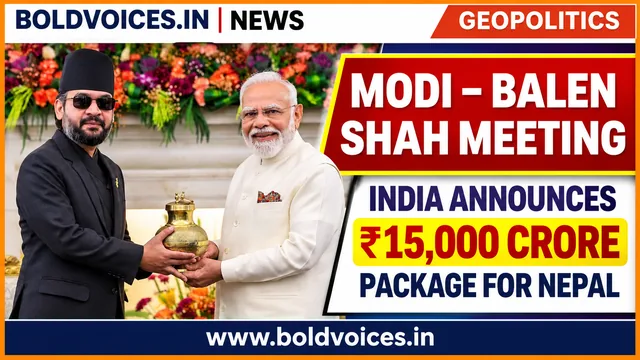
Indian Prime Minister Narendra Modi met Nepalese Prime Minister Balendra Shah, widely known as Balen Shah, in New Delhi on 23 November 2026.
India announced a ₹15,000 crore development assistance package for Nepal, alongside major initiatives covering railways, aviation, hydropower, petroleum infrastructure, education, healthcare, technology and cross-border trade.
The two countries also exchanged eight Memoranda of Understanding (MoUs) and adopted a joint vision titled “Viksit Bharat and Samunnat Nepal”, laying the foundation for a long-term development partnership.
The visit marked Shah’s first visit to India after assuming office in March 2026.
Featured image: AI-edited illustration based on a PMO/PIB photograph of the meeting.
PMO joint press release · India–Nepal Joint Vision
1. Key highlights of the India–Nepal meeting
| Area | Major announcement |
|---|---|
| Financial assistance | ₹15,000 crore |
| Direct grant | ₹3,500 crore |
| Line of credit | ₹11,500 crore |
| Bilateral MoUs | Eight |
| Railway connectivity | Ayodhya–Janakpur Express |
| Higher education | IIT campus in Nepal |
| Hydropower | 669 MW Lower Arun project |
| Maritime trade | Access to Kandla Port |
| Aviation | Bidirectional air route |
| Border issues | Further diplomatic negotiations |
| Diplomatic engagement | PM Modi accepts invitation to visit Nepal |
2. Nepal PM receives ceremonial welcome
Balendra Shah arrived in New Delhi on 22 November for a two-day state visit at the invitation of Prime Minister Narendra Modi.
His official engagements included:
- Ceremonial reception at Rashtrapati Bhavan.
- Paying tribute to Mahatma Gandhi at Rajghat.
- Meeting President Droupadi Murmu.
- Discussions with External Affairs Minister S. Jaishankar.
- Bilateral negotiations and an official luncheon hosted by PM Modi.
Shah travelled with a senior official delegation. Nepal’s Foreign Ministry said Finance Minister Swarnim Wagle addressed the Nepal–India Business Roundtable during the visit.
Nepal Foreign Ministry account of day one
3. India announces ₹15,000 crore financial assistance
One of the most important outcomes was India’s announcement of substantial financial support for Nepal’s reconstruction and economic development.
The package totals ₹15,000 crore (NPR 24,000 crore). It comprises a ₹3,500 crore grant (23.33%) and a ₹11,500 crore rupee-denominated line of credit (76.67%).
The grant component will support reconstruction following devastating floods in Nepal and the development of new infrastructure.
The credit component will finance energy sector projects. Individual projects and financing arrangements will be determined through consultations between the two governments.
4. Ayodhya–Janakpur Express: Strengthening cultural relations
The two prime ministers flagged off the inaugural Sarayu–Kamala Express, connecting Ayodhya in Uttar Pradesh with Janakpur in Nepal.
The railway service carries special religious and cultural significance due to the historical association of Ayodhya with Bhagwan Ram and Janakpur with Mata Sita.
The initiative is expected to promote religious tourism, generate local business opportunities and strengthen the historic relationship between the people of both countries.
India and Nepal will also explore connectivity initiatives to develop Buddhist and Shiv-Shakti pilgrimage circuits.
5. Major railway and road infrastructure projects
Raxaul–Kathmandu Railway
The leaders announced that the route survey for the proposed electrified broad-gauge railway was complete. Construction timelines are yet to be announced.
East–West Railway
India and Nepal will collaborate on developing Nepal’s East–West railway infrastructure.
Dharchula–Darchula Bridge
A new motorable cross-border bridge was inaugurated, improving connectivity between India and western Nepal.
The leaders also laid the foundation stone for a new Integrated Check Post at Banbasa and reviewed ongoing border infrastructure projects.
These developments could reduce transportation costs, improve trade efficiency and create economic opportunities in border regions.
6. Nepal gets additional access to Indian seaports
Being a landlocked country, Nepal depends heavily on transit arrangements for international trade.
PM Modi announced that Nepal would gain an additional maritime trade route through Deendayal Port, commonly known as Kandla Port, in Gujarat.
Access to Paradip Port in Odisha is also envisaged once the necessary infrastructure becomes available.
Potential benefits include reduced dependence on existing trade routes, greater logistical flexibility and improved access to international markets.
7. New aviation connectivity agreement
The countries agreed to make the existing B345 Kathmandu–Bhairahawa–Lucknow aviation route bidirectional.
This development could help Nepal improve international aviation connectivity, particularly for its western regions.
Technical discussions will determine the implementation arrangements. Other aviation proposals remain under consideration.
8. India to establish an IIT campus in Nepal
In a significant educational development, both governments agreed that India would establish an overseas Indian Institute of Technology (IIT) campus in Nepal.
The joint press release records an agreement to establish an offshore IIT campus. The Joint Vision describes the exploratory work on Indian higher education campuses in Nepal, starting with an IIT. The campus location, admission criteria, academic programmes and commencement date have not yet been officially announced.
Joint Vision on education and skills
9. Hydropower and renewable energy cooperation
The two prime ministers virtually laid the foundation stone for the 669 MW Lower Arun Hydroelectric Project.
Nepal’s Himalayan rivers offer considerable hydropower potential, while India’s expanding economy requires reliable energy supplies.
Greater electricity cooperation could allow Nepal to earn export revenue and India to diversify its energy resources.
Progress was also reviewed on proposed high-capacity electricity transmission connections linking Nepal with Purnea and Bareilly in India.
10. Pancheshwar project and flood management
The leaders directed the relevant authorities to finish the detailed project report for the Pancheshwar Multipurpose Project and begin implementation.
The project has potential benefits in electricity generation, irrigation and water management.
The governments also agreed to advance planning for the Saptakoshi and Sunkoshi multipurpose projects.
These initiatives have particular significance for communities vulnerable to flooding in Nepal and downstream regions of India.
11. Expansion of petroleum infrastructure
The leaders inaugurated the second phase of the Motihari–Amlekhgunj petroleum pipeline.
They virtually laid the foundation stone for a petroleum terminal in Jhapa and called for work to begin soon on the proposed Siliguri–Jhapa pipeline.
Both countries will also explore potential cooperation in natural gas pipeline infrastructure.
Expanded pipeline networks could reduce Nepal’s dependence on road-based fuel transportation and improve distribution reliability.
12. Complete list of eight MoUs exchanged
| No. | Area of cooperation | Purpose |
|---|---|---|
| 1 | Forensic sciences | Research and criminal investigation capabilities |
| 2 | Police training | Institutional cooperation and professional training |
| 3 | Civil services | Capacity building for Nepalese government officials |
| 4 | Ayurveda | Traditional medicine and healthcare cooperation |
| 5 | Satellite communication | Utilisation of the South Asia Satellite |
| 6 | Urban development | Sustainable infrastructure and urban planning |
| 7 | Healthcare | Medical and public health cooperation |
| 8 | Livestock and fisheries | Agricultural development and technical assistance |
These agreements expand the bilateral relationship beyond conventional diplomacy into public administration, scientific research, healthcare and modern technology.
13. India–Nepal border dispute
During the meeting, both governments reviewed progress in the maintenance of boundary pillars and directed their foreign secretaries to address outstanding boundary matters.
However, no final territorial settlement was announced.
Continued diplomatic dialogue will therefore remain important in maintaining stable relations while addressing the respective concerns of both countries.
14. Digital payments, banking and telecommunications
The leaders also recognised the need to make banking and telecommunications services more accessible to Indian and Nepalese citizens residing in each other’s countries.
Greater digital integration could benefit migrant workers, students, tourists, entrepreneurs and cross-border businesses.
The discussions also covered start-ups, financial technology, digital innovation and emerging technologies.
The Joint Vision calls for faster implementation of cross-border retail payments, building on the link between India’s UPI and Nepal’s national payment system.
15. India’s support for Nepal’s agriculture
The two countries welcomed plans for an agro-industrial park in Chitwan, supported by Indian grant assistance.
Such an initiative could help Nepal improve food processing, agricultural productivity, storage facilities and rural employment.
It could also create opportunities for agricultural equipment manufacturers, food processing companies and investors from both countries.
16. Who is Nepal PM Balendra Shah?
Balendra Shah
Balendra Shah, widely known as Balen Shah, was sworn in as Nepal’s prime minister in March 2026. His India visit represents an important step in establishing his government’s bilateral diplomatic priorities.
17. Why this meeting matters for India
India’s relationship with Nepal extends beyond geographical proximity.
The countries share an open border, deep cultural connections, historical trade relations and extensive family ties.
For India, stronger relations with Nepal could deliver several strategic advantages:
- Greater regional stability.
- Enhanced Himalayan border cooperation.
- Improved access to renewable electricity.
- New opportunities for Indian businesses.
- Increased religious and cultural tourism.
- Greater economic integration across South Asia.
MEA India–Nepal bilateral brief
18. Regional context
Nepal occupies a strategically important geographical position between India and China.
India’s latest development commitments provide Kathmandu with additional opportunities for investment, infrastructure development and regional connectivity.
The durability of India’s partnership will depend substantially on timely project execution, mutual respect and tangible benefits for Nepalese citizens.
19. How ordinary citizens could benefit
| Sector | Potential public benefit |
|---|---|
| Education | Greater access to technical education |
| Employment | Infrastructure and industrial jobs |
| Electricity | Expanded generation and export opportunities |
| Tourism | Improved pilgrimage connectivity |
| Transportation | Better railway and road networks |
| Healthcare | Medical cooperation and training |
| Agriculture | Food processing and market access |
| Banking | Easier cross-border financial services |
| Disaster management | Improved reconstruction and flood preparedness |
These benefits will depend on the successful implementation of the announced projects.
20. PM Modi accepts invitation to visit Nepal
Prime Minister Balendra Shah formally invited Narendra Modi to visit Nepal.
The Indian prime minister accepted the invitation, although the official dates will be decided through diplomatic channels.
A future visit could offer an opportunity to review the progress of the commitments announced during the New Delhi meeting.
Conclusion: From historical friendship to economic partnership
The Modi–Balen Shah meeting represents a significant effort to transform India’s longstanding relationship with Nepal into a modern, development-oriented partnership.
The ₹15,000 crore assistance package, railway initiatives, hydropower cooperation, proposed IIT campus, aviation connectivity and eight bilateral agreements demonstrate the broad scope of this relationship.
The real test, however, will be implementation.
The practical impact will depend on project selection, financing arrangements and delivery.
If both governments execute these commitments effectively while addressing outstanding differences through diplomacy, the November 2026 meeting could emerge as an important milestone in India–Nepal relations.


