
Curated by the Team of Boldvoices
23 November 2026
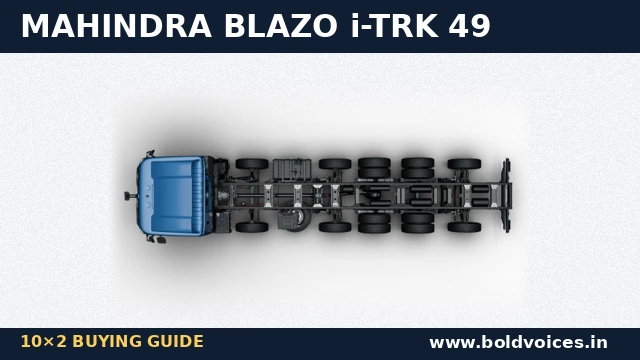
The Mahindra Blazo i-TRK 49 10×2 is a five-axle rigid haulage truck with a listed 49,000 kg gross vehicle weight. Choosing between the 28, 30 and 31 ft deck classes starts with two questions. How much of the deck will your regular freight use, and how much will the completed truck weigh empty? A contract paid by the tonne and one paid by the pallet can justify different bodies on the same chassis.
Identify the five-axle i-TRK on the quote
Mahindra’s official page retains an older Blazo X address, but the specification heading identifies the i-TRK 49 10×2 five-axle model. Match the dealer’s model code to the 239 kW engine, nine-speed gearbox and 6,955 mm wheelbase. Ask for the registered gross limit, axle-group ratings and the tyre specification for the build in writing. If you are also evaluating the i-TRK 48, compare the two completed vehicles on the same body design, freight and routes. The 1,500 kg difference in listed GVW tells you only part of the payload story.
Mahindra Blazo i-TRK 49 10×2 specifications
| Item | Mahindra listing |
|---|---|
| Gross vehicle weight | 49,000 kg |
| Axle configuration | 10×2, five axles |
| Engine | 7.2-litre six-cylinder mPower iFuelSmart |
| Power | 239 kW (320 hp) at 2,200 rpm |
| Torque | 1,100 Nm at 1,100–1,700 rpm |
| Transmission | Eaton nine-speed manual synchromesh |
| Clutch | 430 mm dry single plate |
| Suspension | Front parabolic leaf springs with dampers, rear bell-crank type |
| Brakes | 10-bar dual-circuit full-air S-cam with ABS |
| Tyres | 295/90 R20 RAT as listed |
| Diesel and AdBlue | 415 L and 50 L |
| Wheelbase | 6,955 mm |
| Cab and body basis | Air-conditioned sleeper cab, cabin chassis |
Pick the deck that earns its space

Price the 28 ft body if your regular loads are dense and usually reach their allowable weight with floor space left over. Compare the 30 and 31 ft builds if a longer floor fits more billable cargo or reduces extra trips. Draw your actual loading layout with the space taken by posts, doors and restraints. The nominal deck length alone cannot tell you whether another row fits.
Ask the body builder for the clear internal dimensions, rear overhang, exterior height, floor ratings, restraint locations and estimated weight by axle group. Check the finished vehicle’s path at the tightest gate, reversing area and loading dock. Ask the fleet customer which body or weather protection it requires and who pays if the truck waits for a bay.
Work out what you can carry
If the completed truck weighs 17,200 kg ready for work with fuel, driver and equipment, the listed GVW leaves 31,800 kg of gross-weight headroom. At a hypothetical 18,100 kg working tare, the headroom falls to 30,900 kg. Use the actual weighbridge readings and registered axle-group limits to establish the usable figure. Check representative partial loads too, particularly when unloading over several stops changes how weight is distributed.
Require a finished-truck weighbridge record before delivery sign-off. If a body receives lining, a toolbox or additional equipment after weighing, record the change and recheck as needed. When quoting a rate per tonne, calculate revenue using the load you can legally carry on the route.
Price and availability checked 23 November 2026
Mahindra’s official overview and specification pages did not display a current ex-showroom price. Local stock and delivery timing were unconfirmed. Request a dated quote that separates chassis, body, registration, insurance, taxes, accessories and delivery. Ask where the body and chassis can be repaired under warranty and who handles claims involving both. The overview lists iMAXX 2.0 with a subscription term. Confirm the included services, activation date and renewal price. Compare financing on total payable and the date repayments begin.
Operating economics for a 1,000 km round trip
At an illustrative 2.5 km/L and ₹92/L diesel, the trip uses 400 L and costs ₹36,800 in fuel. Add ₹7,000 in tolls, ₹4,000 for crew costs and ₹5,500 for tyres and maintenance. Direct costs reach ₹53,300. Allocating ₹10,000 for fixed ownership costs brings the planning break-even to ₹63,300, or ₹63.30/km, before omitted costs and taxes.
At ₹70,000 in trip revenue, the example leaves ₹6,700. At 2.2 km/L, fuel costs about ₹41,818 and that margin falls to about ₹1,682. Calculate loaded and return legs separately with your own fuel slips and toll statements. Model unpaid kilometres, maintenance days and delays in customer payment. If the longer body costs more, calculate how many extra billable tonnes or pallet positions you would need each month to cover the difference.
What to check before booking
- Match the model code, axle layout, gearbox, tyre specification, wheelbase and cabin to the order.
- Get a signed body drawing and tare estimate, then confirm the loading and depot constraints before fabrication.
- Have the dealer demonstrate the truck on a representative route and show warning indicators and onboard diagnostics.
- Check workshop coverage, common parts availability and breakdown response along your freight lane.
- For a used truck, review registration and service records and arrange an independent inspection of the frame, suspension, air system and tyre wear across all five axles.
Which configuration should you shortlist?
| Regular work | First configuration to quote | What would change the decision |
|---|---|---|
| Dense, weight-limited freight | 28 ft deck | A longer deck improves axle loading for your real cargo or wins a regular return load. |
| Mixed palletised freight | 30 ft deck | A measured loading trial shows that the 31 ft deck fits an additional billable row. |
| Bulky freight with predictable depot access | 31 ft deck | The extra body weight, rear clearance or customer’s door-opening requirements cancel out the extra space. |
Alternatives to quote on the same route
Compare the Blazo i-TRK 48 with the same finished body, tyres and equipment. Its 47,500 kg listed GVW is 1,500 kg lower. To estimate the difference in usable load, subtract the difference in completed tare and confirm the axle ratings for both builds. Also quote the Blazo i-TRK 42 if your contracts seldom need the heavier chassis. Compare both alternatives using cost per paid tonne or per paid pallet, including the return leg.
What to verify on delivery day
- Match the chassis and engine numbers to the invoice, order and registration paperwork. Record the tyre specification and check it against the signed offer.
- Measure the usable floor, door openings and rear overhang against the approved body drawing. Photograph the restraint fittings, body mounts and any deviations.
- Weigh the finished truck in its normal working condition and record individual axle-group weights. Keep the receipt with the vehicle records.
- Have the dealer demonstrate the dashboard warnings, telematics activation and routine inspection points. Collect the chassis and body warranty terms and named service contacts.
Verdict
Shortlist the i-TRK 49 10×2 when you have steady, heavy freight and can use the added registered capacity after accounting for the body and axle loads. Start with the shortest deck that earns the full contract rate. Move up only when a measured loading plan, a depot trial and a conservative return-load forecast support the extra cost.
Disclaimer. Confirm the specification, pricing, legal weight limits, stock and warranty for the individual truck. The operating and payload examples use hypothetical inputs and do not guarantee performance or earnings.
Official Mahindra sources
#MahindraTrucks #BlazoITRK49 #FiveAxleTruck #HaulageTruck #TruckBuyingGuide #TruckPayload #FleetEconomics #RoadFreight #LogisticsIndia #BoldVoices


