11 November 2026 | Curated by Vishaljeet Singh, Lisbon, Portugal
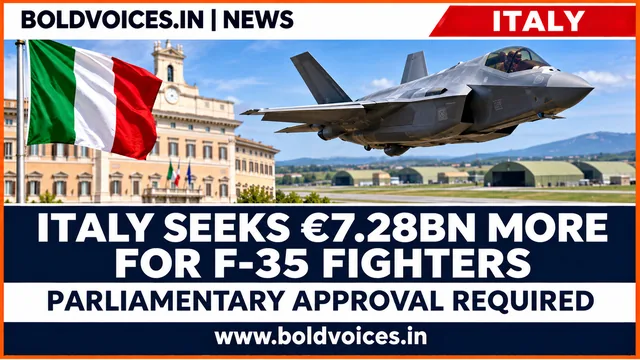
Italy’s government is seeking parliamentary approval for an additional €7.28 billion in planned spending on its F-35 fighter aircraft programme, according to a parliamentary document dated 10 November. The proposed increase would raise the overall projected cost of the programme by more than 50%, placing one of Europe’s largest defence procurement commitments under renewed political and financial scrutiny.
The move comes as NATO members reassess military readiness, European governments debate how to strengthen their defence industries and Italy faces pressure to balance security requirements with public finances. The additional funding is not yet a completed expenditure decision: the government must secure parliamentary approval before proceeding with the expanded plan.
What the €7.28 billion increase means
The proposed increase is substantial because it would lift the planned financial commitment to the F-35 programme by more than half compared with the previous projection. The figure refers to an increase in planned programme spending, not a single payment being made immediately. The final financial profile will depend on parliamentary scrutiny, procurement schedules and the timing of future deliveries and support requirements.
The F-35 programme involves more than purchasing aircraft. Its long-term costs include equipment, training, maintenance, spare parts, upgrades, technical support and the infrastructure needed to operate advanced stealth fighters. These elements can extend over decades, meaning that the acquisition price alone does not represent the full cost of maintaining an operational fleet.
Why Italy wants to expand its F-35 capability
The F-35 is a fifth-generation combat aircraft designed to combine low-observable characteristics with advanced sensors, data-sharing and precision-strike capabilities. For Italy, the aircraft is intended to strengthen air defence, support NATO operations and provide capabilities that older fighter platforms cannot fully replicate.
Italy operates both conventional F-35A aircraft and the short-take-off and vertical-landing F-35B variant. The latter is particularly relevant to the country’s naval aviation requirements, allowing operations from aircraft carriers and other suitably configured ships. The programme is therefore connected to both the Italian Air Force and Navy, as well as to the country’s wider military planning.
Supporters of the expansion argue that modern air forces need aircraft able to operate in contested environments, coordinate with allied platforms and collect information across multiple domains. They also point to the growing complexity of European security following Russia’s invasion of Ukraine and rising tensions in other regions.
Parliamentary scrutiny and political questions
The proposed increase now requires parliamentary approval. Lawmakers are expected to examine the reasons for the higher projected cost, the planned number and configuration of aircraft, the procurement timetable and the impact on Italy’s wider defence budget.
Opposition politicians have called for Defence Minister Guido Crosetto to provide a fuller explanation of the programme’s financial trajectory. Their questions concern not only the scale of the increase but also how the government intends to fund it while meeting other military requirements and domestic spending priorities.
The debate is likely to involve competing priorities. Italy must maintain credible military capabilities as a NATO member, but it must also demonstrate that major procurement commitments are based on transparent planning, realistic cost estimates and clear assessments of operational need.
Italy’s industrial stake in the F-35 programme
Italy is not only a customer of the F-35 system. It also has an industrial role in the international programme. The Cameri facility in Piedmont is a major European centre for final assembly and check-out of F-35 aircraft, and it is involved in maintenance and support activities for the fleet.
This industrial participation gives the programme an economic dimension beyond the armed forces. It supports specialised manufacturing, engineering, maintenance skills and supply-chain activity. Italian companies also participate in the wider international industrial network associated with the aircraft.
However, industrial benefits do not automatically cancel out the public cost of procurement. Parliament will need to weigh employment, technology and strategic advantages against the long-term financial obligations that come with operating an advanced combat aircraft.
How the decision fits into Europe’s defence debate
Across Europe, governments are under pressure to increase defence readiness after years in which military stockpiles and industrial capacity received less attention than other public priorities. The war in Ukraine has highlighted shortages in ammunition, air defence and equipment production, while NATO members are reviewing their ability to respond to a range of security threats.
Italy’s F-35 decision illustrates the difficult choices involved in modernising armed forces. Advanced aircraft can provide capabilities that are difficult to replace, but they also require sustained investment in maintenance, weapons, training and technology upgrades. Governments must decide how to balance high-end platforms with air defence, drones, naval forces, land systems and the less visible infrastructure needed to keep the military operational.
The programme also raises questions about European strategic autonomy. Although several European countries operate or plan to operate the F-35, the aircraft is an American-led programme. European participation provides industrial opportunities and interoperability with the United States, but it also leaves operators dependent on international supply chains, software updates and long-term support arrangements.
What happens next?
Parliament will examine the proposed €7.28 billion increase and decide whether to approve the expanded spending plan.
Defence officials may be asked to explain the programme’s revised cost assumptions and delivery schedule.
Lawmakers will assess how the commitment fits alongside other priorities, including air defence, ammunition and military readiness.
The government will need to clarify the long-term funding implications for aircraft operation, maintenance and upgrades.
Italian industry’s role at Cameri and in the international supply chain will remain part of the economic case for the programme.
The bigger picture
Italy’s proposed €7.28 billion increase is a major test of how the country plans to finance its military modernisation. The F-35 offers advanced capabilities and gives Italy an important role in a multinational defence programme, but the scale of the proposed increase makes parliamentary oversight essential.
The central question is not simply whether Italy needs modern fighter aircraft. It is whether the government can demonstrate that the expanded programme is affordable, properly scheduled and balanced against other defence requirements. The parliamentary decision will offer a clearer indication of how Rome intends to meet its NATO commitments while managing the cost of national security.
Like what you read? Help BoldVoices.in keep independent journalism going.
Manage Consent
To provide the best experiences, we use technologies like cookies to store and/or access device information. Consenting to these technologies will allow us to process data such as browsing behavior or unique IDs on this site. Not consenting or withdrawing consent, may adversely affect certain features and functions.
Functional
Always active
The technical storage or access is strictly necessary for the legitimate purpose of enabling the use of a specific service explicitly requested by the subscriber or user, or for the sole purpose of carrying out the transmission of a communication over an electronic communications network.
Preferences
The technical storage or access is necessary for the legitimate purpose of storing preferences that are not requested by the subscriber or user.
Statistics
The technical storage or access that is used exclusively for statistical purposes.The technical storage or access that is used exclusively for anonymous statistical purposes. Without a subpoena, voluntary compliance on the part of your Internet Service Provider, or additional records from a third party, information stored or retrieved for this purpose alone cannot usually be used to identify you.
Marketing
The technical storage or access is required to create user profiles to send advertising, or to track the user on a website or across several websites for similar marketing purposes.