Category: Business & Economics | Automobile Industry
Curated by the Financial Desk of Boldvoices
24 November 2026
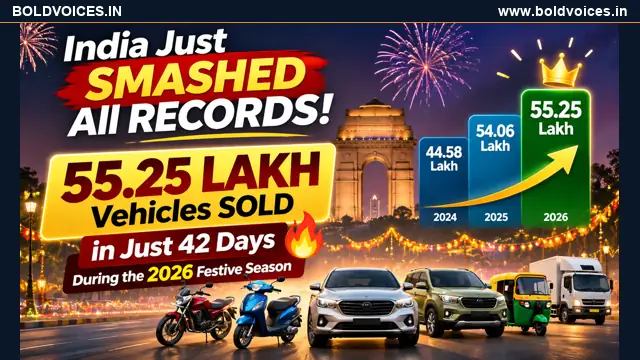
The reported sale of 55.25 lakh vehicles during India’s 42-day festive season represents a potentially historic milestone for the country’s automobile industry, highlighting the scale of domestic consumption and demand for personal mobility.
The Federation of Automobile Dealers Associations (FADA) has officially confirmed the record, with 55,25,490 vehicles retailed between 11 October and 21 November 2026.
To put the achievement into perspective, India retailed an average of approximately 91 vehicles every minute during the festive period.
Three consecutive years of rising festive sales
India’s festive automobile retail sales
Figures in lakh units. Data: FADA festive vehicle retail statistics.
The achievement is particularly significant because the 2025 festive season had already benefited from stronger demand following GST reforms.
India managed to surpass that elevated sales base, adding nearly 1.20 lakh vehicle sales compared with the previous festive season.
Category-wise automobile sales in 2026
Vehicle category
Units sold
Annual growth
Two-wheelers
43,13,276
+3.67%
Three-wheelers
1,93,576
+5.32%
Commercial vehicles
1,55,761
+7.13%
Construction equipment
10,452
+26.06%
Passenger vehicles
7,48,616
−7.16%
Tractors
1,03,809
+2.24%
Total
55,25,490
+2.21%
AI-generated illustration of a vehicle showroom during the festive season.
Two-wheelers dominate India’s automobile market
Share of total festive vehicle sales
Share of total 2026 festive vehicle registrations, calculated from FADA data.
Motorcycles and scooters remained the backbone of India’s automobile market, accounting for approximately 78% of total festive retail volumes.
Affordable personal transportation continues to play an important role in the daily lives of students, working professionals, small business owners and rural households.
For millions of Indians, a two-wheeler is not a luxury purchase but an essential economic asset that provides access to employment, education and business opportunities.
Electric vehicles emerge as the biggest success story
India’s electric mobility transition gained remarkable momentum during the festive season.
India’s festive EV sales
Number of electric vehicles retailed: 3,04,197 in 2024, 3,33,935 in 2025 and 5,09,667 in 2026.
EV category
Units sold
Annual growth
Electric two-wheelers
3,30,846
+61.10%
Electric three-wheelers
1,20,330
+25.45%
Electric passenger vehicles
52,104
+72.91%
Electric commercial vehicles
6,387
+154.56%
Total
5,09,667
+52.62%
AI-generated illustration of electric scooters at charging points.
Electric vehicles accounted for approximately 9.22% of total festive sales, meaning nearly one in every ten vehicles retailed was electric.
Lower running costs, expanding model availability, improvements in battery technology and growing charging infrastructure could further accelerate India’s transition towards electric mobility.
Passenger cars: The surprising exception
Despite the record-breaking performance of the overall automobile industry, passenger vehicle sales declined by 7.16% compared with 2025.
However, passenger vehicle sales still remained 16.43% above their 2024 festive levels.
The decline highlights the importance of looking beyond headline figures. While overall demand remained resilient, not every automobile segment experienced the same level of growth.
Manufacturers will need to focus on affordability, financing options, product innovation and inventory management to sustain customer interest.
What is driving India’s automobile demand?
Several factors could be supporting India’s expanding automobile market:
Greater affordability following GST rationalisation.
Growing demand in rural and semi-urban markets.
Traditional festive preferences for purchasing vehicles.
Wider availability of vehicle financing.
Increasing choice across petrol, diesel, CNG, hybrid and electric vehicles.
Infrastructure development and commercial transportation requirements.
Rising aspirations among younger consumers.
India’s centuries-old tradition of making major household purchases during auspicious festivals continues to play a meaningful role in the modern consumer economy.
What does this mean for India’s economy?
The automobile industry’s performance has implications that extend far beyond vehicle manufacturers and dealerships.
Higher automobile demand can support economic activity across steel, aluminium, electronics, tyres, batteries, auto components, banking, insurance, logistics and vehicle servicing.
The expanding electric vehicle ecosystem could also create new opportunities in battery manufacturing, charging infrastructure, power electronics, software and technical employment.
Commercial vehicle growth, meanwhile, is an encouraging indicator for transportation and business activity, although vehicle sales alone cannot establish the overall health of the economy.
Can India cross the three-crore annual sales milestone?
FADA believes India is approaching its first calendar year with more than three crore vehicle retail sales.
Achieving this milestone would represent another major step in India’s evolution as a global automobile market. However, the final outcome will depend on demand during the remaining weeks of 2026.
The road ahead
India’s 2026 festive automobile sales tell a bigger story than numbers alone.
They reflect a country where personal mobility remains deeply connected with economic opportunity, household aspirations and changing technology.
While conventional vehicles continue to dominate the market, the rapid expansion of electric mobility is gradually transforming the industry.
India has not merely broken another festive automobile sales record. It is entering a new chapter in its mobility journey, where affordability, technology, consumer choice and sustainability will shape the road ahead.
The figures represent retail registrations. FADA notes that 2026 festive-period registration data for three-wheelers, commercial vehicles and tractors in Telangana was unavailable.
Like what you read? Help BoldVoices.in keep independent journalism going.
Manage Consent
To provide the best experiences, we use technologies like cookies to store and/or access device information. Consenting to these technologies will allow us to process data such as browsing behavior or unique IDs on this site. Not consenting or withdrawing consent, may adversely affect certain features and functions.
Functional
Always active
The technical storage or access is strictly necessary for the legitimate purpose of enabling the use of a specific service explicitly requested by the subscriber or user, or for the sole purpose of carrying out the transmission of a communication over an electronic communications network.
Preferences
The technical storage or access is necessary for the legitimate purpose of storing preferences that are not requested by the subscriber or user.
Statistics
The technical storage or access that is used exclusively for statistical purposes.The technical storage or access that is used exclusively for anonymous statistical purposes. Without a subpoena, voluntary compliance on the part of your Internet Service Provider, or additional records from a third party, information stored or retrieved for this purpose alone cannot usually be used to identify you.
Marketing
The technical storage or access is required to create user profiles to send advertising, or to track the user on a website or across several websites for similar marketing purposes.