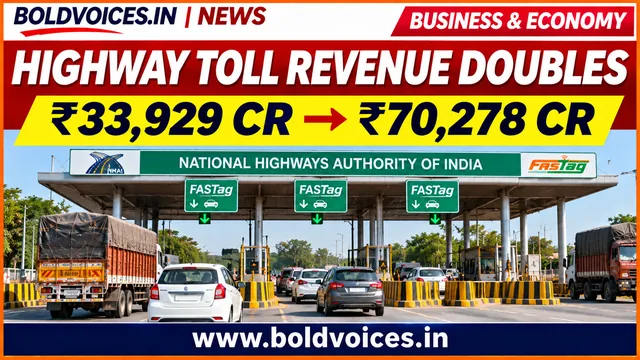
India’s national highway toll collections have more than doubled in four years, reaching ₹70,278 crore in FY2025–26 compared with ₹33,929 crore in FY2021–22. The figures presented in Parliament reveal a major transformation in highway financing. They also raise a question: as motorists and transport operators pay more, are they receiving safer, faster and better-maintained roads?
The growth reflects an expanding network of tolled highways, increased traffic, periodic toll revisions and widespread adoption of digital payments. Higher revenue alone, however, cannot establish that road quality or travel efficiency has improved proportionately.
National Highway toll collections: Five-year comparison
Financial year
Toll collection
2021–22
₹33,929 crore
2022–23
₹48,032 crore
2023–24
₹55,882 crore
2024–25
₹61,408 crore
2025–26
₹70,278 crore
Collections grew approximately 107.1% between FY22 and FY26, including growth of about 14.45% in the latest year. The combined receipts across the five years total approximately ₹2.69 lakh crore. The FY26 total includes ₹1,795.18 crore from the FASTag annual-pass scheme; the amount attributed to individual states and fee plazas was ₹68,483 crore before this separately reported component.
Why are toll collections increasing?
More toll plazas and highways
The number of operational National Highway toll plazas rose from 733 in FY2021–22 to 1,183 in FY2025–26, an increase of approximately 61%. More operational tolled stretches can raise total receipts even without equivalent increases in charges for an individual journey.
Traffic and commercial movement
Industrial production, freight transportation, tourism and private vehicle movement all influence highway use. Commercial vehicles generally pay more than private cars. But aggregate receipts are not a precise measure of freight growth because road coverage, rates and vehicle categories also change.
Periodic toll revisions
National Highway user fees are governed by applicable rules and concession agreements. Periodic revisions, including adjustments linked to the Wholesale Price Index, can increase charges. Motorists reasonably expect corresponding maintenance and service standards.
State-wise toll collections: Correct top five
Rank
State
FY26 collection
1
Uttar Pradesh
₹8,862 crore
2
Rajasthan
₹7,318 crore
3
Maharashtra
₹7,054 crore
4
Gujarat
₹6,352 crore
5
Karnataka
₹4,779 crore
The five states together account for approximately 48.9% of state-attributed toll collections, or about 48.3% of the national total including annual passes. Tamil Nadu, at approximately ₹4,708 crore, ranks below Karnataka. Other substantial collections include Andhra Pradesh (₹4,400 crore), Madhya Pradesh (₹4,344 crore), Haryana (₹4,024 crore) and West Bengal (₹3,301 crore).
These totals reflect networks and traffic as well as toll rates. They do not establish which states charge the most per kilometre.
FASTag: A major change in highway payments
FASTag uses radio-frequency identification technology to deduct user fees electronically from linked accounts. Government information published in January 2026 indicated that more than 98% of National Highway user-fee payments were collected through FASTag.
Digital payments can reduce cash handling, improve transaction records and shorten queues. However, barriers, lane restrictions, equipment failures and congestion can still cause delays. The government has also explored barrier-free tolling using automatic number-plate recognition alongside FASTag on selected stretches.
FASTag annual pass: Who benefits?
The annual pass for eligible non-commercial cars, jeeps and vans covers up to 200 eligible National Highway fee-plaza crossings or one year, whichever comes first. The initial ₹3,000 price was revised to ₹3,075 for FY2026–27.
For illustration, 80 eligible crossings at a hypothetical ₹100 per crossing would otherwise cost ₹8,000; compared with a ₹3,075 pass, the difference is ₹4,925. Actual savings depend on route eligibility, toll charges and usage. Commercial vehicles are not eligible for this pass, and not every toll road is covered.
Are motorists getting better roads?
India’s National Highway network has expanded substantially. The government’s December 2025 year-end review reported approximately 1.47 lakh kilometres of National Highways, compared with around 91,000 kilometres in 2014. Access-controlled expressways have also grown.
Network expansion does not guarantee that every highway offers good conditions. Motorists still encounter damaged surfaces, unsafe diversions, poor drainage, inadequate lighting, congestion and neglected service roads. A meaningful evaluation should measure pavement condition, crash rates, travel-time reliability, maintenance response and user complaints—not just receipts.
Who receives the toll money?
It is incorrect to assume that all National Highway toll collections become freely available profit for the central government. Toll roads operate under different publicly funded and concession arrangements, including Build-Operate-Transfer, Toll-Operate-Transfer and infrastructure investment trust models. Revenue allocation and maintenance obligations depend on the applicable agreements.
The government told Parliament that consolidated toll-plaza operating expenditure is not maintained centrally because costs arise under different operating arrangements. Consequently, ₹70,278 crore in gross collections must not be described as ₹70,278 crore of government profit.
How rising tolls affect the Indian economy
Freight and logistics
Trucks carrying food, construction materials and consumer goods pay tolls as part of operating costs. Higher toll expenses can contribute to freight rates and, potentially, consumer prices. But smoother highways can also reduce fuel consumption, vehicle wear and travel time. The net effect depends on the route and service quality.
Businesses and manufacturers
Reliable highways connect factories, warehouses, ports and markets. Better connectivity can improve supply-chain efficiency, but toll expenses remain an important consideration in logistics planning.
Households and commuters
Frequent highway users can face significant recurring charges. Transparent fee schedules, accurate FASTag deductions, accessible grievance mechanisms and proper road maintenance are essential to public confidence.
What needs to improve next?
India’s highway toll system has become a major revenue-generating infrastructure network. The next phase should focus on measurable value: faster barrier-free payments, consistent maintenance, transparent concession information, effective grievance resolution and clear communication about fee revisions.
Public reporting on road quality, congestion, safety and maintenance expenditure would make it easier to judge whether charges collected are translating into better journeys.
The bigger picture
India’s National Highway toll collections have risen from approximately ₹34,000 crore to more than ₹70,000 crore in four years. That demonstrates the growing financial scale of the highway network. But the real test is whether roads become safer, journeys faster, freight more efficient and the public receives lasting value.
India’s highway success should ultimately be measured in better journeys—not just higher toll collections.
Like what you read? Help BoldVoices.in keep independent journalism going.
Manage Consent
To provide the best experiences, we use technologies like cookies to store and/or access device information. Consenting to these technologies will allow us to process data such as browsing behavior or unique IDs on this site. Not consenting or withdrawing consent, may adversely affect certain features and functions.
Functional
Always active
The technical storage or access is strictly necessary for the legitimate purpose of enabling the use of a specific service explicitly requested by the subscriber or user, or for the sole purpose of carrying out the transmission of a communication over an electronic communications network.
Preferences
The technical storage or access is necessary for the legitimate purpose of storing preferences that are not requested by the subscriber or user.
Statistics
The technical storage or access that is used exclusively for statistical purposes.The technical storage or access that is used exclusively for anonymous statistical purposes. Without a subpoena, voluntary compliance on the part of your Internet Service Provider, or additional records from a third party, information stored or retrieved for this purpose alone cannot usually be used to identify you.
Marketing
The technical storage or access is required to create user profiles to send advertising, or to track the user on a website or across several websites for similar marketing purposes.