India’s manufacturing story is no longer just about new factories, bigger investments and production targets. The real question is whether industrial growth is creating meaningful employment for ordinary Indians.
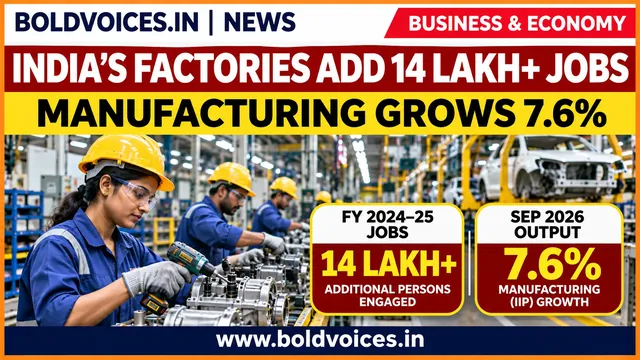
The latest Annual Survey of Industries (ASI) shows India’s registered factory sector added more than 14 lakh people during FY2024–25, taking estimated persons engaged to approximately 2.10 crore. Separately, manufacturing production grew 7.6% year on year in September 2026, according to the Index of Industrial Production. These measures refer to different periods and should not be interpreted as simultaneous results.
Factory employment crosses two crore
The Ministry of Statistics and Programme Implementation released the ASI 2024–25 factsheet on 30 September 2026 and detailed survey publications in November.
Indicator
FY2024–25
Persons engaged
2.10 crore
Employment growth
7.19%
Additional persons engaged
Over 14 lakh
Registered establishments
2.67 lakh
Industrial output growth
7.81%
Gross value added growth
9.59%
Total emoluments growth
12.08%
Fixed capital growth
10.54%
The ASI covers registered factories and certain other covered establishments, not the entire informal manufacturing workforce. Its employment change is an estimated increase in persons engaged between survey years, not a count of current vacancies or individual hiring announcements.
Which states lead factory employment?
Tamil Nadu, Maharashtra, Gujarat, Uttar Pradesh and Haryana together accounted for about 56% of persons engaged in registered manufacturing in FY2024–25. Tamil Nadu’s automotive, textile and electronics industries, Maharashtra’s diversified manufacturing base, Gujarat’s chemical and engineering clusters, Uttar Pradesh’s industrial expansion and Haryana’s automotive supply chains illustrate the importance of established production ecosystems.
Concentration also highlights the challenge of spreading industrial opportunities to more regions through infrastructure, skills and investment.
Which industries are growing fastest?
September’s IIP release reported overall industrial growth of 6.7% and manufacturing growth of 7.6%. Electrical equipment, motor vehicles, rubber and plastics, other transport equipment and fabricated metal products were among the expanding industries.
Production growth should not be confused with job growth. Output can rise because of additional workers, longer shifts, new machinery, automation or higher productivity. The monthly IIP does not provide a matching monthly employment count.
Are workers earning more?
Total employee emoluments increased 12.08% in FY2024–25, faster than the 7.19% rise in persons engaged. This suggests average nominal compensation may have improved, but it does not mean every worker received a 12.08% raise. Workforce composition, bonuses and additional hiring all affect the aggregate figure. Real purchasing power also depends on inflation.
What automation means for future jobs
Factories are increasingly using robotics, computer-controlled machinery, sensors and digital quality checks. These technologies can increase efficiency and global competitiveness while changing the skills employers need. Routine tasks may be automated, but opportunities can expand for technicians, maintenance workers, machine operators and industrial software specialists.
Vocational education, apprenticeships and employer-linked training are essential to helping workers move into these roles.
Why MSMEs matter
Large manufacturers depend on networks of component suppliers, packaging companies, logistics operators and specialist service providers. Small and medium enterprises can benefit when major factories expand. However, access to working capital, modern equipment, skilled labour and reliable electricity remains a constraint for many smaller businesses.
Industrial growth becomes more inclusive when smaller suppliers can participate in established production networks.
Are there enough opportunities for young Indians?
Manufacturing offers work for vocational trainees, diploma holders, graduates and experienced workers, including electricians, welders, quality inspectors, production operators and maintenance technicians. But meaningful employment also requires safe workplaces, reliable compensation, skills development and career progression.
Employment totals are encouraging; job quality and long-term stability remain equally important.
Why investment matters
Fixed capital in the registered factory sector increased 10.54% in FY2024–25. Investment in machinery, buildings and production capacity can strengthen competitiveness and future output. Yet capital-intensive plants may employ relatively fewer people than labour-intensive industries, so industrial policy must consider productivity and employment together.
Challenges facing Indian manufacturing
Skills mismatch: specialised industrial roles require training. Infrastructure: reliable electricity, transport and logistics affect competitiveness. MSME financing: small suppliers need affordable capital. Regional concentration: industrial employment is unevenly distributed. Global competition: producers must meet quality, price and delivery requirements. Workforce conditions: safe and sustainable jobs are essential.
What comes next?
Future industrial-production releases will indicate whether output momentum continues, while subsequent Annual Surveys of Industries will reveal whether employment expansion is sustained. Productivity, wages, worker safety and opportunities for small suppliers will help determine whether manufacturing growth translates into broad economic benefits.
The bottom line
India’s registered factories added more than 14 lakh persons engaged in FY2024–25, and manufacturing output continued growing in September 2026. These are positive signs, but a stronger industrial economy must be measured not only by output and investment but by the quality and durability of the jobs it creates.
Like what you read? Help BoldVoices.in keep independent journalism going.
Manage Consent
To provide the best experiences, we use technologies like cookies to store and/or access device information. Consenting to these technologies will allow us to process data such as browsing behavior or unique IDs on this site. Not consenting or withdrawing consent, may adversely affect certain features and functions.
Functional
Always active
The technical storage or access is strictly necessary for the legitimate purpose of enabling the use of a specific service explicitly requested by the subscriber or user, or for the sole purpose of carrying out the transmission of a communication over an electronic communications network.
Preferences
The technical storage or access is necessary for the legitimate purpose of storing preferences that are not requested by the subscriber or user.
Statistics
The technical storage or access that is used exclusively for statistical purposes.The technical storage or access that is used exclusively for anonymous statistical purposes. Without a subpoena, voluntary compliance on the part of your Internet Service Provider, or additional records from a third party, information stored or retrieved for this purpose alone cannot usually be used to identify you.
Marketing
The technical storage or access is required to create user profiles to send advertising, or to track the user on a website or across several websites for similar marketing purposes.