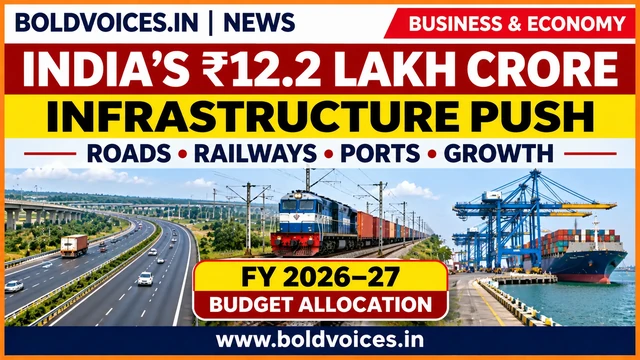
India is investing heavily in the roads, railways, ports, electricity networks and digital connectivity that support its economy. The Union Budget for FY2026–27 provides approximately ₹12.22 lakh crore for capital expenditure, continuing the government’s focus on building productive assets. But a bigger budget does not automatically guarantee better infrastructure. The real questions are how quickly projects are delivered, whether transport and logistics become more efficient, and whether businesses and ordinary citizens experience meaningful benefits.
How much is India investing?
Indicator
Amount
Union capital expenditure, FY2014–15
Approximately ₹2 lakh crore
FY2025–26 Budget Estimate
₹11.2 lakh crore
FY2026–27 Budget Estimate
₹12.22 lakh crore
Capital-asset creation grants, FY2026–27
₹4.93 lakh crore
Effective capital expenditure, FY2026–27
₹17.15 lakh crore
Capital support to states under SASCI
₹2 lakh crore
Effective capital expenditure includes grants for creating capital assets alongside the Union government’s direct capital spending. These figures are budget estimates, not actual expenditure already incurred. Government accounts must be used to measure execution throughout the financial year.
National highways: a growing project pipeline
According to the Ministry of Statistics and Programme Implementation’s October 2026 infrastructure performance dashboard, 2,236.3 kilometres of National Highway projects were awarded during April–September 2026, up 62.9% from the corresponding period a year earlier. This is an encouraging sign for the future project pipeline, but awarded projects are not the same as completed roads.
For businesses, better highways can reduce delivery uncertainty and connect producers with customers. For citizens, they can improve access to employment, healthcare and education. Benefits depend on timely construction, land availability, maintenance and operational performance.
Railways: why modernisation matters
The FY2026–27 Budget proposed seven high-speed rail corridors and an additional dedicated freight corridor. These are proposals, not completed or operational projects. Freight capacity and reliability matter because moving bulk goods efficiently can reduce logistics costs for manufacturers, farmers and trading companies. Passenger improvements can also support regional economic activity. Project completion, safety, affordability and operating efficiency will determine the results.
Ports: trade activity is expanding
During April–August 2026, cargo handled at major ports grew 7.2% year on year to approximately 390.4 million tonnes. Non-major ports handled around 313.4 million tonnes, up 1.8%. This indicates expanding maritime cargo activity, but cargo volume alone does not prove that every port has become more efficient. Vessel turnaround, container dwell times, capacity utilisation and logistics costs are important complementary measures.
Digital infrastructure beyond big cities
India’s optical-fibre cable network reached approximately 7,52,113 kilometres by August 2026, with another 29,256 kilometres laid during April–August. Expanded fibre networks can support telecommunications, digital public services, business connectivity and online education. However, the presence of fibre does not automatically guarantee affordable high-quality service to every home; last-mile connections and reliability still matter.
Power infrastructure supports industry
India’s installed electricity-generation capacity reached approximately 5.33 lakh megawatts in FY2025–26, an increase of 12.1%. Renewable capacity rose 29.5% and represented about 42% of installed capacity. Reliable electricity is essential for factories, logistics and digital services. Yet installed capacity is not the same as actual electricity generation. Transmission, storage, renewable integration and distribution-company finances also shape performance.
How does infrastructure spending create jobs?
Construction projects employ engineers, equipment operators, electricians, technicians, supervisors and other workers. They also create demand for cement, steel, machinery and transportation. Once operational, infrastructure can help businesses lower costs and invest more. The number of jobs depends on project design, local supply chains and labour intensity; an expenditure allocation should not be translated into a specific employment count without supporting evidence.
Can infrastructure investment help MSMEs?
Small manufacturers often face high freight costs, power interruptions and limited access to distant markets. Better roads, electricity and digital connections can improve their competitiveness. Industrial clusters and logistics facilities can also help suppliers participate in larger production networks. But financing, skills and fair market access remain essential for smaller enterprises to benefit.
Why private investment matters
The government cannot finance every infrastructure requirement alone. Private developers, banks, infrastructure funds and financing institutions also contribute. Instruments such as Infrastructure Investment Trusts and asset monetisation programmes can help mobilise capital. The FY2026–27 Budget proposed an Infrastructure Risk Guarantee Fund to encourage private participation. Public-private partnerships still require transparent procurement, carefully allocated risks and financially sustainable contracts.
What about smaller cities?
The FY2026–27 Budget proposed City Economic Regions, with support of ₹5,000 crore per region over five years through a competitive, reform-linked framework. The aim is to coordinate infrastructure and regional economic development. Smaller cities could benefit from stronger transport links, industrial investment and employment, but results will depend on local planning, governance and project delivery.
Challenges India must address
Project delays: land acquisition, approvals and contractor performance can slow work. Cost overruns: delays and changes in scope can raise costs. Maintenance: roads, railways and utilities need ongoing upkeep. Regional inequality: benefits can be unevenly distributed. Environmental impact: large projects must address ecological and community concerns. Financial sustainability: public investment must be balanced with fiscal responsibility.
What should India measure next?
First, actual FY2026–27 capital expenditure should be compared with the budget allocation. Second, departments should be evaluated on completed assets, costs, safety and operational results rather than announcements alone. Third, logistics efficiency, private investment and regional employment should be monitored to understand broader economic effects.
The bottom line
India’s ₹12.22 lakh crore capital expenditure allocation reflects a substantial commitment to infrastructure-led growth. Highway project awards, port cargo activity, digital connectivity and electricity capacity show progress, but allocations, awards and operational results are different measures. The real test is whether public investment becomes completed, reliable and affordable infrastructure that reduces business costs and improves everyday life.
Like what you read? Help BoldVoices.in keep independent journalism going.
Manage Consent
To provide the best experiences, we use technologies like cookies to store and/or access device information. Consenting to these technologies will allow us to process data such as browsing behavior or unique IDs on this site. Not consenting or withdrawing consent, may adversely affect certain features and functions.
Functional
Always active
The technical storage or access is strictly necessary for the legitimate purpose of enabling the use of a specific service explicitly requested by the subscriber or user, or for the sole purpose of carrying out the transmission of a communication over an electronic communications network.
Preferences
The technical storage or access is necessary for the legitimate purpose of storing preferences that are not requested by the subscriber or user.
Statistics
The technical storage or access that is used exclusively for statistical purposes.The technical storage or access that is used exclusively for anonymous statistical purposes. Without a subpoena, voluntary compliance on the part of your Internet Service Provider, or additional records from a third party, information stored or retrieved for this purpose alone cannot usually be used to identify you.
Marketing
The technical storage or access is required to create user profiles to send advertising, or to track the user on a website or across several websites for similar marketing purposes.