
Curated by the Team of Boldvoices
Updated: 1 November 2026 | 10:40 PM IST
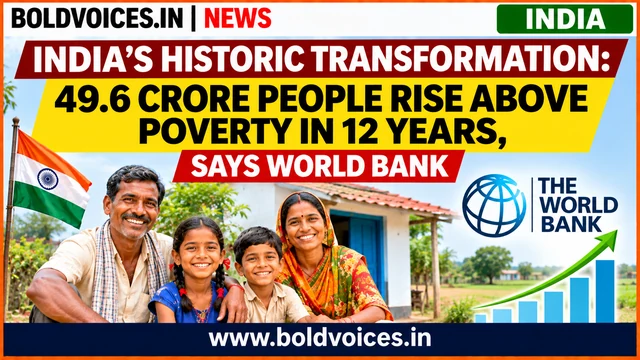
India’s development journey has reached a landmark moment. An estimated 49.6 crore people moved above the World Bank’s lower-middle-income poverty threshold between 2011 and 2023, according to its October 2026 Poverty and Equity Brief. The scale of this change is a powerful indicator of how far the country has travelled in a little over a decade—and of the growing capacity of its economy and public delivery systems to improve the lives of millions.
The achievement deserves recognition, not complacency. Poverty reduction on this scale reflects the combined impact of economic growth, rising household consumption, expanding employment and support reaching vulnerable families. It is also a reminder that India’s next ambition must be even higher: turning the gains of the past decade into secure livelihoods, stronger incomes and opportunity in every state and district.
The numbers behind a historic Indian achievement
The World Bank estimates that 496 million people—49.6 crore—moved above the $4.20-a-day poverty line, measured in 2021 purchasing power parity (PPP), between 2011 and 2023. This is the Bank’s poverty threshold for lower-middle-income countries. India’s estimated poverty rate at this line fell from 57.7% to 16.1%.
There has also been a steep decline in extreme poverty. At the separate $3-a-day international extreme-poverty line, the estimated rate fell from 27.1% in 2011 to 2.6% in 2023. The distinction matters: the 49.6-crore figure relates to the $4.20 threshold, while 2.6% is the reported extreme-poverty rate. Together, these indicators show the breadth of India’s progress without confusing two different measures.
These are estimates based on household consumption surveys and the World Bank’s methodology, not a literal count of individuals interviewed one by one. At the $4.20 line, poverty in 2023 was 19.3% in rural areas and 8.6% in urban areas; about 80% of the population remained below the separate $8.30 upper-middle-income line. The Bank cautions that the large measured gains between 2022–23 and 2023–24 likely reflect both genuine welfare improvements and better measurement. It also says household surveys may not fully capture consumption among wealthier households and may therefore understate inequality. The 496 million figure should be read as an estimate of people moving above the specified $4.20 threshold—not as a claim that all crossed the extreme-poverty line or achieved lasting financial security.
Growth translated into improvements for ordinary households
A strong national growth story matters most when it reaches households. The World Bank identifies rising consumption as a key factor behind the reduction. When families are able to spend more on food, housing, transport, education, healthcare and other essentials, their risk of falling below a consumption-based poverty line declines.
India’s economic expansion has coincided with a broad strengthening of public infrastructure and welfare delivery. Food support, access to essential services and social transfers can help families withstand periods of weak earnings, seasonal work or unexpected shocks. India’s expanding digital and financial infrastructure has also created new channels through which citizens can access payments, banking and public services. These systems are part of the country’s wider development capacity, although the World Bank’s poverty estimate should not be attributed to any single programme or technology.
The larger lesson is that development works best when growth and effective delivery reinforce each other. A growing economy creates resources and jobs; capable institutions and well-targeted support help ensure that more citizens can participate in that growth.
More people at work—and more rural women entering paid employment
Employment has been another important part of the progress. The World Bank brief estimates that the number of people employed increased by around 134 million between 2017 and 2023, nearly twice the growth in the working-age population over the same period. It highlights the contribution of rural women entering paid work, an important shift for household incomes and women’s economic participation.
When women earn, families can gain an additional source of income and greater financial resilience. Women’s participation also strengthens local markets and broadens the country’s productive workforce. The next opportunity is to expand access to better-paid work, skills, credit, markets, safe transport and childcare so that women can move from participation into sustained economic advancement.
India’s employment challenge now is to convert the scale of its workforce into higher productivity and better-quality jobs. Manufacturing, modern services, construction, logistics, tourism, food processing and small enterprises can all contribute if investment and skills development keep pace with the needs of a young and ambitious population.
India’s progress is significant—but the next goal is shared prosperity
The World Bank also highlights an earnings gap: median earnings among the top 10% of workers are estimated to be about 13 times those of the bottom 10%. This does not erase the poverty-reduction achievement. Instead, it points to the next stage of the national task—ensuring that the benefits of growth reach workers across income groups and regions.
Rising employment numbers must be accompanied by better wages, stable work, safe conditions and opportunities to acquire valuable skills. Productivity growth is essential: workers and small businesses need access to technology, reliable infrastructure, affordable finance and larger markets. The aim should be not merely to move families above a statistical poverty line, but to help them build savings, withstand emergencies and plan confidently for the future.
Regional development will shape the next chapter
The progress has not been uniform. The World Bank brief indicates that around 57% of people still classified as poor are concentrated in the broad belt from Uttar Pradesh to West Bengal. This is a clear opportunity for focused development—not a reason to overlook the national achievement. Faster progress in these states can make India’s overall poverty reduction more balanced and durable.
Better rural roads, irrigation, reliable electricity, quality schools, healthcare, digital connectivity and access to non-farm jobs can help unlock the potential of districts where poverty remains concentrated. Local manufacturing, food processing, logistics, tourism and women-led enterprises can create income closer to home and reduce dependence on seasonal agriculture or distress migration.
India’s diversity means that a single development model cannot fit every region. State governments, local institutions, businesses and communities all have a role in adapting national priorities to local needs. The next phase should be judged by whether opportunity reaches smaller towns, villages and districts as strongly as it reaches major economic centres.
Beyond income: improvements in basic living conditions
Poverty is not only about income. Multidimensional poverty measures examine disadvantages in areas such as nutrition, schooling, sanitation, housing and access to basic services. India’s national multidimensional poverty estimates have also recorded a substantial decline over the past two decades, reflecting improvements across several aspects of everyday life.
These measures should be understood separately from the World Bank’s $3 and $4.20 poverty lines. They use different indicators, definitions and methods, and their figures cannot simply be added together. Read alongside one another, however, they offer a wider picture of India’s development: progress in household consumption as well as progress in access to essential services.
What the World Bank projects for the years ahead
The World Bank brief projects that the poverty rate at the $4.20 threshold could fall from an estimated 14.2% in 2026 to 12.1% by 2028. These are projections rather than guaranteed outcomes. Sustaining the trend will depend on continued economic growth, job creation, household earnings, inflation and the effectiveness of support for people who remain vulnerable.
India has an opportunity to build on the progress through stronger learning outcomes, better nutrition, affordable healthcare, job-linked skills, higher farm productivity and a competitive manufacturing and services base. Investment in infrastructure and human capability can help more citizens become contributors to—and beneficiaries of—the country’s growth.
A milestone for India—and a foundation for greater ambition
The World Bank’s estimate that 49.6 crore people moved above the lower-middle-income poverty line between 2011 and 2023 is a major milestone in India’s development story. The fall in extreme poverty to 2.6% is equally important. These results deserve to be recognised as evidence of substantial national progress, while keeping the measurement definitions clear and the remaining challenges firmly in view.
India’s story is not simply one of people crossing a poverty threshold. It is a story of a country seeking to expand opportunity at extraordinary scale, strengthen the foundations of household security and improve the reach of development. The next chapter should aim for more productive jobs, rising real incomes, empowered women, stronger rural economies and better opportunities for young people.
The achievement is significant. The ambition must be greater still: an India where prosperity is not confined to a few cities or sectors, but is increasingly visible in the lives of families across the country.
#India #WorldBank #IndiaDevelopment #PovertyReduction #IndiaGrowthStory #IndianEconomy #EconomicProgress #InclusiveGrowth #WomenEmpowerment #Employment #RuralDevelopment #DigitalIndia #IndiaRising #BoldVoices


